
Most appliance repair bills look simple on the surface, until you see two big line items that don’t feel “simple” at all: service fees and parts. Homeowners in Phoenix often ask the same question right before booking: Am I paying for someone to show up, or am I paying to actually fix the appliance?
This guide breaks down how appliance repair pricing typically works, what those charges usually include, where surprise add-ons come from, and how to compare quotes without getting lost in the fine print.
The two buckets that make up most repair totals
Nearly every professional appliance repair invoice can be grouped into:
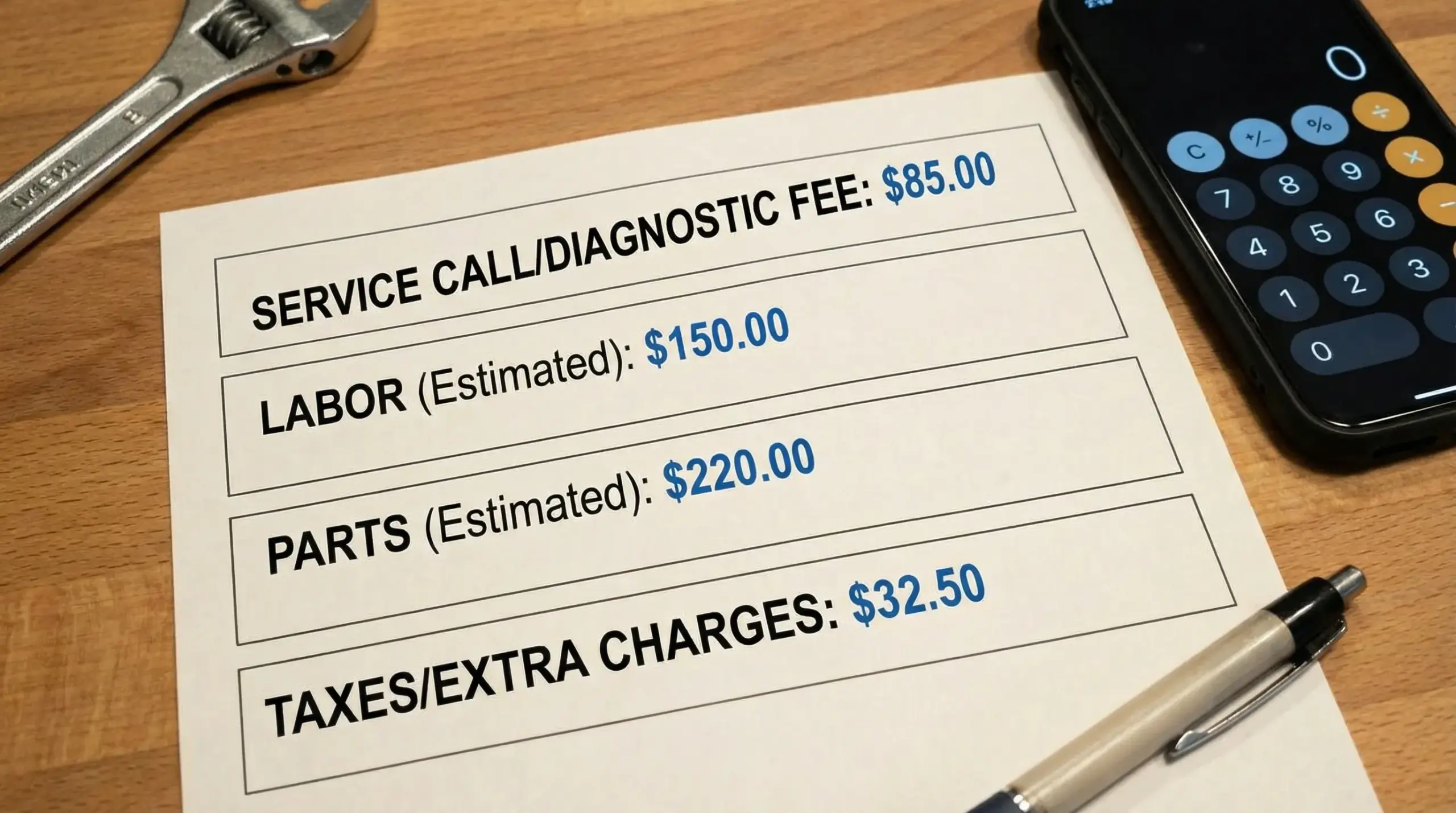
- Service fees (the cost to dispatch a technician and diagnose the problem)
- Repair costs (labor plus parts, sometimes plus extra services like refrigerant work)
A common misunderstanding is assuming the service fee is “extra” or “junk.” In many business models, it is the mechanism that makes the appointment possible, even if you decide not to repair.
What a “service fee” usually covers (and why it exists)
The wording varies by company, but you will commonly see service call fee, trip charge, or diagnostic fee.
Service call, trip charge, diagnostic: similar idea, different policies
In practice, these charges often cover a combination of:
- Travel and dispatch (sending a technician to your home in Phoenix or nearby)
- Time spent diagnosing (testing, taking readings, pulling the unit out, checking error codes)
- Business overhead that supports safe, insured work (vehicle, tools, licensing/insurance, scheduling)
Some companies structure it like this:
- A service call fee that covers arrival and basic assessment
- A separate diagnostic fee if deeper troubleshooting is needed
Others combine them into one amount.
The key question: is the service fee credited toward the repair?
A very common policy is: pay a diagnostic/service fee, and if you approve the repair, that fee is applied toward the final labor total. Another common approach is: the fee covers diagnosis only, and labor starts after approval.
Because policies differ, two quotes with the same “total” can mean very different things.
What to ask before scheduling:
- “Is the diagnostic/service fee applied to labor if I proceed?”
- “Does it include any labor time, or diagnosis only?”
- “What changes if parts need to be ordered and you return?”
Labor: flat-rate pricing vs hourly billing
After diagnosis, you’ll usually see labor priced in one of two ways.
Flat-rate labor
Flat-rate means the company uses a standardized price for a specific repair, for example “replace oven igniter” or “install washer drain pump,” regardless of whether it takes 25 minutes or 90.
This is common in appliance repair because it makes totals more predictable.
Hourly labor
Hourly billing usually includes a minimum (often at least one hour) and then additional time billed in increments.
This can make sense for complex intermittent issues, unusual installations, or stacked troubleshooting, but it can also feel less predictable.
Here is how to compare the two without guessing:
| Pricing model | What you typically get | Best for | Watch-outs |
|---|---|---|---|
| Flat-rate labor | One price for a defined repair | Common, well-known fixes | Make sure the repair is clearly defined, and ask what happens if the diagnosis changes |
| Hourly labor | Pay for time spent | Complex diagnostics, unusual situations | Ask about minimum hours, billing increments, and what counts as billable time |
Parts: what you are paying for (beyond the plastic or metal)
Parts pricing can feel confusing because you might see the same part online for less. That does not automatically mean the shop is overcharging.
OEM vs aftermarket vs refurbished
- OEM parts (original equipment manufacturer) are made to the appliance brand’s specifications. They usually cost more but reduce fit and compatibility risk.
- Aftermarket parts can be cheaper and work well, but quality varies widely by supplier.
- Refurbished parts (common for certain control boards) can be a cost saver, but you should confirm the warranty terms.
When you compare quotes, you are not only comparing “a part,” you are comparing risk.
Why a shop part can cost more than the same item online
Even when the part number matches, professional parts pricing may include:
- Sourcing and verification (confirming compatibility by model/serial)
- Faster availability through distributor networks
- Handling returns if the diagnosis changes or the part arrives defective
- Warranty support (some shops warranty parts and labor together)
A good technician should be able to tell you whether they are installing OEM or aftermarket and why.
Special case: sealed-system refrigerator parts and refrigerant work
If your refrigerator diagnosis involves the sealed system (compressor, evaporator, condenser, refrigerant leak), parts and labor get expensive quickly and require specialized equipment.
Also, refrigerant handling is regulated. In the US, technicians who work with refrigerants must meet federal requirements (see EPA guidance on Section 608 technician certification). If a quote includes refrigerant recovery, evacuation, and recharge, that is not “just topping it off,” it is a controlled process.
If you are trying to sanity-check local totals, you may also want to read our Phoenix-specific breakdown: Refrigerator repair cost in Phoenix.
The “hidden fees” that are not always hidden, just easy to miss
Appliance repair quotes often change because of scheduling urgency or site conditions, not because someone is trying to sneak in charges.
Common add-ons include:
- Same-day or emergency appointment surcharge (especially evenings, weekends, or holiday windows)
- Second technician fee for heavy built-in units or complex installs
- Installation materials (hoses, clamps, connectors, anti-vibration pads)
- Haul-away or disposal for certain replaced components
- Access issues (tight cabinetry, stacked laundry centers, hard-to-reach shutoffs)
In Phoenix, urgency pricing is especially common for refrigeration during heat spikes because demand jumps and food-loss risk is real. If you need urgent service, be explicit: “Is this priced as emergency appliance repair, or standard scheduling?”
How to read an estimate like a pro (and compare companies fairly)
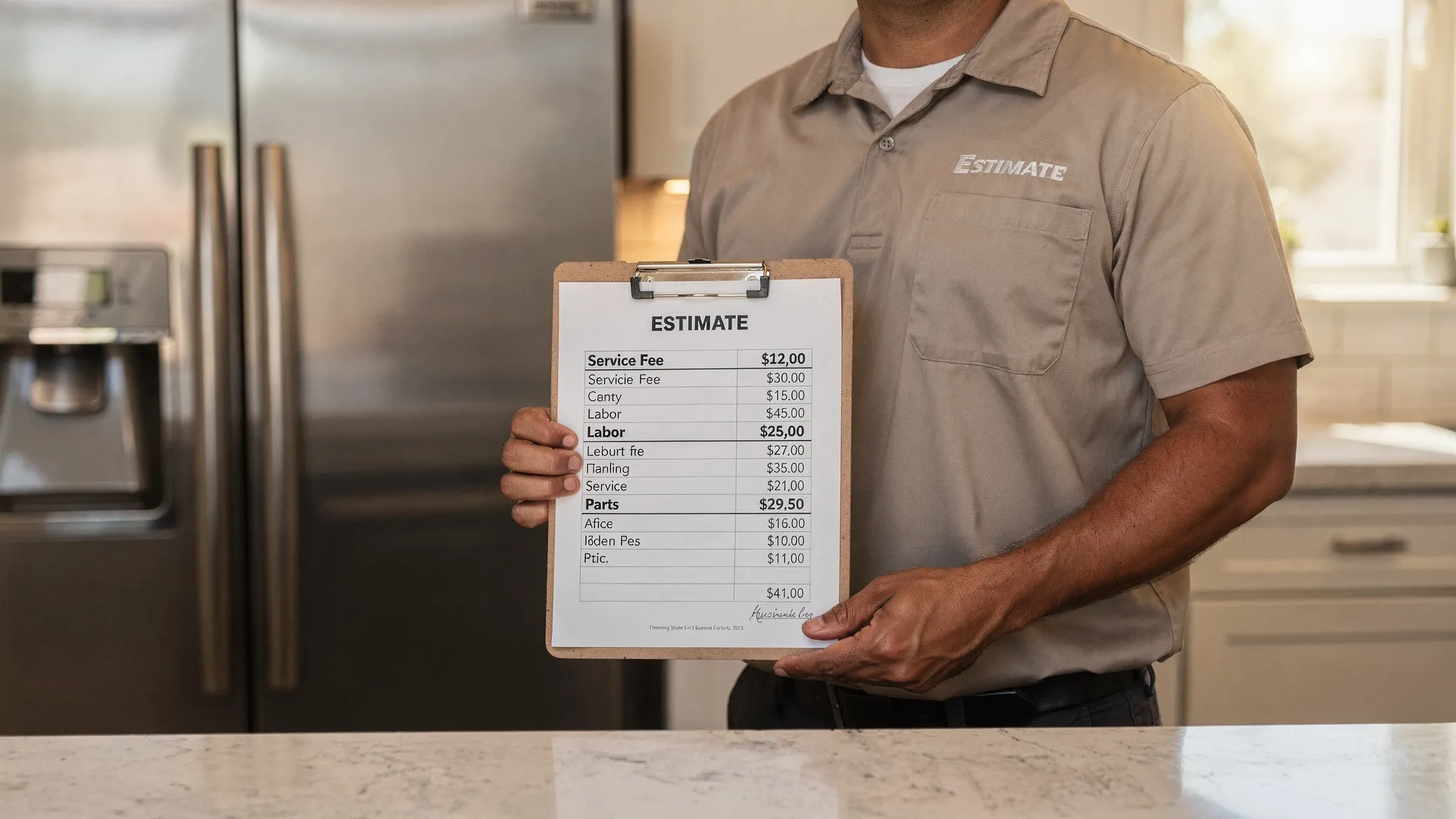
A professional estimate should make it easy to answer three questions:
- What exactly is wrong?
You do not need a novel, but you do want something more precise than “not cooling.” A good diagnosis points to a failing component or system and explains the symptom chain.
- What exactly will be replaced or repaired?
Look for part names and, ideally, part numbers. “Control board” can mean multiple boards on the same appliance.
- What is included in the price?
This is where service fee policies and warranty terms matter.
If you want a quick script that keeps the conversation clear, ask:
- “Can you itemize service fee, labor, and parts?”
- “Is the part OEM or aftermarket?”
- “What warranty do you provide on parts and on labor?”
- “If the part has to be ordered, do I pay another service call for the return visit?”
- “If you open it up and find additional issues, do you pause and get approval before adding cost?”
Warranty terms are part of the price
Two quotes can differ by $60 to $150 because one includes a stronger warranty or uses OEM parts. When you compare, treat warranty as value, not fine print.
If a company will not put warranty terms in writing (even a simple email or invoice note), that is a signal to slow down.
Realistic example totals (hypothetical, for understanding the math)
Every home, appliance, and company is different, so the numbers below are not a price promise. They are illustrative examples to show how service fees and parts stack together.
| Scenario (example only) | Service fee | Labor | Parts | Possible extras | Example total |
|---|---|---|---|---|---|
| Oven door gasket replacement | $99 | $120 | $55 | Tax | $274 plus tax |
| Washer drain pump replacement | $99 | $160 | $110 | Install materials | $369 plus tax/materials |
| Refrigerator fan motor replacement | $99 | $180 | $140 | After-hours surcharge (if urgent) | $419 (higher if emergency) |
If you’re dealing with an oven heat leak specifically, our step-by-step local guide can help you understand what’s involved before you approve a quote: How to repair an oven door seal in Phoenix.
When the service fee is “worth it,” even if you do not repair
Sometimes the best outcome is paying for a diagnosis and then choosing not to proceed. That is not wasted money if it helps you avoid a bad repair decision.
A service call is especially valuable when:
- The symptom could be caused by multiple parts (diagnosis prevents guessing)
- You suspect an electrical or gas-related issue where DIY is risky
- The appliance is high-end or built-in and replacement costs are high
- You need documentation for a home warranty, landlord, or insurance claim
If you are on the fence between repair vs replace, Consumer Reports has practical guidance on repair vs replace decision-making by appliance category and expected lifespan (see Consumer Reports appliance reliability and repair guidance).
How to keep costs down without gambling on DIY
There is a middle ground between “pay whatever the invoice says” and “replace parts until something works.”
Do a few safe prep steps before the technician arrives
These steps can reduce diagnostic time without creating risk:
- Clear access to the appliance (especially washers in tight closets)
- Take a photo of the model and serial tag
- Write down symptoms, when they started, and any error codes
- For refrigerators, note whether the freezer is cold while the fridge is warm (useful clue)
Use the quote to control scope creep
Ask the technician to state the repair as a single sentence you can approve, for example: “Replace igniter and test bake and broil operation.” That makes it harder for costs to balloon without discussion.
If you want more troubleshooting context before you book service, you can also browse our repair guides and cost breakdowns here: PHX Appliance Fix Blog.
Bottom line: focus on transparency, not just the cheapest total
The best appliance repair experiences usually come from clear expectations:
- Service fees should be explained and consistently applied
- Parts should be identified (and ideally classified as OEM vs aftermarket)
- Labor should be clearly flat-rate or clearly hourly
- Warranty terms should be written down
If you are comparing Phoenix appliance repair services, use itemization and warranty terms as your tie-breakers. When two quotes are close, the better documentation usually signals the better process, and that is what prevents surprise charges later.