
Unexpected appliance repair bills usually come from misunderstandings, not scams: you thought a “warranty” covered labor, the tech assumed you approved a part order, or the invoice included a return trip you did not realize would be billable.
This guide breaks down appliance service warranties, labor policies, and parts policies in plain English, with a Phoenix homeowner’s reality in mind (heat-driven fridge emergencies, summer scheduling crunch, and fast decisions when food safety is on the line).
Why policies matter more than ever in Phoenix
Phoenix homeowners often need decisions fast. A refrigerator that is struggling in a 110°F week can go from “making noise” to “not cooling” quickly, and that urgency affects pricing and policy.
Common Phoenix-specific pressure points include:
- Same-day and emergency premiums for critical appliances, especially refrigerators.
- Garage refrigerators and units in hot utility spaces that run harder and fail sooner, which can change whether repair or replacement makes sense.
- Peak-season delays where a shop can diagnose today but return when the part arrives, and your warranty terms determine what you pay on the second visit.
If you are comparing providers, it helps to separate three things:
- What is covered (warranty)
- How you are billed (labor policy)
- What happens if parts need to be ordered or returned (parts policy)
If you want a deeper primer on how estimates are built, see our breakdown of service fees vs labor vs parts.
Appliance service warranties: the 4 types homeowners run into
In real life, “warranty” can mean four different programs, each with different fine print.
1) Manufacturer limited warranty (included with the appliance)
This is the warranty that came with your refrigerator, oven, washer, or dryer.
What to know:
- Coverage is typically limited (it may cover specific components, and not every failure mode).
- Labor is not always covered, especially after an initial period.
- Many brands carve out special coverage for sealed-system components on refrigerators (compressor, evaporator, condenser, refrigerant circuit), but terms vary by brand and model.
- Some claims require you to use an authorized servicer.
A reliable starting point for understanding how written warranties work in the US is the FTC’s warranty guidance (plain-language explanations of limited vs full warranties, what to look for, and what “implied warranties” can mean).
2) Retailer extended service plan (ESP)
These are the “extra coverage” plans sold at checkout online or in-store.
What to know:
- ESPs often behave like insurance, with deductibles, service fees, or exclusions.
- Some plans offer in-home service, others require approved networks.
- Pre-existing conditions can be excluded (if the unit was already acting up before the plan was purchased).
3) Third-party home warranty (covers multiple home systems)
Home warranties are common with home purchases, and they can help in some scenarios. They can also create delays.
What to know:
- You usually pay a trade call fee (service call fee) per visit.
- The warranty company, not you, typically chooses the contractor.
- Approval, part sourcing, and replacement decisions can take time, which matters when you need same-day refrigerator repair.
4) Repair company workmanship warranty (warranty on the repair itself)
This is different from the appliance’s original warranty. A reputable shop often stands behind its work for a defined period.
What to know:
- It may cover labor, the replaced part, or both, depending on the company.
- It usually applies to the same symptom caused by the same failed component, not unrelated future breakdowns.
- It may require proof of service, so save your invoice.
Here is a practical comparison you can use when reading policies.
| Warranty type | Who provides it | What it usually covers | Common gotchas to check before booking |
|---|---|---|---|
| Manufacturer limited warranty | Brand/manufacturer | Specific defects, sometimes broader coverage early on | Authorized servicer requirements, exclusions for wear/maintenance, labor limits |
| Extended service plan (ESP) | Retailer or plan administrator | Repairs under plan terms | Deductibles or service fees, plan exclusions, claim approval steps |
| Home warranty | Warranty company | Covered appliances/systems under contract | Trade call fee per visit, contractor assigned by warranty, caps/limits, delays |
| Workmanship warranty | Repair company | The repair performed (part, labor, or both) | Only same issue, proof required, voided by DIY tampering |
Labor policies: how appliance service labor is actually billed
Labor policy is where most surprise charges hide, even when the part price seems fair.
Diagnostic or service call fee
Many companies charge a diagnostic fee to come out, troubleshoot, and provide an estimate.
Key questions:
- Is the diagnostic fee credited toward the repair if you proceed?
- Does it cover one appliance or multiple appliances at the same address?
- How long is the diagnosis valid (same day only, or a set number of days)?
If you are trying to compare quotes in Phoenix, it helps to know what local pricing commonly looks like by appliance and problem. For refrigerators, start with our Phoenix price guide: refrigerator repair cost in Phoenix.
Flat-rate vs hourly labor
Two legitimate billing models exist, but they feel different as a customer.
- Flat-rate (job pricing): You pay a set labor price for a specific repair, regardless of whether it takes 30 minutes or 2 hours.
- Hourly: You pay for time, often with a minimum (for example, a one-hour minimum).
Neither model is automatically “better.” Flat-rate can be easier to budget, hourly can be fair when the problem is unusual. The important part is that the model is explained clearly, before work starts.
Minimum labor, second-visit labor, and “return trip” rules
A very common scenario in Phoenix:
- Tech diagnoses the problem.
- A part must be ordered.
- The tech returns to install it.
Whether you pay labor twice depends on policy and what was authorized. Ask directly:
- Will there be an additional labor charge when the part arrives?
- Is there a second trip charge?
- Is the second visit covered if the part was wrong or defective?
After-hours, weekend, and emergency labor premiums
Emergency service is real, but it should be transparent.
If a company offers emergency appliance repair in Phoenix, clarify:
- The definition of “emergency” (after-hours, same-day, holiday)
- The premium structure (fixed surcharge vs higher hourly rate)
- Whether emergency applies to diagnosis only, or also to parts installation
For realistic expectations around urgent scheduling, see same-day kitchen appliance repair options.
Parts policies: OEM vs aftermarket, deposits, and returns
Parts are not just “a part is a part.” The policy around sourcing, pricing, and returns can change your final cost and your timeline.
OEM, aftermarket, and refurbished parts
You will usually hear one of these terms:
- OEM (original equipment manufacturer): Made by the brand or for the brand.
- Aftermarket: Made by a third party, not the brand.
- Refurbished or used: Previously used, restored, or salvaged.
There is no universal rule that OEM is always best, but OEM is often preferred for fit, compatibility, and predictable performance. For certain electronics (control boards) or safety-critical components, many homeowners choose OEM when available.
What to ask is not only “OEM or aftermarket,” but also:
- Is the part new?
- Is the part returnable if it does not fix the issue? (many electrical parts are not returnable once installed)
- What warranty comes with the part itself?
Parts availability and lead times
Even in 2026, appliance parts availability can vary by brand, model age, and whether the part is discontinued.
A good service policy should explain:
- Whether the company stocks common parts
- Whether parts are ordered from the manufacturer or distributors
- How updates are communicated (text, email, call)
Deposits, restocking fees, and special-order rules
These are legitimate business practices, but they should be disclosed before you approve an order.
Watch for:
- Deposits required for expensive parts
- Restocking fees if you cancel after ordering
- Special-order parts that cannot be returned
Core charges (common in some categories)
Some parts have a “core” charge, meaning the old part must be returned for rebuilding or recycling (certain motors or compressors in some supply chains). If it applies, your invoice should show it clearly and explain how and when it is refunded.
The fine print that most homeowners miss
Policies usually hinge on a few phrases that sound harmless.
“Normal wear and tear” vs “defect”
Warranties often draw a line between manufacturing defects and wear items. Door seals (gaskets), belts, and some hinges may be treated as wear items depending on the warranty.
If you are dealing with door seals specifically, we have Phoenix-focused how-to guides for both ovens and refrigerators:
“Unauthorized repair” and DIY attempts
Many manufacturer warranties and service plans exclude damage caused by improper installation or unqualified repair attempts.
That does not mean you cannot do safe checks. It means you should stop before you cross into risky work (sealed-system work, gas components, or complex electrical diagnosis). A good safety-first starting point is our refrigerator DIY steps to try first.
“Same symptom” vs “new failure”
Workmanship warranties often cover the same failure returning, not a different part failing later.
Example: If an oven is not heating and the igniter is replaced, a later failure of a control board is usually not a warranty callback. It is a new repair.
What to ask before you schedule service (copy/paste checklist)
You do not need to interrogate a company, but you do need clarity. These questions prevent most billing surprises.
| Question to ask | What it protects you from |
|---|---|
| “What is your diagnostic fee, and is it applied to the repair if I approve?” | Paying twice (once to diagnose, again to repair) without realizing it |
| “Do you charge flat-rate or hourly labor, and is there a minimum?” | Open-ended labor totals |
| “If a part must be ordered, will there be an additional trip or labor charge on the second visit?” | Surprise second-visit charges |
| “Are OEM parts available for my model, and do you offer aftermarket options?” | Paying for a part grade you did not intend |
| “What is your parts return policy and any restocking fee?” | Cancellation penalties |
| “What warranty do you provide on parts and labor?” | No recourse if the same issue returns |
| “If this is after-hours or same-day, what surcharge applies?” | Emergency premiums you did not budget for |
If you also want a quick credibility filter, use our guide on how to vet an appliance repair tech.
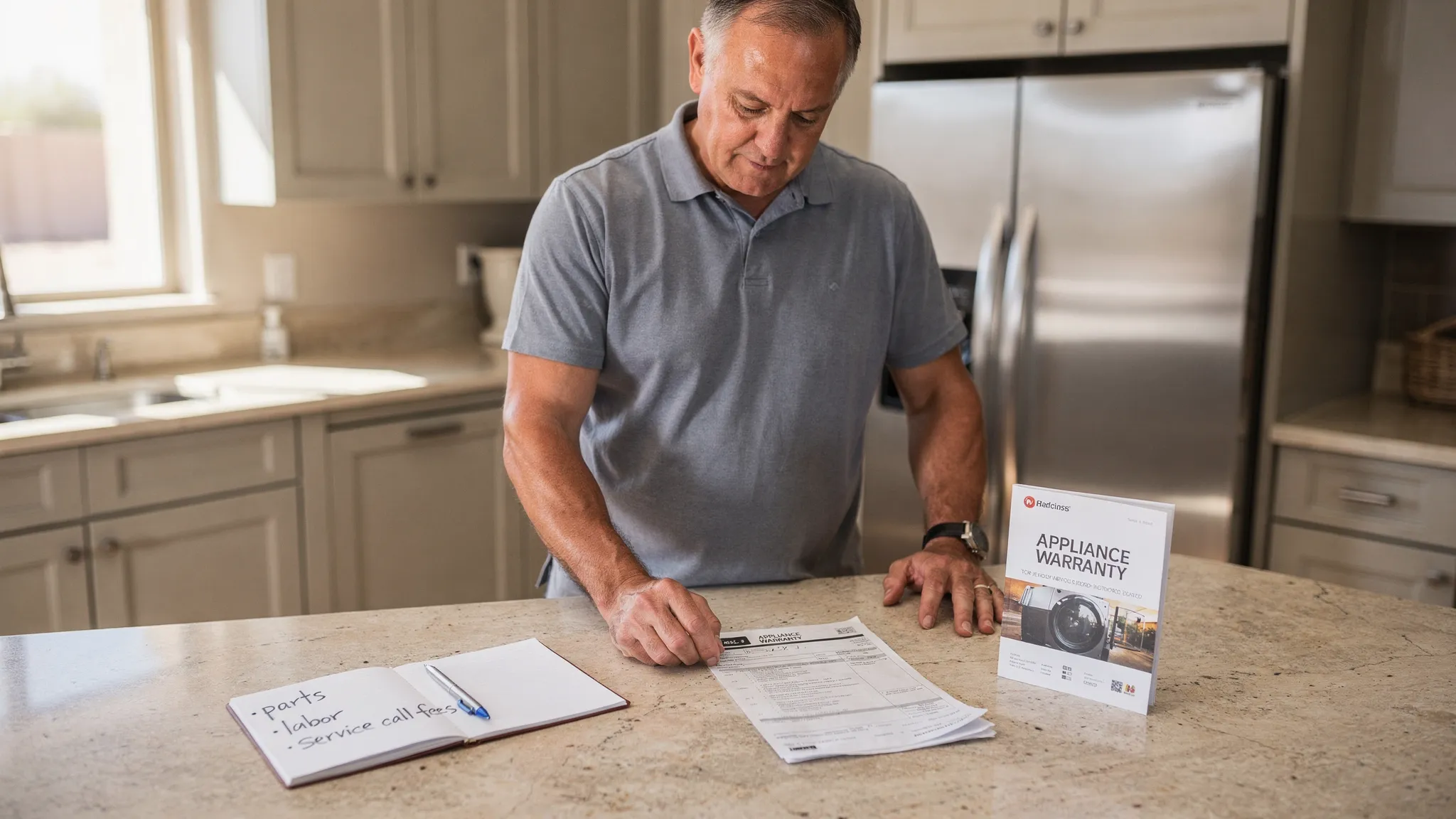
What a “clean” estimate and invoice should look like
A professional estimate usually itemizes the same building blocks, even if the shop uses flat-rate pricing.
Here is an example structure you can expect (illustrative only):
| Line item | What it means | What to look for |
|---|---|---|
| Service call / diagnostic | Travel + troubleshooting | Whether it’s waived or credited if you proceed |
| Labor | Installation, testing, adjustments | Flat-rate vs hourly, minimums, after-hours premium |
| Parts | The component(s) replaced | Part number or description, OEM vs aftermarket when relevant |
| Misc. supplies | Connectors, clamps, sealants | Should be reasonable and disclosed |
| Tax | Local tax rules apply to parts in many cases | Make sure it’s only applied where appropriate |
| Warranty terms | Coverage period and conditions | Written terms, not just verbal |
If a company cannot or will not explain these components, that is a sign to slow down and get a second quote.
How warranties change the “repair vs replace” decision
Warranties do not just reduce cost, they reduce risk.
A repair that is borderline may become reasonable if:
- A major part is covered (you only pay labor).
- The repair comes with a strong workmanship warranty.
- The appliance is in the early or mid portion of its lifespan.
On the other hand, a repair may be a poor bet if:
- The appliance is near end-of-life and the new repair is not warrantied.
- Parts are discontinued or backordered for weeks.
- The unit has a pattern of repeat failures.
For a structured way to think through that decision, see our Phoenix-specific framework: repair vs replace for home appliances.
Practical tips to keep service fast, especially for refrigerators in summer
If you need same-day refrigerator repair in Phoenix, speed depends on preparation. Before the appointment:
- Take a photo of the model and serial tag (usually inside the fridge compartment).
- Write down symptoms with timing (for example, “freezer is 10°F, fridge is 50°F, started yesterday afternoon”).
- Clear access (pull the unit forward if safe, make the outlet reachable).
- If food safety is a concern, follow a conservative approach and use a thermometer. Our food safety timeline guide can help you decide what to keep and what to toss: what happens when your fridge stops cooling.
Those steps reduce diagnostic time, and they reduce the chance that you pay for a second visit due to missing information.
The bottom line
A fair appliance service experience is not only about the final number, it is about whether the company’s warranties, labor rules, and parts policies are transparent before you commit.
If you do one thing after reading this, do this: when you book, ask how the shop handles (1) diagnosis fees, (2) second visits for ordered parts, and (3) warranty callbacks. Those three policies explain most of the difference between a “reasonable repair” and a frustrating one in Phoenix.