Most homeowners assume “appliance stores repair” means the same place that sold the appliance will automatically fix it. Sometimes that is true, but in many cases the store is more like a coordinator: they route your claim to the manufacturer, a warranty administrator, or a local service company.
Knowing which path you are actually on matters because it affects how fast you get scheduled, who shows up, what you pay, and whether the fix is covered.
What “appliance stores repair” usually means
When people search for appliance stores repair, they are typically talking about one of these setups:
- Retailer-managed service: The store offers its own service program (common with electronics retailers and some regional appliance dealers).
- Manufacturer warranty service: The store tells you to contact the brand, and the brand dispatches an authorized servicer.
- Protection plan or extended warranty: The plan might be sold at checkout, but a third-party administrator runs claims and sends a contracted technician.
- Return or exchange process: Within a short window after purchase, the “repair” may really be an exchange, refund, or replacement, especially for smaller appliances.
In other words, the store may help you start the process, but the actual repair is often performed by a separate service network.
The most common “store repair” scenarios (and what to expect)
1) You are inside the return window
If the appliance is brand new and fails quickly, the fastest solution is sometimes an exchange rather than a repair. The store’s policy controls this, not the manufacturer.
What helps: keep the receipt, delivery paperwork, and any installation notes, and document the issue with photos or a short video.
2) You are covered by the manufacturer’s limited warranty
Most major appliances come with a limited warranty. The store may direct you to the manufacturer’s service line.
What helps: have your model and serial number ready, plus purchase date and symptom details.
For a consumer-friendly overview of how warranties work and what to look for, the FTC’s warranty guidance is a solid reference: FTC warranty basics.
3) You bought an extended warranty or protection plan from the store
This is where confusion happens most. You may have bought the plan at the store, but:
- The plan may require authorization before any repair.
- The administrator may send a contracted company, not the store.
- Coverage depends on the plan terms, including exclusions and deductible/service fees.
4) Delivery or installation-related damage
If an appliance was damaged during delivery or installed incorrectly (gas range hookup issues, crushed dryer vent, kinked water line), stores often have a dedicated process for claims.
What helps: report problems immediately, do not keep running the appliance “to see if it resolves,” and take photos.
How the store-handled repair process typically works
Even when the store is involved, the workflow usually looks like this.
| Step | What you do | What happens behind the scenes | Where delays happen most |
|---|---|---|---|
| Claim intake | Provide model/serial, proof of purchase, symptoms | Your case is logged and triaged | Long hold times, incomplete info |
| Triage | Answer questions, sometimes upload photos | They decide if it is in-home, depot, or replacement eligible | Misclassification of the issue |
| Scheduling | Pick a date/time window | A local servicer is assigned | Limited availability, especially in peak season |
| Diagnosis visit | Tech confirms the failure | Parts list is generated and approved | Authorization and parts ordering |
| Repair visit | Tech returns with parts | Repair is completed and documented | Backordered parts, repeat visits |
| Closeout | You receive completion notes | Warranty claim is closed | Paperwork errors or missing signatures |
If you are in Phoenix, the biggest real-world bottleneck is often parts plus scheduling during high-demand periods (summer heat spikes are notorious for refrigerator workload issues and increased service volume).
Pros and cons of appliance stores handling repairs
Pros
Centralized paperwork can be convenient. One claim number can cover the diagnosis, parts, and completion documentation.
Potentially better coverage if you are truly inside a warranty or protection plan, because the program may pay a large portion of parts and labor.
Authorized service channels can matter for certain brands and complex repairs, since manufacturers may restrict parts access or require authorized techs.
Cons
Scheduling can be slower than calling a local shop directly because there are extra steps (triage, approvals, dispatch assignment).
You may not get to choose the technician. A third-party administrator typically dispatches whoever is in their network.
Back-and-forth visits are common. The first visit is often diagnosis only, then a second visit happens after parts arrive.
Coverage surprises can happen if the failure is excluded, considered wear and tear, or classified as misuse.
Phoenix reality check: when store-managed repairs may not be fast enough
Phoenix heat changes the urgency calculus. If your refrigerator is warming up, waiting a week for a dispatch window can become a food-safety and cost problem.
If you need rapid triage, it helps to distinguish:
- Same-day diagnosis: a tech confirms the issue and orders parts.
- Same-day repair: only possible when the problem is minor or the part is common and stocked.
- Emergency appliance repair Phoenix situations: smoke, burning smell, gas odor, repeated breaker trips, or unsafe temperatures in a fridge.
If you suspect you need same-day help, compare what “same-day” really means before you commit to a warranty queue. This guide explains what’s realistic and how to prepare for a fast visit: kitchen appliance repair near me: same-day options.
For refrigerator urgency decisions (repair versus replace, and why Phoenix conditions matter), this related read is useful: Is it worth repairing a refrigerator in Phoenix’s heat?.
What store repairs usually cost (and what is often covered)
Costs vary widely by brand, appliance type, and your plan terms, but the structure is predictable:
- Diagnostic or service call fee: sometimes waived if you proceed with repair, sometimes not.
- Labor: flat-rate or hourly.
- Parts: OEM parts can cost more, and availability drives timeline.
- Add-ons: after-hours, weekend, or expedited dispatch fees (where offered).
If you are under a warranty or protection plan, you may still pay:
- A service fee or deductible
- Non-covered parts (for excluded items)
- Secondary damage (for example, flooring damage from a leak is often outside appliance coverage)
To understand how invoices and estimates are typically built in Phoenix, and how to compare apples to apples, see: appliance repair costs: service fees vs parts explained.
Store repair vs local technician in Phoenix: a practical decision guide
Here is a homeowner-friendly way to choose, without guessing.
| Situation | Store or warranty channel is usually best | Local appliance repair Phoenix provider is often best |
|---|---|---|
| You are clearly under manufacturer warranty | Yes, it may maximize coverage | Sometimes, but confirm warranty impact first |
| You bought a protection plan and want to use it | Yes, that is the point of the plan | Only if you are okay paying out of pocket |
| You need same-day refrigerator repair Phoenix due to rising temps | Sometimes, but often slow | Often faster scheduling and direct communication |
| You want control over who you hire and the repair approach | Not usually | Yes |
| You suspect a simple issue and want a quick second opinion | Not ideal | Good fit |
| Parts are uncommon or brand-restricted | Often, authorized networks help | Depends on brand and parts access |
If your priority is speed and control, a vetted local provider can be the better path. If your priority is minimizing out-of-pocket cost under coverage, the store or warranty route can make sense, as long as you accept the timeline.
How to get better results when the store is handling the repair
Most store-handled repair delays come from missing information, unclear symptoms, or approval loops. You can reduce friction with a little prep.
First, document the problem like a technician would. Write down what is happening, when it started, and what changed recently (power outage, monsoon surge, cleaning, moving the appliance).
Then focus on the details that reduce repeat visits.
- Model and serial: take a photo of the rating plate.
- Error codes: capture a clear photo of the display.
- Short video: record noises, ignition clicking, leaks, or door alignment issues.
- Temperature proof (for refrigerators): use an appliance thermometer and note readings.
- Access and constraints: built-in oven, stacked laundry, tight closet, or second-floor install.
Finally, ask the scheduling rep a few direct questions:
- “Is the first visit diagnosis only, or can it be repaired if parts are available?”
- “If parts are needed, do you schedule the return visit automatically?”
- “Who exactly is coming out, the manufacturer’s authorized servicer or a third-party contractor?”
- “If this is not covered, what will I owe for the visit?”
If you want a broader framework for choosing a reliable provider (store-dispatched or not), this vetting checklist helps you avoid common pitfalls: Home appliance repair near me: how to vet a tech.
Special note: repairs that stores commonly refuse or reroute
Retailers and plan administrators often have strict boundaries. These are common reasons they may decline a repair or require a different process:
- Gas odor or suspected gas leak: you should leave the area and contact your gas provider or emergency services. Do not wait for a warranty appointment.
- Electrical burning smell or repeated breaker trips: shut off power to the appliance and seek qualified service.
- Sealed-system refrigerator work: may be limited to certain authorized technicians.
- Cosmetic or “wear item” issues: some plans exclude knobs, racks, light covers, and other non-functional parts.
If you are dealing with a refrigerator emergency, it also helps to follow a food safety timeline while you wait. This guide covers what to do and when to discard perishables: What happens when your fridge stops cooling? Food safety timeline.
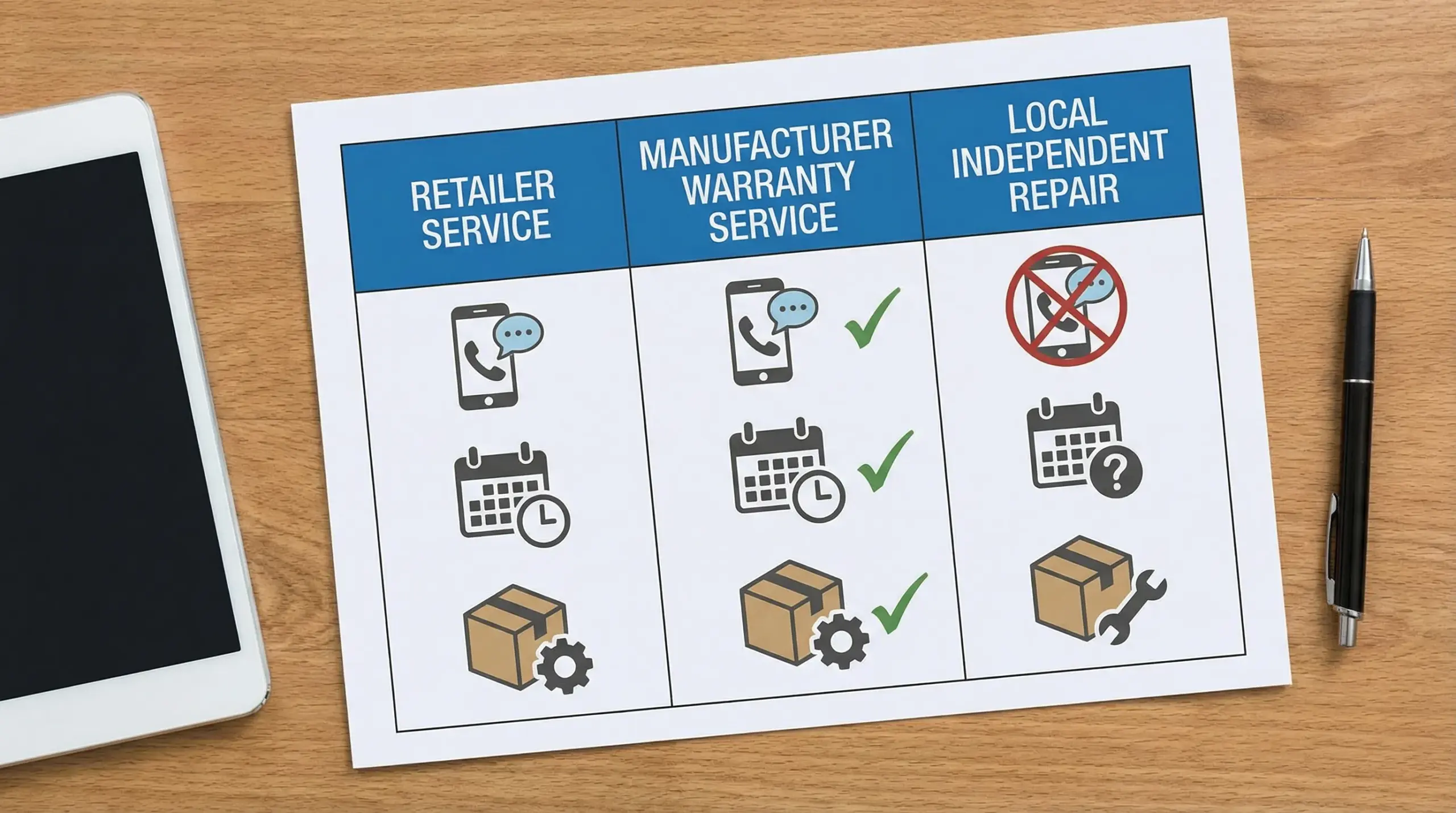
Frequently Asked Questions
Do appliance stores actually repair appliances themselves? Often they coordinate repairs rather than perform them. Some retailers have in-house service teams, but many dispatch manufacturer-authorized or third-party technicians.
Will using a local repair company void my warranty? It depends on the warranty terms and the type of repair. Many warranties cannot require you to use only one service provider for routine service, but they can deny coverage for damage caused by improper repairs. If you are inside the manufacturer warranty period, confirm requirements before authorizing out-of-pocket work.
Why is the first visit sometimes “diagnosis only”? Many store-administered programs require verification and approval before parts are ordered or billed. That often creates a two-visit process: diagnose, then repair after parts arrive.
Is store repair slower than calling a local company in Phoenix? It can be. Store and warranty routes often add call-center intake plus approval steps. A local shop may schedule faster, especially for urgent refrigerator or oven repair Phoenix needs, but you may pay more out of pocket if you are not using coverage.
What information should I have ready when I call? Model and serial number, proof of purchase, a clear symptom description, any error codes, and photos or a short video if the issue is intermittent.
Next steps: choose the path that matches your urgency and budget
If you are deciding between store repair, warranty service, or hiring a local technician, start by clarifying two things: Are you covered, and how urgent is the failure?
For Phoenix-specific pricing and decision support, these guides can help you plan the next move:
When you know the likely cost range and the realistic timeline, it becomes much easier to decide whether “appliance stores repair” is the best route for your situation, or whether a direct local repair call is the smarter move today.