A dishwasher that won’t drain is one of those problems that feels urgent, even when it’s often something simple. The good news is that many “not draining” calls come down to a clogged filter, a blocked air gap, or a drain hose issue you can spot in minutes.
Below is a practical, homeowner-safe troubleshooting flow you can run before you book a service visit. It’s written for Phoenix-area homes, where hard water scale, dust, and frequent garbage disposal use can make drainage issues more common.
Safety first (what to do before you touch anything)
Standing dishwasher water is unpleasant, but the bigger risks are electricity and sharp debris.
- Turn off power at the breaker if you’ll reach near wiring, remove panels, or use water near the door switch area.
- Wear gloves if you’ll pull debris from the sump or filter area.
- Avoid mixing cleaners (especially bleach with other products).
- Stop and call a pro if you smell burning, see melted plastic near wiring, or the breaker keeps tripping.
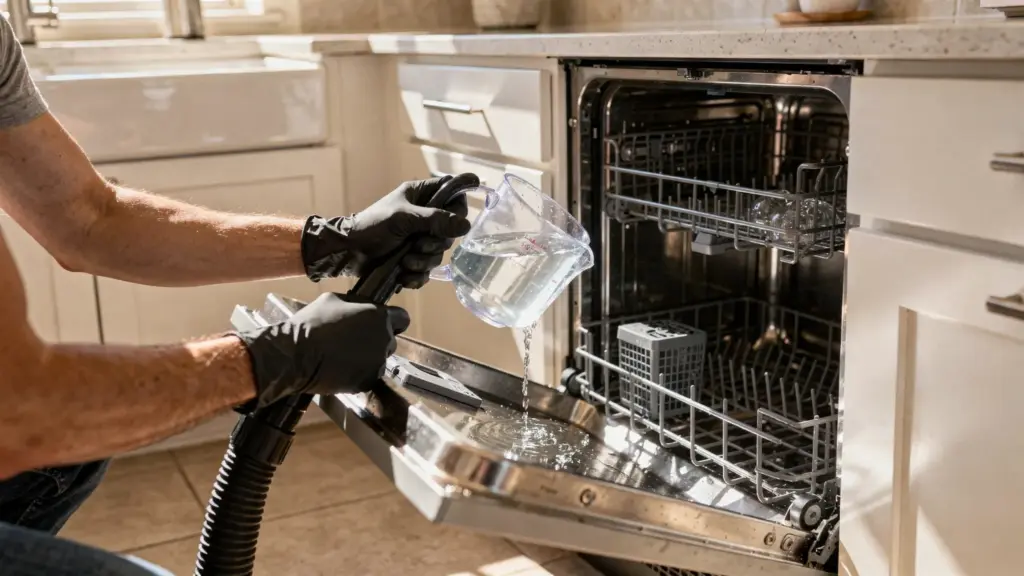
If you need to bail water out, a wet/dry vac is ideal. Otherwise, use a cup and towels.
Quick diagnosis: is it truly “not draining” or just holding a little water?
Many dishwashers keep a small amount of water below the filter area to keep seals from drying out. What you’re looking for is standing water that covers the bottom of the tub, water that returns after a drain cycle, or water that smells strongly and contains food debris.
A fast check:
- Run Cancel/Drain (wording varies by brand).
- Listen: do you hear a drain pump hum or a strong “whoosh” into the sink/disposal?
- Check the sink: does the disposer or sink back up at the same time?
If the sink backs up too, you may be chasing a plumbing blockage (trap, branch line, or disposal) rather than a dishwasher-only problem.
Dishwasher not draining: the most common causes (and quickest checks)
Here’s a simple symptom-to-check table to keep you focused.
| What you notice | Most likely cause | Quick fix to try first |
|---|---|---|
| Water remains after cycle, lots of debris | Clogged filter or sump | Remove and clean the filter and sump screen |
| Water drains slowly, sink/disposal gurgles | Disposal inlet clog or sink trap issue | Check disposal knockout plug, clear trap/branch line |
| Water returns into dishwasher after draining | No high loop, blocked air gap, or backflow | Clear air gap, confirm high loop under counter |
| Dishwasher hums but no water moves | Jammed drain pump impeller or blockage | Check for glass/bones in pump area (power off) |
| Drains sometimes, fails other times | Sticky check valve, scale buildup, weak pump | Deep clean filter area, then consider pump service |
Step 1: Clean the dishwasher filter (this fixes a lot)
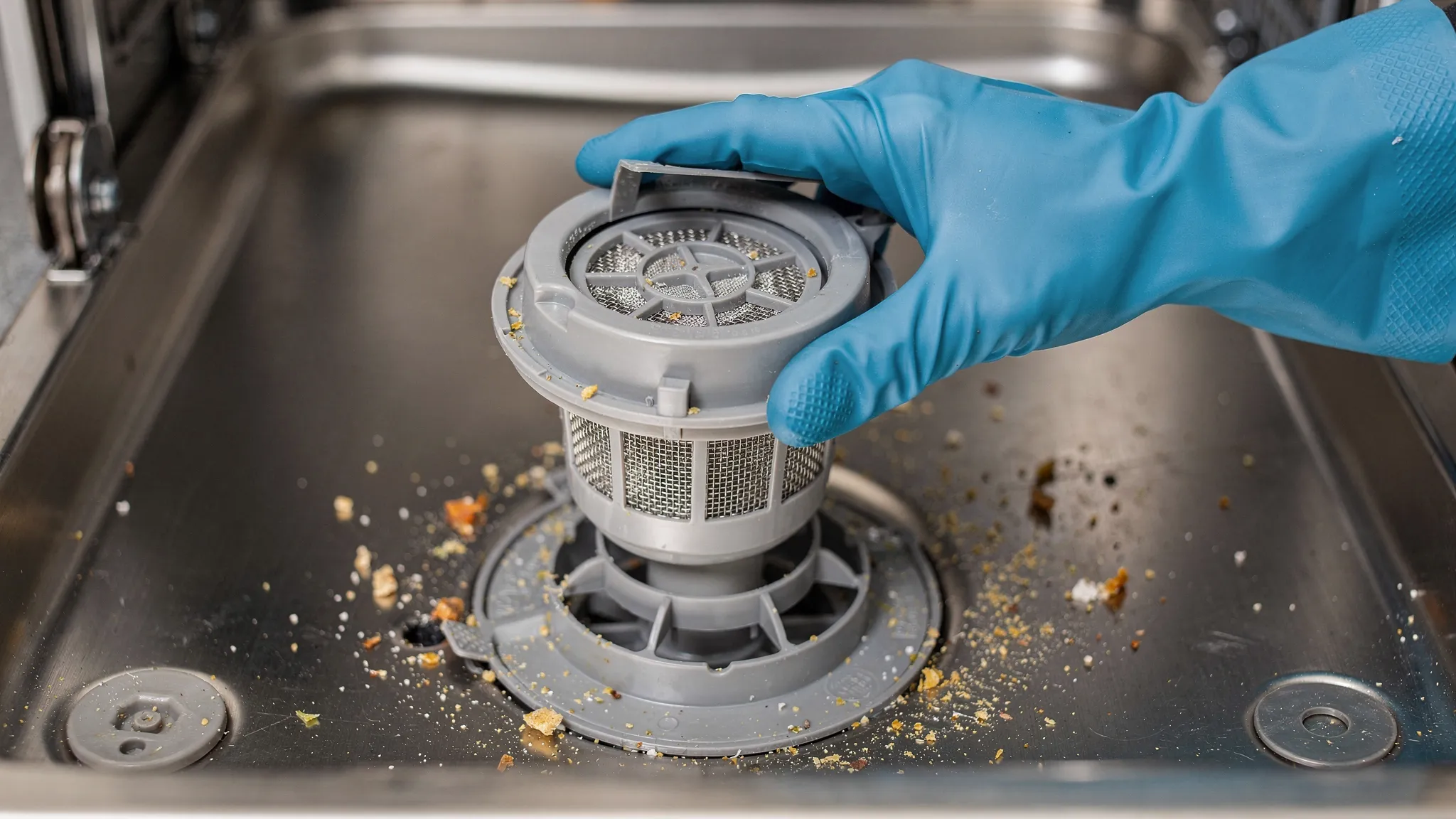
In many modern dishwashers, the filter is designed to be cleaned regularly. If it clogs, water can’t move to the drain pump effectively.
What to do:
- Open the dishwasher and remove the lower rack.
- Locate the filter assembly at the bottom (often a twist-lock cylinder plus a flat screen).
- Remove it and rinse under hot water.
- Use an old toothbrush to remove grease and gritty hard-water deposits.
- Wipe the filter housing area and remove visible debris.
- Reinstall the filter snugly (misalignment can cause poor wash and poor drain).
Phoenix note: if you see chalky, gritty buildup, that’s often hard water scale mixed with detergent residue. Filter cleaning is even more important in hard-water areas.
Step 2: Check the air gap (if you have one)
Many homes have a small cylinder near the kitchen faucet called an air gap. It prevents dirty sink water from siphoning back into the dishwasher, but it can also clog with food particles.
Signs it’s the issue:
- You see water spurt out of the air gap during draining.
- You get a slow drain and occasional backflow into the tub.
How to clear it:
- Twist off the cap.
- Remove any inner cover piece.
- Clean out debris, then flush with water.
If you don’t have an air gap, your setup should typically have a high loop in the drain hose (a loop secured high under the countertop) to reduce backflow risk.
Step 3: Confirm the garbage disposal connection (especially after a new disposal)
If your dishwasher drains into a garbage disposal, there’s a classic gotcha: the disposal’s dishwasher inlet knockout plug.
This happens when:
- A disposal was replaced recently.
- The installer forgot to punch out the knockout plug.
Result: the dishwasher “drains” but hits a solid plug, so water stays in the tub.
What you can do:
- If you’re comfortable and have access, disconnect the dishwasher drain hose from the disposal inlet and check for blockage.
- If the plug is still intact, it must be removed (many homeowners choose to have a plumber or appliance tech do this to avoid leaks).
If you recently had work done and drainage failed immediately afterward, this is one of the highest-probability causes.
Step 4: Inspect the drain hose for kinks, clogs, and routing problems
A dishwasher can have a perfectly good pump and still not drain if the hose is pinched behind the unit or packed with sludge.
Checks to do:
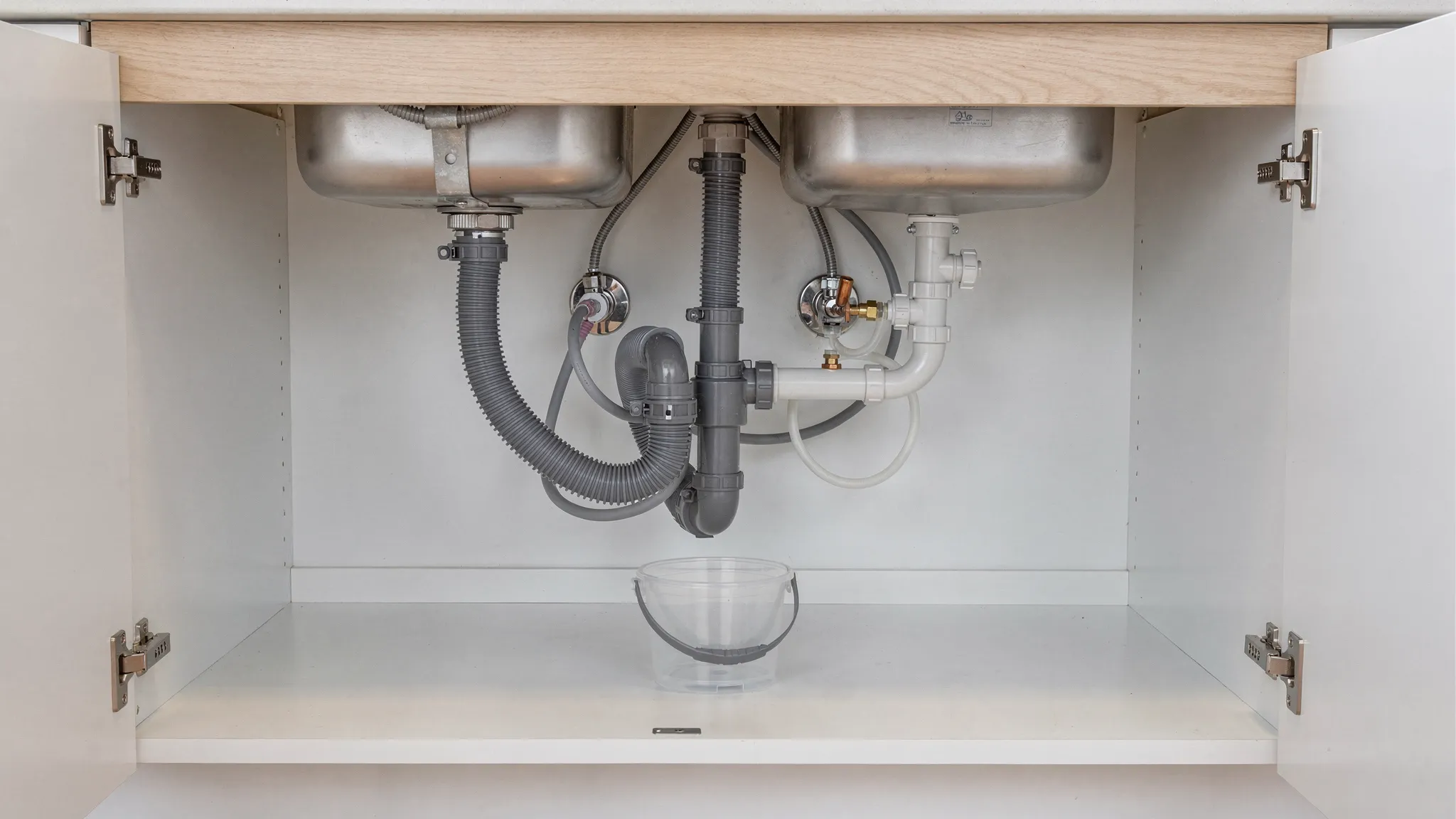
- Look under the sink and find the dishwasher drain hose.
- Verify it isn’t kinked, crushed, or sagging.
- Confirm it routes in a high loop as it heads to the disposal or drain.
If you suspect a clog:
- Turn off power to the dishwasher.
- Place a towel and shallow pan under the connection.
- Remove the hose at the sink/disposal end and see if water drains out.
- You can gently flush the hose or replace it if it’s brittle or permanently kinked.
If the hose is routed incorrectly (low and sagging), dirty sink water can backflow into the dishwasher, creating a “not draining” complaint that’s actually a backflow problem.
Step 5: Check the sink trap and kitchen drain line
If your sink drains slowly, your dishwasher often will too. A partially clogged P-trap or branch line can choke the dishwasher’s drain flow.
Clues:
- Dishwasher drains into the sink/disposal and the sink is slow.
- You hear gurgling during the drain portion of the cycle.
If you’re comfortable with basic plumbing, you can clean the trap. If not, this is an efficient time to call for help, because the dishwasher may be fine.
Step 6: Look for a stuck float or float switch issue
Most dishwashers have a float (a small dome or cylinder in the tub floor area) that prevents overfilling. If it’s stuck, some models can behave oddly, including ending cycles early or triggering drain behavior that looks like a failure.
What to do:
- Locate the float inside the tub.
- Lift it gently, it should move freely.
- Clean around it if you see soap scum or debris.
If the float switch underneath is faulty, that typically moves beyond DIY, because it may require accessing lower panels and electrical testing.
Step 7: Listen for the drain pump (and what the sound means)
When you run Cancel/Drain, listen closely:
- Strong pump sound + water rushing: drainage system is likely working.
- Humming but no water movement: pump may be jammed, the impeller may be blocked, or there’s a downstream clog.
- No sound at all: could be a control issue, door latch issue, wiring problem, or failed pump.
If you hear humming, it’s worth checking for a simple blockage first.
Step 8: Check for debris in the sump and drain pump area (carefully)
Broken glass, labels, bone fragments, and plastic bits can lodge in the sump area and stop drainage.
Safe approach:
- Turn off power at the breaker.
- Remove the filter again.
- Use a flashlight to inspect the sump area.
- Remove visible debris with gloved fingers or needle-nose pliers.
If access to the pump cover requires removing screws or panels and you’re not confident, stop there. A small leak from an improperly reinstalled seal can create a bigger problem than the original clog.
Phoenix-specific reasons dishwashers stop draining
A few local conditions tend to show up in service calls:
Hard water scale that sticks valves and clogs screens
Mineral buildup can contribute to sticky check valves and restricted flow paths. If you routinely see gritty residue on filters, consider:
- Cleaning the filter more often.
- Using rinse aid to reduce spotting and film.
- Running a periodic cleaning cycle using a dishwasher-safe descaler that matches your manufacturer guidance.
Heavy disposal use and food particles in the drain path
Homes that scrape less and rely on the dishwasher to “eat” debris can clog filters and air gaps faster. Dishwashers are not disposals, even if they have choppers.
Monsoon season and neighborhood drain issues
During heavy storms, some homes see slow kitchen drains due to saturated lines or backups. If multiple drains in the home are slow at the same time, it’s more likely a plumbing event than a dishwasher failure.
What not to do (common DIY mistakes)
A few moves often waste time or create leaks:
- Don’t pour harsh drain opener chemicals into the dishwasher. Many products are not appliance-safe and can damage seals and metal parts.
- Don’t ignore the filter and jump straight to parts replacement.
- Don’t run the unit repeatedly with standing dirty water. You can worsen odors and redeposit debris into the pump area.
- Don’t pull the dishwasher out without planning for water supply and anti-tip stability.
When it’s time to call a technician
Call for service if any of the following is true:
- You cleaned the filter, confirmed the hose routing, cleared the air gap, and it still won’t drain.
- The unit hums but never moves water, especially if it’s intermittent.
- You see leaks under the unit, wet flooring, or repeated overflow.
- The breaker trips, the unit smells hot, or controls behave erratically.
- You suspect a drain pump, control board, or wiring issue.
If you need faster help (for example, standing water plus a full house and no time to troubleshoot), use a same-day strategy and ask the right questions when booking. This guide on same-day kitchen appliance repair options in Phoenix can help you set expectations for what “same-day” realistically means.
If you do call, here’s how to get a faster, more accurate quote
Techs can usually narrow a dishwasher drain issue faster if you provide details up front.
Have ready:
- Brand and model number (often on the door edge).
- Whether it drains into a disposal or a sink drain.
- Whether you have an air gap.
- What you already tried (filter cleaned, air gap cleared, Cancel/Drain test results).
- Any error code shown.
For pricing transparency, it helps to understand what’s in the bill, especially the difference between diagnostic fee, labor, and parts. See Appliance Repair Costs: Service Fees vs Parts Explained before you approve an estimate.
And if you’re comparing providers, this Phoenix-focused checklist on how to vet an appliance repair tech covers the practical questions that prevent surprises.
A simple prevention routine to reduce future drain problems
Most “not draining” issues are repeatable, meaning the same cause returns unless the routine changes.
A realistic routine:
- Clean the filter on a schedule (monthly if you run the dishwasher often).
- Rinse heavy food debris off plates (especially rice, pasta, seeds, and labels).
- Keep the disposal and sink drain healthy.
- Run a periodic dishwasher cleaning cycle based on your usage and water hardness.
If you want a broader checklist that fits Phoenix’s heat, dust, and hard-water realities, bookmark Home Appliance Servicing: A Seasonal Maintenance Plan.
Bottom line
If your dishwasher isn’t draining, start with the filter, then work outward: air gap, disposal connection, hose routing, and sink plumbing. Those checks solve a large share of cases without parts.
If you’ve confirmed the basics and the problem persists, especially with humming, intermittent draining, leaks, or electrical symptoms, it’s likely time for professional diagnosis so you don’t trade a clog for a bigger water damage repair.