A garbage disposal that hums but won’t grind is usually getting power, but the motor cannot turn. In most homes, that points to one of three things: a jammed impeller, a stuck flywheel, or a failing motor or start capacitor. The good news is that many “hum but no grind” situations can be fixed in under 15 minutes with the right safety steps.
Below is a homeowner-safe troubleshooting path, plus clear stop points for when it’s time to call a pro in Phoenix.
First: make it safe (do this every time)
Before you reach into or under the sink, do all of the following:
- Cut power at the switch, then unplug the disposal under the sink. If it’s hardwired, turn off the correct breaker.
- Never put your hand into the grinding chamber, even if the unit is off.
- Use a flashlight to look inside from above.
If your disposal is smoking, smells like burning insulation, or keeps tripping the breaker immediately, skip DIY and move to the “when to call a pro” section.
What the humming sound usually means
The hum is the motor trying to start. When the grinding plate cannot rotate, the motor stalls and draws more current. Many disposals respond by tripping the overload protector (the reset button) or a GFCI.
In other words, humming is often a “mechanical stop” problem, not an “electric no power” problem.
Quick diagnosis: match the symptom to the likely cause
| What you notice | Most likely cause | DIY-friendly? | Risk level |
|---|---|---|---|
| Hums, then shuts off, reset button pops | Jammed impeller or stuck flywheel | Yes | Low (if power is off) |
| Hums, breaker or GFCI trips quickly | Severe jam, wiring issue, or failing motor | Sometimes | Medium |
| Hums, no reset trip, still won’t turn by hand | Motor seized or failed start capacitor (model-dependent) | Usually no | Medium |
| Hums after you dropped a hard object (bone, metal) | Foreign object jam | Yes | Low |
| Hums and you see water leaking from the bottom housing | Internal seal failure | No | High (replace unit) |
Step-by-step fix (most common): clear a jam and free the flywheel
This is the highest-success approach for a disposal that hums.
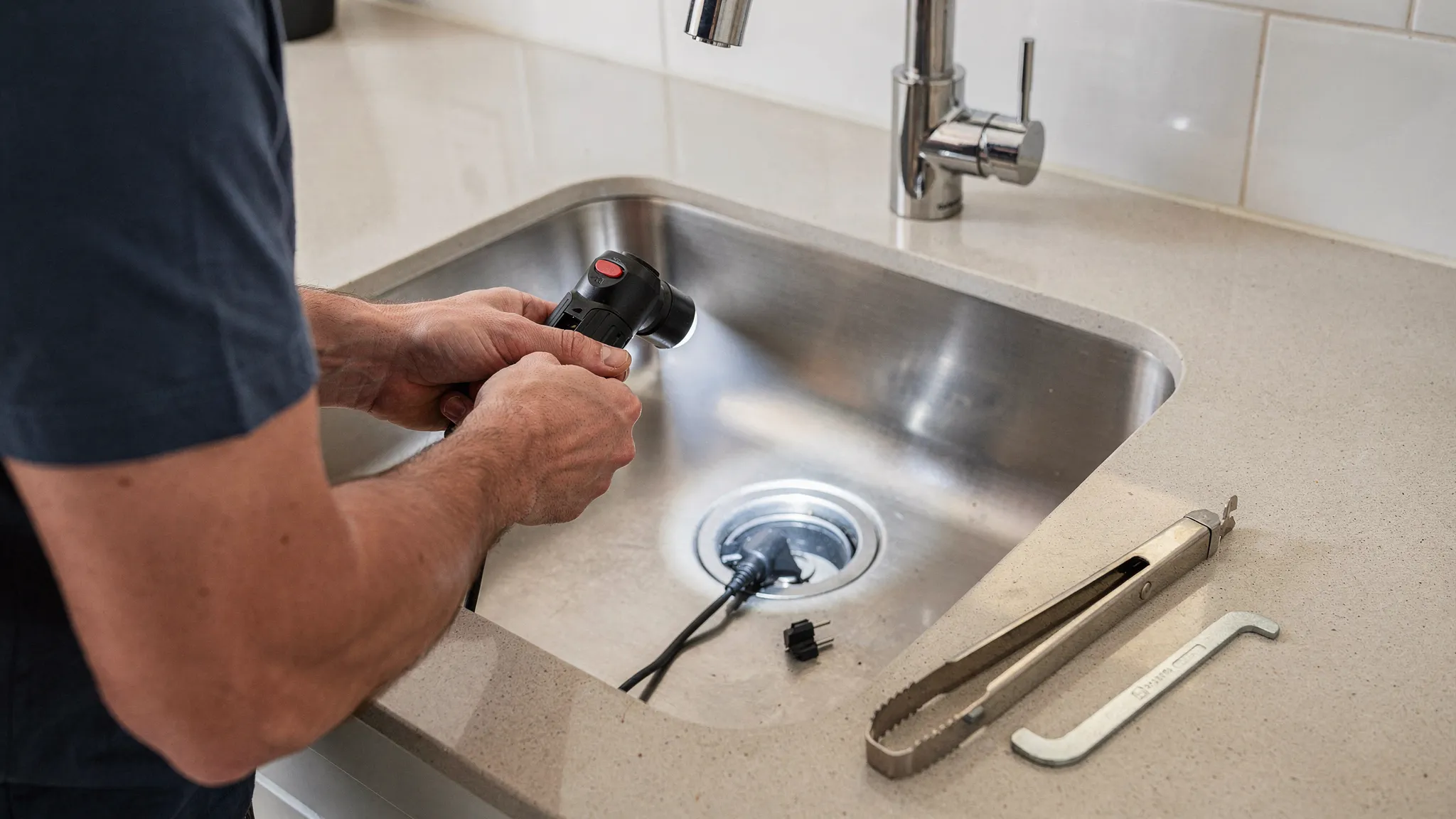
1) Remove obvious debris from above (no hands)
With power disconnected:
- Shine a flashlight into the disposal.
- Use tongs or pliers to remove visible objects.
Common jam items include bottle caps, pull tabs, small utensil pieces, fruit pits, and broken glass.
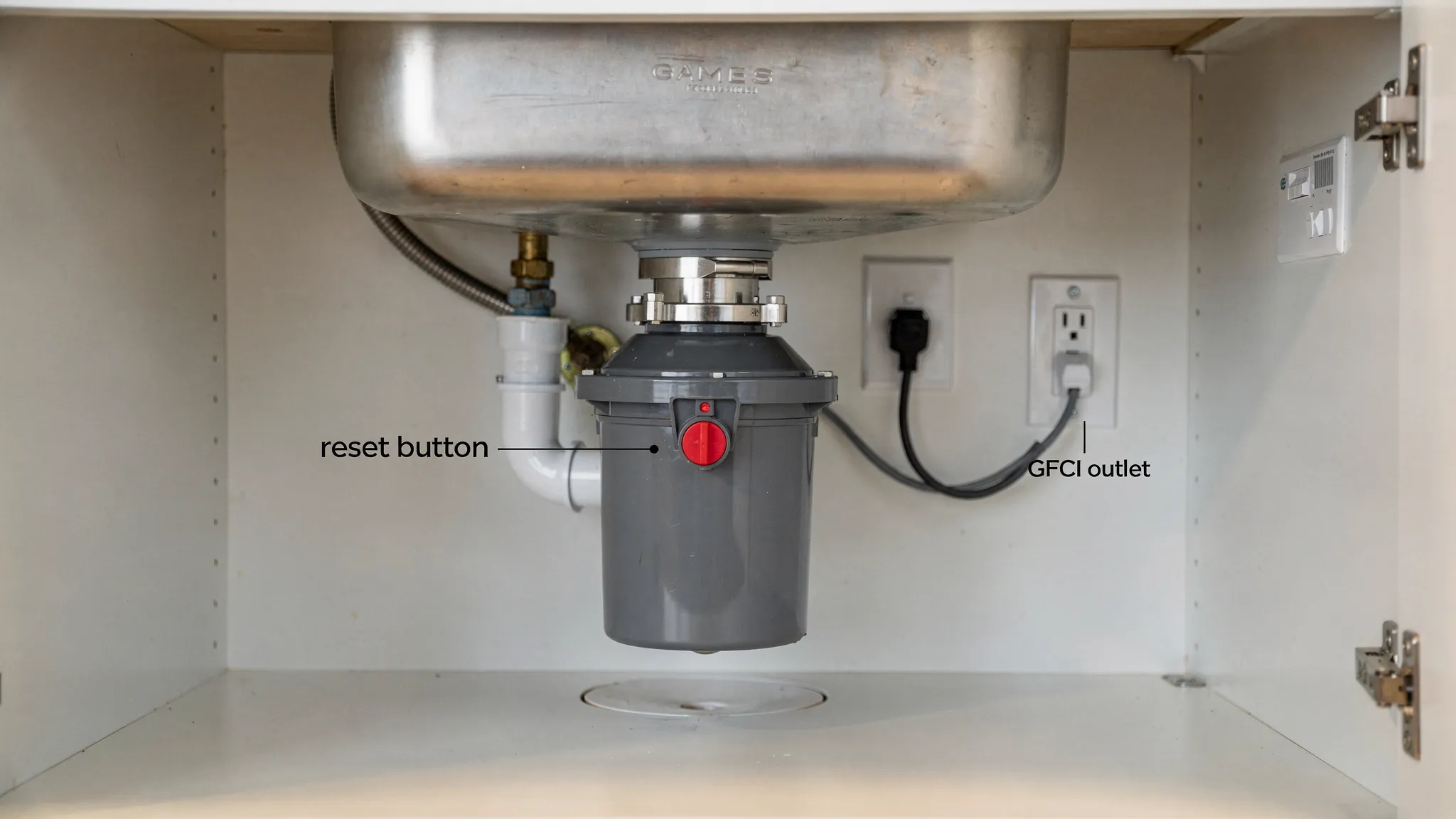
2) Press the reset button (after clearing)
Most disposals have a red reset button on the bottom. If it popped:
- Wait 1 to 2 minutes for the motor to cool.
- Press the button firmly until it clicks.
Do not keep resetting and trying again without freeing the flywheel first. Repeated stalled starts can finish off a weak motor.
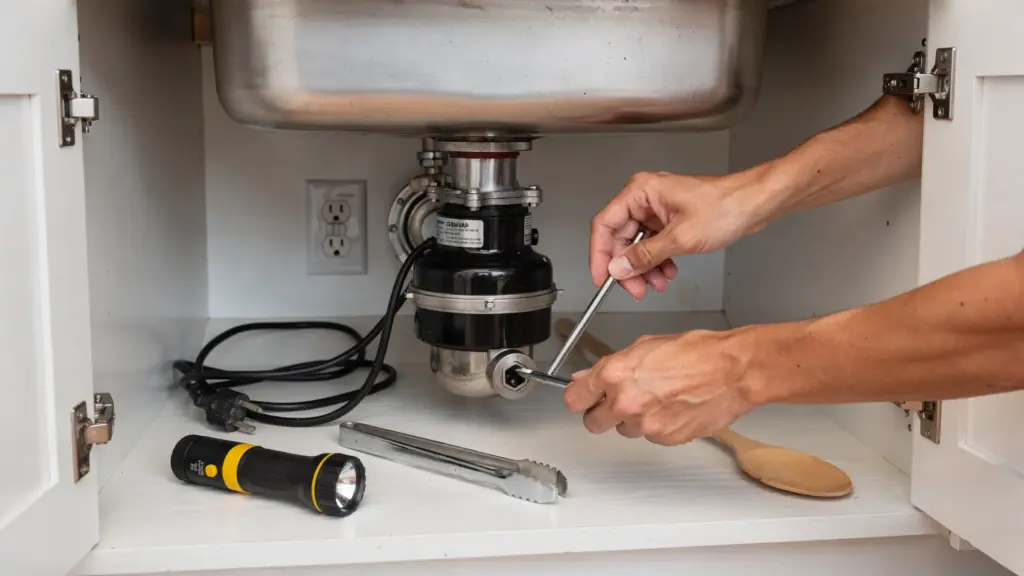
3) Manually turn the flywheel from underneath
Many models have a hex socket on the bottom for an Allen wrench (often 1/4 inch). If yours does:
- Insert the correct hex key.
- Work it back and forth until it rotates freely.
If there is no hex socket, you can usually free the plate from above using a broom handle.
4) Turn the grinding plate from above (broom handle method)
From the sink opening:
- Place a wooden spoon or broom handle into the chamber.
- Push the grinding plate back and forth to break the jam loose.
You are not “prying,” you are rocking the plate until it spins.
5) Restore power and test correctly
When the plate spins freely:
- Plug the unit back in (or restore breaker).
- Run cold water at a steady flow.
- Switch the disposal on for 1 to 2 seconds, then off.
If it spins normally, run it for 10 to 15 seconds with water and you’re done.
If it hums again, stop and go back to step 1. A second jam is common if a fragment is still inside.
If it still hums: power and control checks (fast, no tools)
Even though humming implies power, you can still have a partial electrical issue that causes weak starting.
Check the easy reset points
- GFCI outlet: Many disposals are plugged into a GFCI under the sink or share one with the dishwasher. Press “reset.”
- Breaker: Some breakers trip “halfway.” Turn it fully off, then on.
- Wall switch: A worn switch can pass enough power to hum but not to start under load (less common, but it happens).
Listen for the pattern
- Hum for 1 to 3 seconds, then silence often means the overload protector is tripping.
- Continuous hum without tripping can mean the motor is stalled but not protected correctly, or protection is failing.
If you’re in Phoenix and the under-sink cabinet gets very warm (especially in summer), stalled starts can overheat a disposal faster than you’d expect.
When the “hum” is actually telling you to stop DIY
There are a few conditions where continuing to try starts can create more damage.
1) The disposal is leaking from the bottom
A leak from the bottom housing typically indicates an internal seal failure. This is not a clamp or putty fix. In most cases, the practical solution is replacement.
2) The grinding plate will not move at all, even manually
If you cannot move the flywheel with the hex key or broom handle after removing debris, possibilities include:
- A severe jam wedged out of sight
- Corrosion and seized bearings
- Internal mechanical failure
At that point, a technician can decide whether it’s worth freeing or whether replacement is more cost-effective.
3) You smell burning, see smoke, or the unit is hot to the touch
Disconnect power and do not attempt more restarts. A stalled motor can overheat windings and permanently fail.
4) It trips the breaker repeatedly
One trip can happen with a jam. Repeated trips can indicate a motor drawing excessive current, a wiring issue, or a failing switch or outlet.
If you need guidance on choosing a reputable local technician, use this vetting checklist: Home Appliance Repair Near Me: How to Vet a Tech.
Phoenix-specific causes that make jams and stalls more likely
Phoenix homes have a few patterns that show up often in kitchen service calls:
Hard water and mineral buildup
Hard water can contribute to scale and buildup in kitchen plumbing, especially when combined with grease. While minerals do not “cause” the motor to stall by themselves, they can worsen slow drainage and increase the chance of sludge forming around the disposal, which makes jams and overload events more frequent.
Heat, cabinet temps, and summer workload
In summer, under-sink cabinets can be warmer, and disposals may be used more for quick meal cleanup. Heat can reduce the margin for a motor that is already struggling. If your unit is older and frequently hums, replacement may be cheaper than repeated service calls.
Grease plus starchy scraps
Grease, rice, pasta, potato peels, and fibrous scraps can create thick paste that restricts movement. A disposal can hum even when the “jam” is essentially packed food waste.
What not to do (common mistakes that make it worse)
These are the moves that turn a simple jam into a bigger repair:
- Do not use chemical drain cleaners in or near a disposal. They can damage components and create a safety hazard for anyone servicing the unit.
- Do not keep flipping the switch while it hums. That repeated stalled start overheats the motor.
- Do not reach in to feel for the obstruction.
- Do not use hot water while grinding food waste. Hot water softens fats and can carry grease downstream where it re-solidifies.
For general safety guidance around home electrical devices and outlets near water, the U.S. Consumer Product Safety Commission (CPSC) is a solid reference.
If you cleared the jam but it still won’t start: likely part failures
Once you’ve confirmed the plate turns freely by hand, ongoing humming points to motor-start issues.
Start capacitor (some models)
Some disposals use a start capacitor to give the motor extra torque to begin spinning. If the capacitor is weak, the motor may hum but fail to start even though nothing is jammed.
Capacitor diagnosis and replacement is usually a technician job unless you’re experienced with appliance electrical repair and can do it safely with proper testing.
Motor failure or seized bearings
If the motor windings are damaged or bearings are seized, the unit can hum and never reach operating speed. At that point, replacement is commonly recommended, especially for older disposals.
“Repair vs replace” decision: a practical rule of thumb
Garbage disposals are often replaced rather than repaired because labor can exceed the cost of a new unit, especially if there’s internal leakage or motor failure.
A simple decision framework:
- Replace if: leaking from the bottom, repeated breaker trips after jams are cleared, unit is very old, or the motor is seized.
- Repair or service if: jammed by a foreign object, mounting or sink flange is loose, electrical supply issue (switch, outlet, GFCI), or minor leak at the drain connections.
If you want to understand how appliance invoices are typically built (diagnostic fee vs labor vs parts), this breakdown will help you compare quotes: Appliance Repair Costs: Service Fees vs Parts Explained.
When to call for same-day help
Call for same-day service if:
- The disposal is leaking and you cannot stop the water exposure under the sink.
- You smell burning or the unit overheats.
- The disposal shares plumbing with a dishwasher and you have standing water that could backflow.
For Phoenix timing expectations and what “same-day” usually includes (diagnosis vs full repair), see: Kitchen Appliance Repair Near Me: Same-Day Options.
Prevent it from happening again (realistic habits)
Most repeat “hum but won’t grind” situations come down to what goes in and how it’s run.
Better operating routine
- Run cold water before, during, and for 10 to 15 seconds after use.
- Feed scraps gradually, not all at once.
- If you hear the pitch drop, stop adding waste and let it catch up.
Reduce jam-prone inputs
Avoid grinding:
- Grease, oil, and fat
- Rice, pasta, potato peels, and other starchy scraps in large amounts
- Fibrous foods (corn husks, celery strings)
- Hard objects (bones, fruit pits)
Monthly “light cleaning” that doesn’t harm components
A simple, low-risk approach:
- Flush with cold water.
- Grind a few ice cubes (if your manufacturer allows it) to help dislodge soft buildup.
- Follow with cold water again.
If you’re unsure whether your model recommends ice, check your disposal’s manual or the manufacturer’s support page.
Bottom line
If your garbage disposal hums but won’t grind, treat it like a stalled motor: disconnect power, clear the chamber with tools, manually free the flywheel, then reset and test with cold water. If it still hums after the plate spins freely, or if you see bottom leaks, burning smells, or repeated breaker trips, it’s time for professional diagnosis or replacement.
If you’re dealing with multiple appliance issues at once, you can also browse our Phoenix-focused repair guides and cost explainers at appliancerepairpros.net.