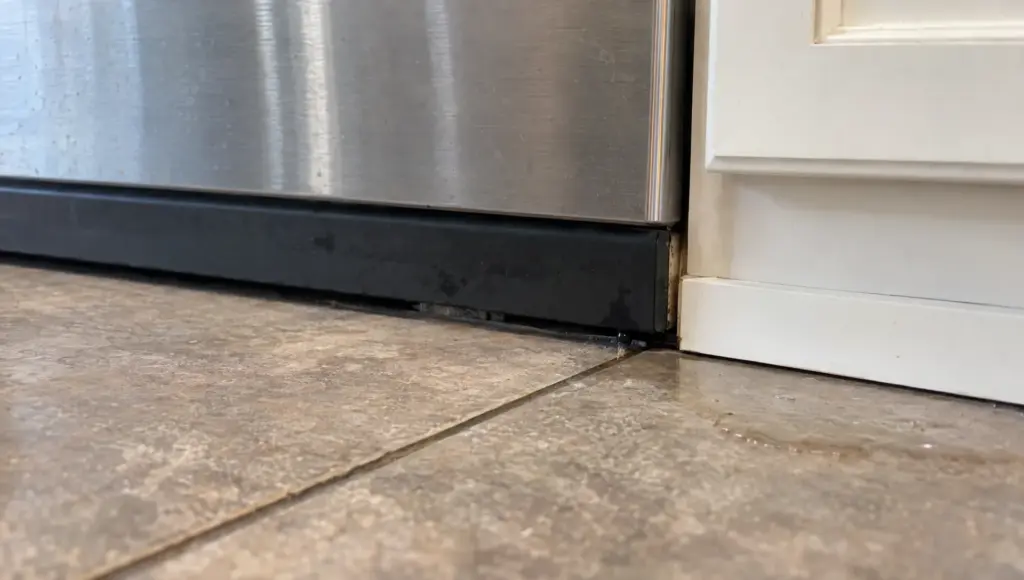
A Bosch dishwasher E15 error usually means the appliance’s leak-protection system has detected water in its base, underneath the washing compartment. The dishwasher may stop its cycle, refuse to start or keep running its drain pump. The safest response is to stop using it, close its water supply and arrange a leak diagnosis if the cause is not clear.
E15 does not identify the leaking part, and clearing the display does not necessarily fix the problem. Here is how to protect your kitchen, make a few safe observations and decide when professional repair is needed.
What E15 means on a Bosch dishwasher
Many Bosch dishwashers have a collection tray beneath the wash tub. If water reaches that tray, a float can rise and activate the appliance’s anti-flood protection. The control system then interrupts normal operation and may run the drain pump to remove water from the washing compartment.
That lower tray is separate from the area beneath the removable filter inside the dishwasher. A little water in the filter well does not, by itself, explain E15. Likewise, a dry kitchen floor does not rule out a leak: water can collect inside the appliance before it becomes visible outside.
Bosch’s official E15 support guidance identifies activation of the water-protection system and directs owners to close the water tap and contact customer service.
The code points to a protection event, not a diagnosis of a failed pump, door gasket or control board. A technician still needs to establish where the water came from. Less commonly, the float mechanism or its electrical circuit may need investigation.
What to do immediately
Do not start another cycle to see whether the error disappears. Continued operation can add water to a leak and increase the risk of cabinet or flooring damage.
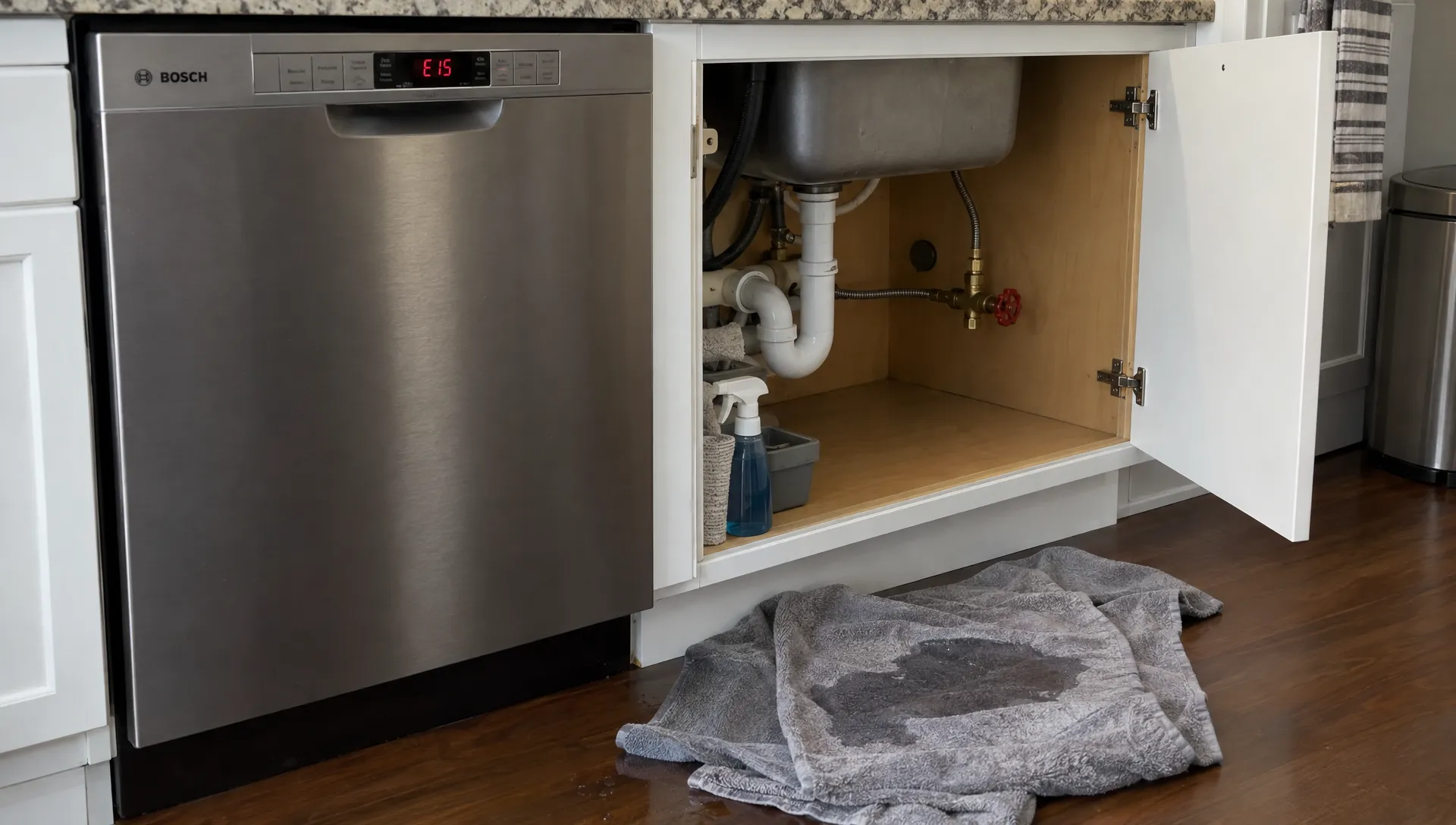
- Close the dishwasher’s water supply valve: This is often under the kitchen sink, but installations vary. Close the correctly identified valve without forcing a seized handle. If water is actively escaping and you cannot isolate the dishwasher, use the home’s main shutoff if you know how to do so safely.
- Disconnect electrical power safely: Use the dishwasher’s dedicated circuit breaker or an accessible plug in a dry location. Do not reach behind the appliance, touch a wet outlet or stand in water while handling electrical equipment. The control-panel power button may not stop a protective drain-pump response.
- Contain accessible water: Once the area is electrically safe, use towels to protect nearby flooring. Do not remove lower panels or reach into the appliance’s base to soak up water.
- Record what happened: Photograph the display and note whether E15 appeared during filling, washing or draining. Record any recent installation work, detergent change or visible leak.
If you smell burning, see sparking or find water around electrical connections, stop handling the dishwasher and get qualified help. An active leak that cannot be isolated also requires prompt attention, rather than another reset attempt.
Common causes of a Bosch dishwasher E15 error
Several different faults can put water into the dishwasher’s base. The following are possibilities to investigate, not conclusions you can draw from the code alone.
| Possible cause | What may be happening | Useful observation |
|---|---|---|
| Hose or connection leak | An inlet connection, internal hose or drain connection allows water to escape | The problem began after installation or plumbing work |
| Pump or sump seal leak | A seal around the lower wash assembly leaks during operation | Water collects internally without an obvious door leak |
| Excessive suds | Hand dish soap or unsuitable detergent produces foam that escapes normal water containment | Foam appeared after a detergent change or accidental soap use |
| Door-area or spray-arm problem | A sealing issue or damaged spray arm allows water to escape near the door | Moisture appears along the front edge during washing |
| Water entering from elsewhere | Nearby plumbing leaks or another spill reaches the appliance’s lower area | Wetness is present under the sink or around the installation |
| Float or detection-system fault | The protection mechanism or its circuit needs testing | A technician finds the base dry but the fault remains |
The timing can help narrow the search. An error that appears during filling suggests a different inspection path from one that appears only after circulation begins. However, water may take time to accumulate, so the moment the code appears is a clue rather than proof.
Avoid ordering a drain pump just because you hear it running continuously. It may be responding correctly to the anti-flood signal.
Safe checks you can make without dismantling the dishwasher
Keep the water supply closed and power disconnected during these checks. If accessing anything would require moving the dishwasher, opening its base or handling wet wiring, leave that work to a technician.
Check for accidental soap or excessive foam
Think back to the last load. Was hand dishwashing liquid used in the detergent dispenser? Were dishes loaded with substantial soap residue? Did someone change detergents or add more than the product instructions recommend?
Visible foam is useful information, but it does not prove that suds are the only problem. Water may already have reached electrical components or an internal tray. Do not add household chemicals, run repeated rinse cycles or pour water into the machine to clear E15.
Tell the technician what product was used and approximately how much. Keep the container available so the detergent can be identified.
Look at accessible plumbing and the door area
From a dry, safe position, look for moisture around visible under-sink connections and the dishwasher’s supply valve. Note any droplets, staining or damp cabinet surfaces. Do not loosen a connection to investigate it.
If the surrounding area is dry and there are no signs of an electrical fault, open the door and visually inspect the door gasket for obvious damage or trapped debris. Also look for an item obstructing a spray arm. These observations may help with diagnosis, but do not establish that the lower base is dry or safe.
Do not pull a built-in dishwasher out of the cabinet just to inspect behind it. Mounting screws, short hoses and electrical connections can make that a more involved job than it appears.
Distinguish a drainage problem from a base leak
If you also noticed water remaining in the wash tub, mention it when arranging service. A drainage issue can coexist with E15, but clearing the interior filter does not remove water from the lower leak tray.
Our guide to safe checks for a dishwasher that is not draining explains that separate symptom. With an active E15 fault, keep the appliance out of service rather than restarting it after a filter check.
For an E15 diagnosis, your most useful contribution is a clear symptom history: when the code appeared, where moisture was visible and what changed before the problem began.
Why tilting, drying and resetting are not reliable repairs
Online advice often recommends tipping the dishwasher to empty its base tray. That can lower the float and temporarily clear the error, but removing collected water does not repair the source of the leak.
Tilting also creates avoidable risks. Water can move toward electrical parts, hoses can be strained and a built-in appliance can damage cabinetry or flooring as it moves. Do not tip the dishwasher, bypass its float switch or use a hair dryer inside the base.
Waiting for the tray to dry has the same diagnostic limitation. The code may disappear while the underlying fault remains, then return during the next cycle.
A reset is a control procedure, not a leak repair. Follow the instructions for your exact model only after the cause has been addressed and safe operation has been established. Our guide to common household appliance DIY mistakes explains why repeated resets and unverified part replacements can make troubleshooting harder.
What a technician should investigate
A proper Bosch dishwasher E15 error diagnosis should identify both the collected water and its source. Simply drying the tray and leaving is not enough if the cause remains unexplained.
Depending on the model and symptoms, the technician may inspect hose connections, the sump assembly, pump seals, door-area components and the leak-detection mechanism. They may also check the installation for water entering from nearby plumbing.
Once the cause is corrected, the appliance needs an appropriate leak check under operating conditions. That work should be performed with the necessary electrical precautions, followed by reassembly and confirmation that the protection system functions correctly.
Before the visit, photograph the rating label, commonly found along an accessible door edge. Bosch uses an E-Nr model identifier to distinguish appliances and compatible parts. Include the full identifier and any suffix, along with the FD number if present.
Ask whether the estimate includes diagnosis, parts, labor and a post-repair leak check. Also ask what repair warranty applies. The E15 code alone is not enough to provide a dependable repair price or decide whether replacement makes more sense.
Considerations for Phoenix homeowners
Phoenix-area homes can experience mineral buildup from hard water. That can affect dishwasher maintenance, but E15 is not a hard-water indicator. Do not assume that a descaling cycle will correct a leak-protection fault.
When scheduling appliance repair in Phoenix, describe the situation accurately: “Bosch dishwasher displaying E15, water supply closed, power disconnected, visible leak present or absent.” This helps the company understand the appliance and the urgency without assuming a specific failed part.
If the dishwasher is under warranty, check Bosch’s service requirements before authorizing work. For an active plumbing leak or water damage beyond the appliance, additional plumbing or restoration help may be necessary.
Frequently asked questions
Can I keep using my dishwasher with E15 showing? No. The code indicates that the water-protection system has activated. Stop using the dishwasher, close its water supply and disconnect power safely until the cause is investigated.
Why does the drain pump keep running even when the dishwasher is off? The anti-flood system may command the pump to run regardless of normal cycle controls. That does not automatically mean the pump is defective. Use a dry, accessible electrical disconnect rather than repeatedly pressing the control-panel button.
Does E15 always mean the dishwasher itself is leaking? Usually, water in the base needs investigation, but it can sometimes come from nearby plumbing or another external source. A fault in the detection mechanism is also possible. The code does not identify the source on its own.
Will unplugging the dishwasher reset E15? Disconnecting power may stop the pump, but it does not remove the reason the protection system activated. If water remains in the base or a detection fault persists, the code can return when power is restored.
Can cleaning the filter fix E15? Filter cleaning addresses maintenance inside the wash tub. It does not directly empty the lower base tray or repair a leaking hose, seal or connection. Treat drainage symptoms and E15 as related observations that may require separate diagnosis.
Should I repair or replace the dishwasher? Base that decision on the diagnosed fault, the complete estimate, appliance age, overall condition and warranty coverage. E15 alone does not mean the dishwasher needs replacement.
Your next step
Keep the dishwasher out of service until the water source is understood. Gather the model label, a photo of the error and your observations, then contact Bosch support or a technician experienced with Bosch dishwashers. Ask for a leak diagnosis and an explanation of the proposed repair, not just a code reset.