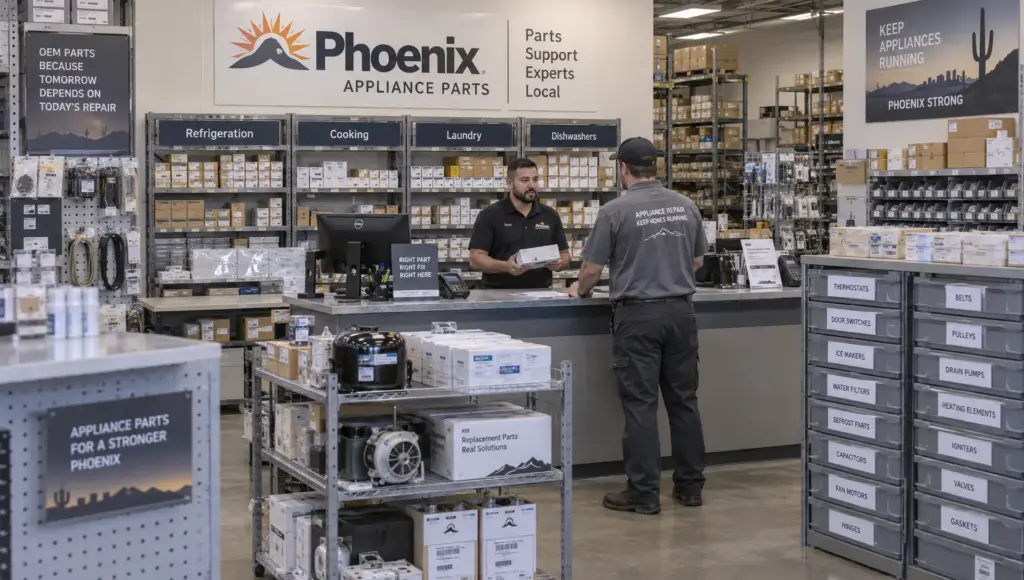
A lower price on appliance repair parts can make a repair quote look attractive, but the cheapest replacement is not always the least expensive repair. The right choice depends on what failed, whether the replacement matches your appliance and who pays if it fails again. For Phoenix homeowners, availability also matters when a refrigerator stops cooling during hot weather.
OEM parts are usually the safest starting point for complex or safety-critical repairs. Reputable aftermarket parts can offer good value when compatibility is documented. Used parts make the most sense for carefully inspected cosmetic components or certain discontinued replacements. None of those labels, by itself, guarantees a successful repair.
Comparing OEM, Aftermarket and Used Appliance Repair Parts
These terms describe different things: who supplies the replacement, whether it is new and how much is known about its condition.
| Part category | What it means | Main advantage | Main limitation |
|---|---|---|---|
| OEM | A replacement supplied under the appliance manufacturer's brand and part number | Manufacturer-backed compatibility information and specifications | Can cost more or be unavailable for older models |
| Aftermarket | A replacement offered by a third-party brand rather than the appliance manufacturer | May reduce cost or provide another supply option | Quality, documentation and fit vary by supplier |
| Used | A previously installed component removed from another appliance | Can make discontinued parts available | Remaining service life and operating history may be unknown |
| Refurbished or rebuilt | A previously used component that a seller says has been restored or repaired | May offer a tested alternative to an unavailable new part | The scope of restoration and testing varies |
OEM stands for original equipment manufacturer. An appliance brand may source components from other manufacturers, so OEM does not necessarily mean the appliance company made the part itself.
An aftermarket replacement is not automatically inferior. Some are well-made, clearly specified alternatives. However, phrases such as “OEM quality,” “OEM equivalent” and “replacement for” do not establish that a listing is a genuine manufacturer-branded part.
Used and refurbished are also not interchangeable. A removed control board might be sold exactly as found, while a rebuilt board may have had failed components replaced. Ask what work and testing support the seller's description.
Choose the Part Category Based on What Failed
Safety-critical components deserve the strictest checks
Gas valves, oven safety controls, thermal cutoffs and door interlocks are poor candidates for a purchase based mainly on price. Their function includes controlling hazards, not simply making the appliance operate.
For these repairs, start with the manufacturer-specified replacement. A qualified technician can determine whether a documented alternative meets the appliance's requirements. Physical fit alone is not enough, and a safety device should never be bypassed to accommodate a substitute.
Microwave internal repairs, gas-system work and refrigerator sealed-system repairs should be handled by appropriately qualified professionals. Unplugging an appliance does not eliminate every hazard, particularly inside a microwave.
Motors, pumps, heaters and electronics require exact specifications
For a washer drain pump, dishwasher circulation motor or electric oven heating element, an aftermarket replacement may be reasonable when the supplier provides reliable compatibility information and the technician accepts it.
Matching specifications can include voltage, wattage, mounting points, connector arrangement and operating characteristics. A component that looks similar may still be unsuitable.
Control boards need additional scrutiny. Depending on the model, a replacement may require programming, configuration or a specific revision. A used board from the same brand is not necessarily interchangeable, even when its connectors match.
The choice of appliance repair parts should follow the diagnosis. Replacing a failed component without correcting the leak, damaged wiring or other condition that caused its failure can lead to another breakdown.
Cosmetic and non-powered parts offer more flexibility
Used knobs, trim panels and handles can be practical purchases when their mounting points and dimensions match. Inspect them for cracks, stripped fittings and excessive wear.
Shelves and drawers also need careful inspection because they support loads. Reject chipped glass, cracked supports or pieces that do not seat securely.
Door gaskets are less straightforward. A used refrigerator gasket may already be distorted, while an oven door seal must tolerate the intended temperature and fit correctly. For seals, a new, model-compatible replacement is generally a better starting point than a salvaged one.
Verify Compatibility Before Ordering
Start with the appliance's complete model number and serial number, not its retail name or appearance. Photograph the identification label so suffixes and production details do not get lost during a phone call.
Manufacturers sometimes change components during a model's production run. They may also replace an old part number with a newer one, a process called supersession. The new replacement can look different or include an adapter, so appearance alone cannot confirm or rule out compatibility.
Before buying, confirm:
- Exact model coverage: The seller identifies your complete model, including any applicable suffix or serial-number range.
- Current replacement number: The part number matches the manufacturer's current replacement information or a documented cross-reference.
- Required configuration: Any programming, calibration or installation kit is identified before purchase.
- Included components: The listing states whether brackets, seals, wiring adapters or other necessary pieces are included.
- Return eligibility: You understand the rules for opened packages, installed components and electrical parts.
Ask the technician or supplier to document the match. “It should fit” is weaker evidence than a model-specific parts lookup.
When buying appliance repair parts online, favor sellers that identify the actual manufacturer, condition and warranty terms. A stock photo and a long list of compatible brands are not enough to establish suitability.
Compare the Installed Cost, Not Just the Part Price
The meaningful comparison is the total cost of getting the appliance working reliably, not the price of the component alone.
A less expensive part may save money initially but require an adapter, extra installation time or another visit. Conversely, an available aftermarket replacement may be more practical than waiting for an OEM component when both are suitable for the repair.
Ask for quotes that separate the replacement part, labor, diagnostic charge and any additional charges. Our guide to appliance repair service fees versus parts costs explains how those items affect the final bill.
| Quote detail | What to ask |
|---|---|
| Part identity | What brand, part number and condition are being supplied? |
| Installation | Are adapters, programming and testing included? |
| Availability | Is the part physically in stock or only available to order? |
| Repeat failure | Who pays for another diagnosis, replacement part and installation? |
| Customer-supplied parts | Will the company install them, and what warranty applies? |
A technician's part price may include sourcing, handling and warranty responsibility. Compare that complete arrangement with an online purchase rather than assuming the difference is pure markup.
If the repair involves an expensive board, compressor or several deteriorated components, also weigh the appliance's overall condition. Our repair-versus-replace guide for Phoenix homeowners covers that broader decision without reducing it to the price of one part.
Understand What the Warranty Actually Covers
Three separate protections may apply: the appliance manufacturer's warranty, the replacement part's warranty and the repair company's labor warranty. They are not necessarily the same length or scope.
A replacement part warranty might provide another component without covering diagnosis, shipping or installation. A repair company may also have different policies for parts it supplies and parts you purchase yourself.
For most U.S. consumer-product warranties, using an aftermarket component does not automatically void the entire warranty. The FTC's guide to federal warranty law explains restrictions on requiring consumers to use branded parts or services. Coverage can still be denied for damage caused by an unsuitable part or improper installation.
If the appliance is under warranty, contact the manufacturer before authorizing a repair. Confirm the service process and get any coverage decision in writing.
When comparing appliance repair parts, ask whether the quoted protection covers both the component and the labor to replace it. Our explanation of appliance service warranties and parts policies can help you identify gaps before approving the work.
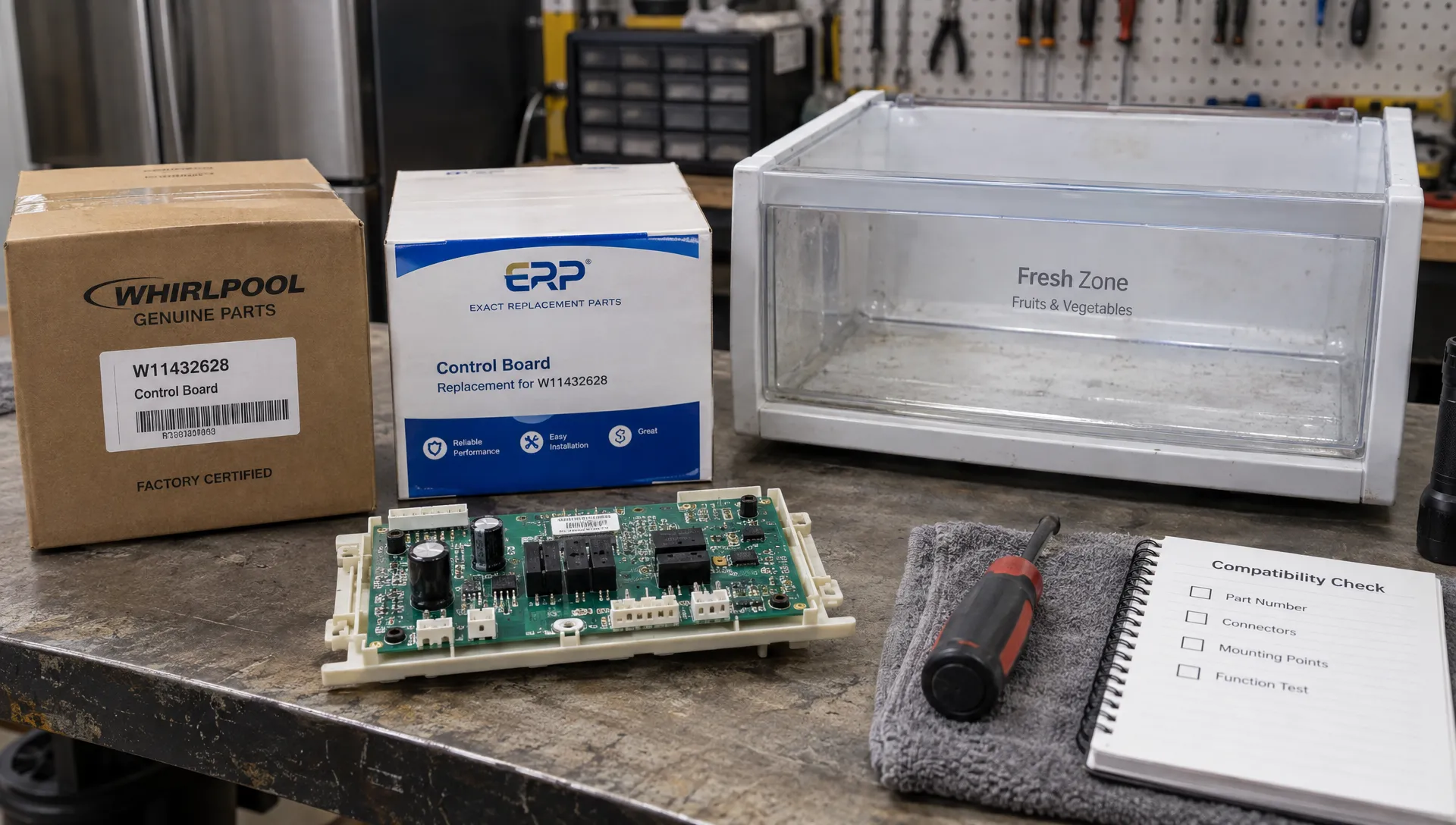
When Used or Refurbished Parts Make Sense
A discontinued handle or trim piece can be a good reason to buy used. Salvaged components may also keep an older appliance repairable when new replacements no longer exist.
The harder question is whether an electrically or mechanically active used part offers enough value to justify its uncertainty. A motor, compressor or control board can function during a brief test without revealing how much useful life remains.
Ask what “tested” or “refurbished” means
“Tested working” is not a standardized description. Ask whether the seller inspected the item visually, powered it on or tested its relevant functions under operating conditions. For a rebuilt board, ask what was repaired and whether the repaired assembly was tested afterward.
Request photographs of the actual item, its label and its connectors. Corrosion, heat discoloration, damaged terminals or evidence of moisture are reasons for concern, although clean photographs cannot prove a component is reliable.
The supplier should explain its return window and failure policy. If installing the replacement requires substantial labor, a short or unclear guarantee can erase the savings from buying used.
Check for relevant recalls
Before repairing an older appliance, search the U.S. Consumer Product Safety Commission's recall database using the brand and model information. A recall may require a specific repair procedure or remedy.
Do not assume a salvaged component resolves a recalled defect. Follow the recall instructions and contact the manufacturer when the affected model or serial-number range matches your appliance.
Phoenix Availability: Fast Service Still Needs the Right Part
When a refrigerator stops cooling in Phoenix, homeowners understandably prioritize speed. But a same-day diagnostic appointment does not necessarily mean the correct replacement is available that day.
Ask whether the proposed part is on the technician's vehicle, stocked locally or arriving from another location. Also ask whether “available” means physically on hand or merely listed by a distributor.
Local conditions can affect the diagnosis. For example, a refrigerator in a hot garage may be operating outside the ambient-temperature range specified in its manual. Replacing a component without addressing the installation conditions may not solve the underlying problem.
For urgent repairs, give the company your complete model number, symptoms and any error code before the visit. That information can help it check appliance repair parts availability, though it cannot replace an on-site diagnosis.
While waiting, keep refrigerator doors closed and move temperature-sensitive food to safe cold storage when necessary. Do not repeatedly reset a breaker that trips or continue using an appliance that smells burned. If you smell gas, leave the area and contact the gas utility or emergency services from a safe location.
Frequently Asked Questions
Are OEM parts always better than aftermarket parts? No. A well-specified aftermarket replacement can be suitable for some repairs. OEM is a strong starting point when compatibility is complex, manufacturer-specific programming is involved or the component performs a safety function.
Can a repair company refuse to install a part I bought? Yes. Companies set their own customer-supplied-parts policies and may decline because they cannot verify compatibility, condition or warranty support. Ask before placing an order.
What should I do if the OEM part is discontinued? Ask about an official superseding part number first. If none exists, discuss a documented aftermarket replacement, professionally rebuilt component or carefully evaluated used part. Replacement of the appliance may be more sensible if no reliable option is available.
Is a used control board worth buying? Sometimes, particularly for a discontinued model, but the exact board revision, configuration requirements, testing and return policy matter. Include installation labor in the comparison because a second board replacement can eliminate the initial savings.
Before You Approve the Repair
Ask for a written quote naming the part's brand, number, condition and warranty, along with the total installed price. If the technician offers alternatives, have them explain why each is suitable for your exact model.
Choose appliance repair parts based on documented compatibility, the component's job and the cost of a repeat failure. That gives you a more useful comparison than choosing OEM automatically or buying the lowest-priced listing.