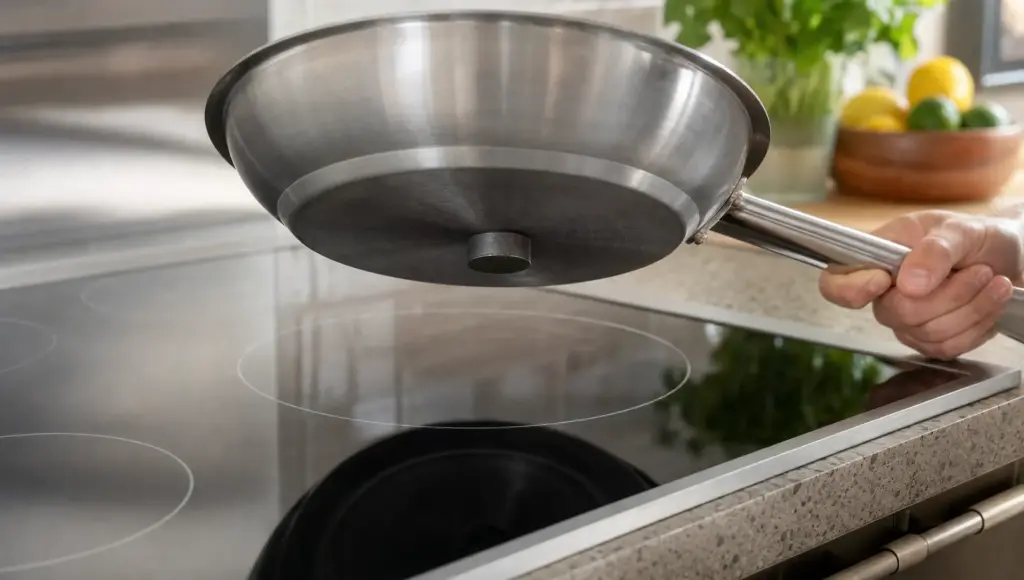
An induction cooktop not detecting pans is usually reacting to one of three things: the pan is not magnetic enough, the pan is not sitting correctly on the heating zone or the cooktop needs a simple reset. Before you assume the appliance has failed, you can rule out several common causes in a few minutes with basic, safe checks.
Induction cooking is different from gas or standard electric cooking because the cooktop does not heat the glass directly in the same way. It creates a magnetic field that heats compatible cookware. If the cooktop cannot “see” the pan, it may flash a pan symbol, beep, show an error code or shut the zone off after a few seconds.
Why induction cooktops fail to detect pans
Induction cooktops depend on cookware with a ferromagnetic base. That means the bottom of the pan must respond strongly to a magnet. Cast iron, many enameled cast iron pans and some stainless steel cookware work well. Aluminum, copper, glass and non-magnetic stainless steel usually do not unless they have an induction-ready base.
Pan detection also depends on size, position and contact. A pan can be compatible but still fail if it is too small for the burner, badly warped or sitting off-center. Some cooktops are more sensitive than others, especially larger flexible zones or bridge zones.
If your induction cooktop worked yesterday and stopped detecting pans today, think about what changed. A new pan, a recent power outage, a spill on the controls or a hot, crowded countertop can all affect performance.
Start with the cookware test
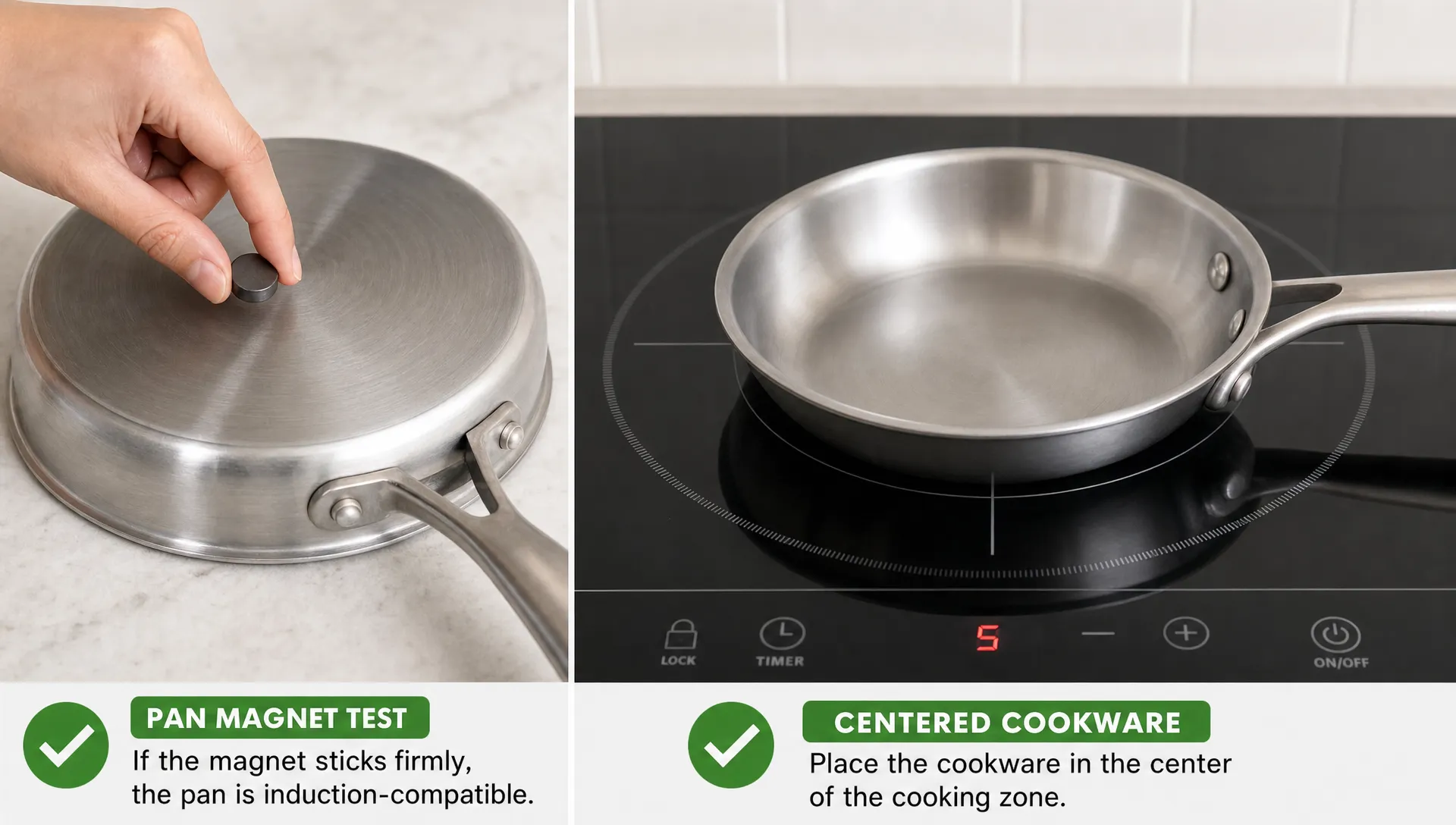
The fastest test is the magnet test. Place a small refrigerator magnet against the bottom of the pan. If the magnet sticks firmly, the pan is likely induction compatible. If it barely clings or slides off, the cooktop may not detect it reliably.
Do not test the side of the pan. Many pans have magnetic sidewalls but a non-magnetic base, and induction detection happens at the bottom. Also check the entire bottom surface, not just a tiny metal stamp or logo.
If one pan works and another does not, the cooktop is probably fine. If no pans work on any zone, move on to power, lock and reset checks.
| Cookware type | Usually detected by induction? | What to check |
|---|---|---|
| Cast iron | Yes | Make sure the base is flat and clean |
| Enameled cast iron | Usually yes | Avoid dragging it across the glass |
| Magnetic stainless steel | Usually yes | Confirm with a magnet on the base |
| Aluminum or copper | No, unless induction-ready | Look for an induction symbol and test with a magnet |
| Glass or ceramic cookware | No | Use induction-compatible cookware instead |
Easy fixes when your induction cooktop is not detecting pans
Once you know the pan should work, focus on placement and surface conditions. Induction sensors can be picky, but the fix is often simple.
Center the pan on the cooking zone
Move the pan so the base is centered inside the printed burner circle. If the pan sits too far to one side, the sensor may not detect enough magnetic surface area. This is especially common with small saucepans on large zones.
If your cooktop has a flexible cooking area, check the manual for the correct pan position. Some flexible zones detect cookware only when the pan covers a certain part of the zone.
Use the right pan size
A very small pan may not trigger a large induction burner. Many cooktops have a minimum pan diameter for each zone, and that minimum varies by brand and model. If a small pot is not detected, try a wider induction-ready pan on the same zone.
The opposite problem can happen too. A pan that is much larger than the active cooking area may heat unevenly or trigger temperature protection if the cooktop cannot manage the heat properly.
Check for a warped or uneven base
A pan that spins, rocks or sits with a visible gap may not make reliable contact with the cooktop surface. Induction does not require direct flame contact, but it still needs the pan base close enough to the magnetic field.
Place the pan on a flat counter and press gently on the rim. If it wobbles, test a flatter pan. Warped cookware is a common reason an induction cooktop not detecting pans seems to happen randomly.
Clean and dry the glass surface
Spills, grease and moisture can confuse touch controls and sometimes interfere with normal operation. Turn the cooktop off and let it cool. Wipe the surface with a soft cloth and a cleaner approved for ceramic glass cooktops.
Pay special attention to the control area. If the cooktop is beeping or ignoring touch commands, a wet control panel may be the real issue rather than pan detection.
Turn off control lock or demo mode
Many induction cooktops have a control lock, child lock or cleaning lock. When active, the surface may light up but refuse to heat. Look for a lock icon on the display, then check the owner’s manual for the unlock sequence.
Some models also have demo mode for showrooms. In demo mode, the display may respond normally but the cooktop will not heat. If the appliance was recently installed or serviced, this is worth checking.
Reset the cooktop safely
A reset can clear temporary software glitches after an outage, voltage dip or control-panel error. Turn all cooking zones off first. Then switch the cooktop off at the breaker for at least 60 seconds before turning it back on.
If the cooktop is hardwired, do not pull it out or open the electrical box just to reset it. Use the breaker. If the breaker trips again, or if you smell burning, stop using the appliance and call a qualified technician.
After the reset, test one known-compatible pan on one burner. If it works, test the other zones one at a time. This helps you separate a one-zone problem from a whole-cooktop problem.
Diagnose the symptom before replacing parts
The display behavior can tell you a lot. A flashing pan icon usually means the cooktop is looking for compatible cookware. A lock icon points to a control setting. A fault code may mean the appliance needs service, especially if the code returns after a reset.
Use this quick guide before spending money on new cookware or parts.
| Symptom | Likely cause | Easy fix to try |
|---|---|---|
| Pan icon flashes, then zone turns off | Pan is incompatible, too small or off-center | Magnet test, center the pan and try a larger pan |
| One pan works, another does not | Cookware base is not magnetic enough | Use induction-ready cookware |
| No zones detect any pan | Control lock, power issue or control fault | Unlock controls, reset at breaker and test again |
| One zone never detects pans | Failed sensor, coil or power module | Stop using that zone and schedule service |
| Cooktop detects pan, then shuts off | Overheating, blocked ventilation or empty pan | Let it cool, clear airflow and avoid heating empty cookware |
If you are comparing symptoms across multiple kitchen appliances, avoid guessing based only on the first sign you notice. The same “no heat” complaint can have very different causes depending on the appliance. PHX Appliance Fix Blog covers this safety-first mindset in its guide to DIY appliance repair mistakes to avoid.
When the pan is not the real problem
If multiple proven pans fail on the same zone, the issue may be inside the cooktop. Common service-level causes include a failed pan sensor, damaged induction coil, loose internal connection, faulty user interface or control board problem.
A single dead zone often points to a localized failure. A full cooktop failure may point to incoming power, a main control issue or a lockout condition after a fault. Induction cooktops use high-voltage components, so internal diagnosis is not a safe DIY project for most homeowners.
Ventilation can also cause trouble. Induction electronics need airflow. If the cooktop is installed above an oven, packed cabinet or blocked vent area, heat buildup can trigger shutdowns. Let the appliance cool completely, then check that vents are not covered by cookware, towels, drawer contents or debris.
What not to do during troubleshooting
Some “fixes” can damage the glass or create an electrical hazard. Keep the troubleshooting simple and stay outside the sealed appliance body unless you are trained to service high-voltage equipment.
Avoid these mistakes:
- Do not open the cooktop cabinet while it is connected to power.
- Do not bypass the breaker, fuse or safety devices.
- Do not use cracked cookware or a pan with a rough, dirty base.
- Do not scrape the glass with a knife, screwdriver or metal tool.
- Do not keep resetting a breaker that trips repeatedly.
Induction cooktops may contain components that hold electrical charge even after power is disconnected. If the problem goes beyond cookware, surface cleaning and a normal breaker reset, it is time to stop troubleshooting.
Can an induction adapter disk help?
An induction adapter disk is a magnetic plate that sits between the cooktop and a non-compatible pan. It can make some cookware usable, but it is not always a great everyday solution.
Adapter disks heat more slowly than direct induction cookware. They can also get very hot, scratch the glass if dragged or trigger overheating if used improperly. Before using one, check the cooktop manual. Some manufacturers warn against adapter plates because they can trap heat against the glass and electronics.
For most households, a properly sized induction-compatible pan is the better fix. If your induction cooktop not detecting pans problem only happens with older aluminum or copper cookware, replacing the pan is usually safer than forcing compatibility.
Phoenix home factors that can affect cooktop performance
Phoenix kitchens can get hot, especially during long summer cooking sessions. If your cooktop sits above a wall oven or inside a tight island cabinet, trapped heat can make shutdowns more likely. Good clearance and ventilation matter more than many homeowners realize.
Dust is another practical issue in Arizona homes. Dust around ventilation paths can make electronics run hotter. You do not need to disassemble the appliance, but you can keep the surrounding cabinet area clean and avoid storing towels, pans or cutting boards where they block airflow.
Power events can also leave electronic appliances acting strangely. If the issue started after a storm, outage or breaker trip, a safe breaker reset is a reasonable first step. If the same fault comes back, schedule a professional diagnosis instead of repeated resets.
If you use gas appliances elsewhere in the kitchen and landed here for a burner issue, the troubleshooting path is different. For ignition problems rather than induction pan detection, see this separate guide to stovetop burners that won’t ignite.
When to call a technician
Call for service if a known-compatible pan is not detected on one specific zone, all zones fail after a reset or the cooktop shows a recurring error code. You should also stop using the cooktop if you smell burning, see cracked glass or hear buzzing that is louder than normal induction hum.
A technician can test incoming voltage, inspect internal connections and diagnose the coil, sensor and control electronics. This is especially important for hardwired cooktops, where incorrect testing can damage the appliance or create a shock hazard.
Before the appointment, write down the brand, model number, error code and exactly which pans failed. If possible, keep one pan that works and one that does not. This gives the technician a faster path to confirming whether the problem is cookware, installation or the cooktop itself.
Frequently Asked Questions
Why does my induction cooktop say there is no pan when a pan is on it? The pan may not be magnetic, may be too small for the zone or may be off-center. Test the bottom of the pan with a magnet, then try centering a larger induction-compatible pan on the burner.
How do I know if my pan works with induction? Place a magnet on the bottom of the pan. If it sticks firmly, the pan is likely compatible. If it does not stick, the cooktop probably will not detect it.
Can a dirty cooktop stop pan detection? Yes, spills or moisture around the touch controls can cause beeping, lockouts or poor response. Clean and dry the glass after it cools, then test the pan again.
Should I repair or replace an induction cooktop that will not detect pans? If the problem is cookware or settings, repair is not needed. If a sensor, coil or control board has failed, compare the repair estimate with the age and replacement cost of the cooktop.
Is it safe to keep resetting the breaker? One reset after an outage or temporary glitch is reasonable. If the breaker trips again or the fault immediately returns, stop using the cooktop and call a qualified appliance technician.
Need help with a cooktop that still will not detect pans?
If these easy checks do not solve the problem, the issue may be inside the appliance rather than on top of the glass. PHX Appliance Fix Blog offers local repair tips, safety guidance and cost information for homeowners comparing next steps. You can browse more Phoenix appliance repair guidance before deciding whether to schedule service or replace the cooktop.