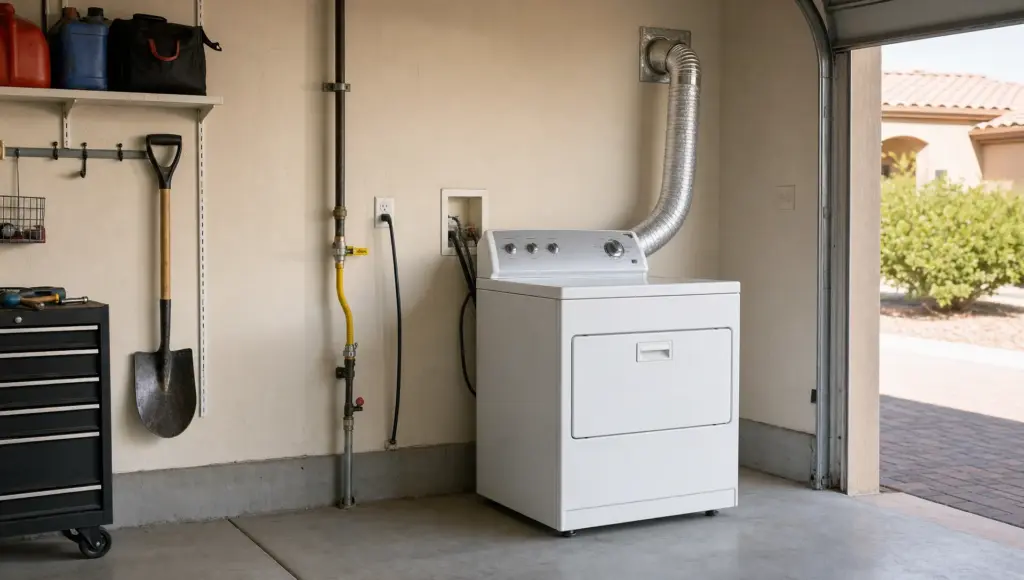
When you have a gas dryer not heating, the goal is not to take the machine apart as fast as possible. The safer move is to rule out simple causes first, then stop before you get into gas lines, ignition parts or internal wiring. Many no-heat dryer complaints come from airflow restrictions, settings, a tripped breaker or a gas valve that was bumped closed, but a few warning signs mean you should leave the house and call for help instead of troubleshooting.
This guide focuses on safe, no-tools checks Phoenix homeowners can do before booking repair. It does not cover opening the burner compartment, testing live components or bypassing safety switches, because those steps can create fire, shock and carbon monoxide risks.
Gas dryer not heating? Start with safety, not parts
A gas dryer uses both gas and electricity. The drum may tumble normally even when the burner is not lighting, which can make the problem feel less urgent than it really is. Still, anything involving fuel gas deserves a cautious approach.
Before touching the dryer, pay attention to smell, sound and the room itself. Do not ignore a rotten egg odor near the dryer, hissing from the gas connection, dizziness, headache or a carbon monoxide alarm. A dryer that keeps running with no heat is inconvenient. A leaking gas connection or blocked combustion exhaust is a safety issue.
If the dryer is hot to the touch, smells scorched or trips a breaker repeatedly, turn it off and let it sit. Do not keep restarting it to “see if it clears.” Repeated testing can turn a small fault into damage that costs more to repair.
If you smell gas or suspect carbon monoxide
Natural gas and propane are different from a clogged lint screen or wrong cycle setting. If you smell gas, do not unplug appliances, flip switches, start the dryer, use a phone near the appliance or search for the leak yourself. Leave the home, then call your gas utility or emergency services from outside.
Carbon monoxide is also a concern with fuel-burning appliances. The CDC explains that carbon monoxide cannot be seen or smelled, which is why working CO alarms matter. If a CO alarm sounds, leave the home and follow the alarm manufacturer’s emergency instructions.
A repair appointment can wait until the space is safe. Appliance troubleshooting should never happen while there is an active gas odor, an active CO alarm or symptoms that improve when you leave the laundry area.
Quick safe checks before you move anything
If there are no emergency warning signs, start with checks that do not require tools. Give the dryer room to cool, remove the load and look for anything obvious. A packed drum, soaked items from a washer that failed to spin or a cycle set to air fluff can all mimic a heating failure.
Use this table to separate simple checks from situations that need a technician:
| What you notice | Safe check to try | Stop and call if |
|---|---|---|
| Dryer tumbles but clothes stay cold | Confirm the cycle is not Air Dry, Air Fluff or No Heat | Correct settings do not restore heat |
| Clothes are warm but still damp | Clean lint screen and inspect outside vent airflow | Airflow is weak after cleaning accessible lint |
| Dryer shuts off quickly | Reduce load size and check for blocked vent flap | Dryer overheats, smells hot or shuts off again |
| No lights or no drum movement | Check outlet, plug and breaker | Breaker trips again or plug feels hot |
| Rotten egg smell near dryer | Leave the home and call utility or emergency services | Always treat this as urgent |
These first checks often tell you whether the problem is user-facing, airflow-related or likely inside the appliance.
Check the cycle, temperature and load
Modern dryers have more low-heat and moisture-sensing options than older models. On some machines, Eco, Delicates, Wrinkle Prevent or Air Dry can make the dryer feel like it is not heating, especially if you check it near the end of the cycle when it has entered cool-down.
Set a timed dry cycle on a normal or high heat setting, then let it run for five to ten minutes with a medium load. Do not run an empty dryer for a long test, since some sensor cycles behave differently without fabric inside. If the drum becomes warm and airflow feels strong outside, the dryer may be working and the issue could be load size, washer spin performance or cycle selection.
If towels come out dripping from the washer, the dryer has to evaporate far more water than usual. In that case, your no-heat complaint may actually start with poor washer spin or an overloaded laundry routine.
Confirm the dryer has power, even though it uses gas
Most residential gas dryers in the U.S. still need a standard 120-volt grounded outlet to run the motor, control board, igniter and safety circuits. The gas supplies heat, but electricity controls when and how that heat starts.
Check that the plug is fully seated and the outlet is not loose, cracked, discolored or warm. Look at the breaker panel for a tripped breaker, then reset it only once if it is clearly tripped. If it trips again, stop. Repeated breaker trips can point to a short, failing motor, wiring issue or another problem that should not be handled through trial and error.
Avoid extension cords and power strips for dryers. A gas dryer should be plugged into a proper grounded outlet that matches the manufacturer’s instructions.
Inspect airflow before blaming the burner
Restricted airflow is one of the most common reasons dryers overheat, take too long or stop heating correctly. Gas dryers need steady airflow to remove moisture and combustion byproducts. If the vent is crushed, packed with lint or blocked outside by debris, the dryer may overheat and shut down the heat circuit through a safety device.
The National Fire Protection Association recommends cleaning the lint filter before or after each load and keeping the area around the dryer clear. In Phoenix homes, dust, pet hair and garage laundry setups can make lint buildup worse, especially if the dryer vent runs a long distance to an exterior wall or roof exit.
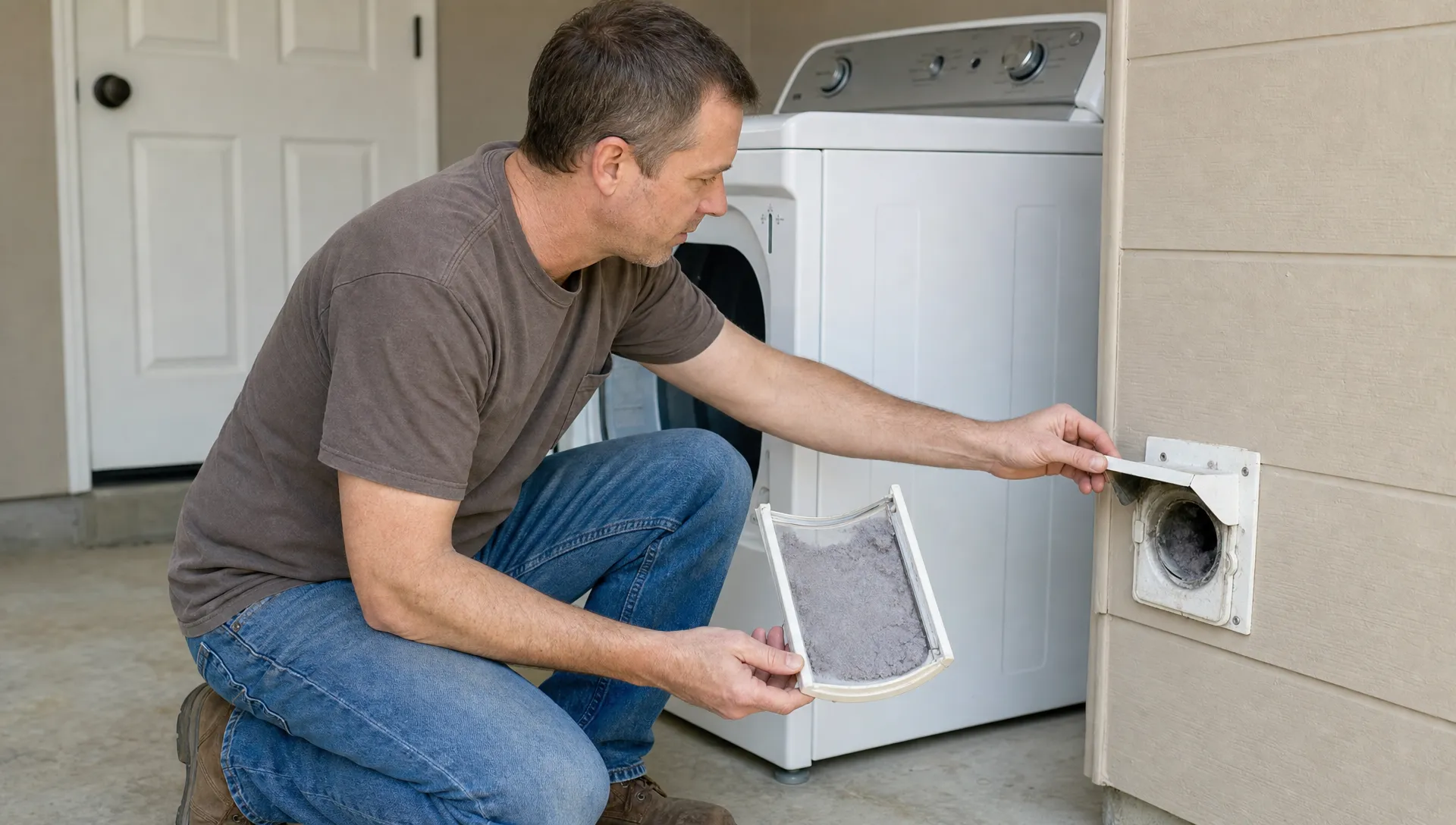
Pull out the lint screen and clean it fully. If you use dryer sheets, wash the screen occasionally with warm water and a soft brush, because residue can reduce airflow even when the screen looks clean.
How to do a no-tools airflow check
Start the dryer on a heated timed cycle, then go outside to the vent hood. You should feel a steady stream of warm, moist air once the burner cycles on. The exterior flap should open freely. If it barely moves, sticks shut or releases only weak air, the dryer may be heating but unable to exhaust properly.
Do not reach deep into a wall duct or roof vent. You can remove lint from the exterior opening if it is within safe reach, but avoid climbing onto roofs or disconnecting gas appliances just to access ductwork. If the flexible vent behind the dryer is visibly crushed and you can correct it without straining the gas line, straighten it gently. If moving the dryer pulls on the gas connector, stop.
For a broader no-heat and long dry time walkthrough, PHX Appliance Fix has a separate dryer repair guide for no heat and poor drying that covers airflow basics across dryer types.
Check the gas supply without opening the dryer
If the dryer has power, the settings are correct and airflow is not obviously blocked, check whether the gas shutoff valve is open. The shutoff is usually located behind the dryer or nearby on the gas supply line. In most installations, the valve handle is parallel with the pipe when open and perpendicular when closed.
Do not force the valve. If it is stuck, damaged, corroded or hard to reach without moving the dryer, leave it alone and book service. Also stop if the connector looks kinked, cracked or strained.
If other gas appliances in the home are not working, such as a stove or water heater, the issue may be with the gas supply rather than the dryer itself. In that case, contact the gas utility or a qualified gas professional instead of assuming the dryer failed.
After confirming the valve appears open, run one short test cycle. If the dryer still tumbles with no heat, avoid repeated tests. Internal ignition parts may be failing, and continuing to run the appliance will not fix them.
What a no-heat gas dryer may need from a technician
Once basic checks are complete, a gas dryer not heating often comes down to internal parts that require proper diagnosis. These components sit near heat, gas flow or electrical circuits, so they are not good candidates for guesswork.
| Possible issue | Common clue | Why a technician is safer |
|---|---|---|
| Failed igniter | Dryer tumbles but burner never lights | Requires access near burner assembly and electrical testing |
| Weak gas valve coils | Heat starts once, then stops after a few minutes | Symptoms can mimic vent or sensor problems |
| Blown thermal fuse | Dryer may run with no heat or stop entirely | Fuse failure often points to an airflow or overheating cause |
| Faulty flame sensor | Ignition sequence does not complete properly | Diagnosis requires safe testing of burner operation |
| High-limit thermostat issue | Heat cycles off too soon or not at all | Must be checked along with venting and temperature control |
| Control or timer fault | Settings respond oddly or heat command never starts | Live electrical diagnosis may be needed |
Replacing parts by symptom alone can waste money. For example, a thermal fuse may blow because the vent was restricted. If the fuse is replaced but the vent problem remains, the new part can fail again.
Checks you should not attempt on a gas dryer
Some dryer advice online skips over safety. Avoid any step that tells you to bypass a thermal fuse, tape a door switch closed, run the dryer with covers removed, test for gas leaks with a flame or keep cycling the dryer while watching exposed ignition parts.
You should also avoid opening the burner housing unless you are trained to service gas appliances. The sequence that lights a gas dryer involves multiple safety checks, and defeating any one of them can create fire or gas buildup risk.
A basic rule works well: if the check requires removing panels, disconnecting the gas line, probing live wires or altering a safety device, it is no longer a homeowner check. PHX Appliance Fix covers similar safety boundaries in its guide to DIY appliance repair mistakes homeowners should avoid.
When to book gas dryer repair in Phoenix
Book repair when the safe checks do not restore heat, the dryer overheats, airflow is weak after cleaning accessible lint or you notice any electrical or gas warning sign. Phoenix heat can make laundry rooms and garages warmer than usual, but outdoor temperature does not explain a dryer that tumbles cold for an entire heated cycle.
You should also schedule service if drying times have slowly stretched from 45 minutes to two hours. A gradual change often points to lint buildup, vent restriction or a part that is failing intermittently. Waiting until the dryer fully stops can make the appointment more urgent and may leave you with damp laundry in the middle of a busy week.
If you are comparing Phoenix appliance repair services, ask whether the company works on gas dryers, whether the diagnostic fee applies to the repair and whether the estimate will separate parts, labor and any vent cleaning recommendation. Clear questions make it easier to compare options without choosing only by the lowest starting price.
What to tell the repair company
A good service call starts with clear information. Before you book, write down the brand, model number, age if you know it and exactly what happens during a heated timed cycle. Mention whether the dryer tumbles, whether you hear ignition attempts, whether the vent airflow feels strong outside and whether the problem started suddenly or slowly.
Share any safety symptoms right away, including gas odor, breaker trips, hot plugs, burning smells or a carbon monoxide alarm. If the dryer is stacked, in a tight closet or installed in a garage, mention that too. Access can affect the time needed for diagnosis.
If you are still choosing a technician, use a practical vetting process. This PHX Appliance Fix article on how to vet a home appliance repair technician explains what to ask before, during and after a service call.
Frequently Asked Questions
Why is my gas dryer running but not heating? A gas dryer can tumble without heat if the cycle is set to air dry, the gas valve is closed, airflow is restricted or an internal part such as the igniter, gas valve coils, flame sensor, thermal fuse or control has failed. Start with safe external checks, then book repair if heat does not return.
Can I relight a pilot light on a gas dryer? Most modern gas dryers use electronic ignition rather than a standing pilot. Do not try to relight anything unless your owner’s manual specifically describes a safe pilot procedure for your model. If you smell gas, leave the home and call the gas utility or emergency services.
Can a clogged vent make a gas dryer stop heating? Yes. Poor airflow can cause overheating, long dry times and safety devices to shut down heat. Cleaning the lint screen and checking the exterior vent flap are safe first steps, but clogged in-wall or roof vents may need professional cleaning.
Is it safe to reset the breaker for a gas dryer? Resetting a clearly tripped breaker once is generally a reasonable check if there is no burning smell, hot plug or visible outlet damage. If the breaker trips again, stop using the dryer and call a qualified professional.
Should I keep running the dryer if it has no heat? No. One short test after safe checks is enough. Repeated cycles can waste energy, stress components and mask a safety problem. If the dryer still has no heat, schedule diagnosis.
Before you book, make the service call easier
A gas dryer no-heat problem is sometimes simple, but the line between “safe homeowner check” and “gas appliance repair” is important. Confirm the settings, power, airflow and gas shutoff position only if you can do so safely. If the dryer still will not heat, stop testing and book a qualified repair visit with the details you gathered.