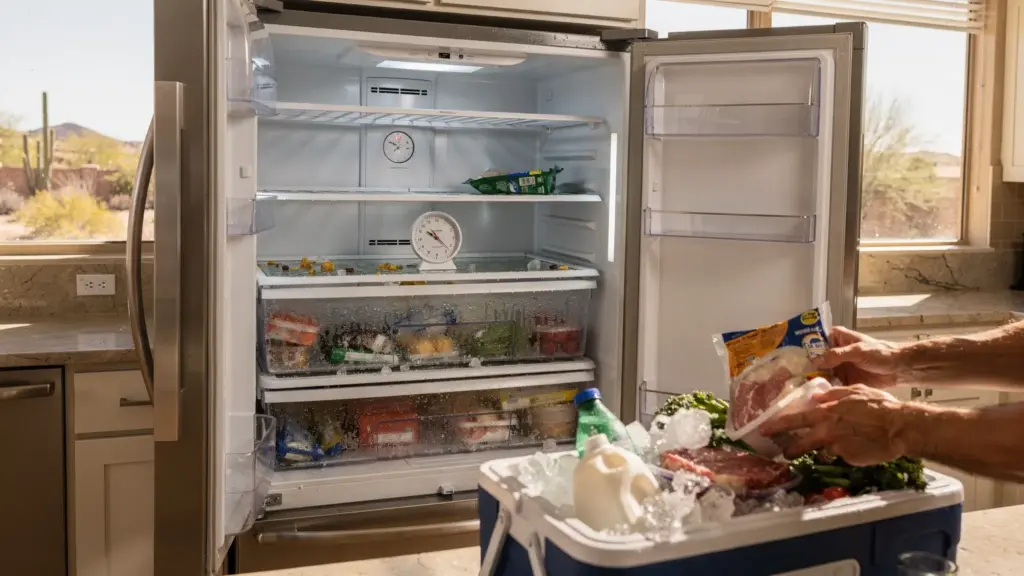
A fridge that is warm while the freezer stays cold is one of the most common (and stressful) refrigerator failures in Phoenix, especially in summer. It usually means your sealed cooling system is still making cold air, but that cold is not being delivered to the fresh food compartment.
The good news: many causes are airflow, frost buildup, or control issues that you can diagnose safely before you pay for service. The urgent part: food safety. The FDA recommends keeping refrigerators at 40°F (4°C) or below and freezers at 0°F (-18°C).
First, confirm the problem (and protect your food)
Before you start taking panels off, make sure you are troubleshooting the right issue.
Check temperatures with a real thermometer
Built-in displays can be wrong. Put an appliance thermometer in:
- The center shelf of the fridge compartment
- Between packages in the freezer (not against the wall)
Wait 30 to 60 minutes with doors closed.
| Compartment | Target temperature | “Problem” zone | What it usually suggests |
|---|---|---|---|
| Fridge | 34 to 40°F (1 to 4°C) | Above 41°F (5°C) | Cold air is not reaching the fridge or the fridge is losing cold |
| Freezer | Around 0°F (-18°C) | Above 10°F (-12°C) | Broader cooling issue (not just airflow to the fridge) |
Quick food-safety triage
If the fridge is above 41°F:
- Move perishable items (meat, dairy, leftovers) to a cooler with ice.
- Minimize door openings while troubleshooting.
- If you suspect food sat above safe temps for hours, consult the USDA Cold Food Storage chart and discard when in doubt.
Why this happens: one cooling system, two compartments
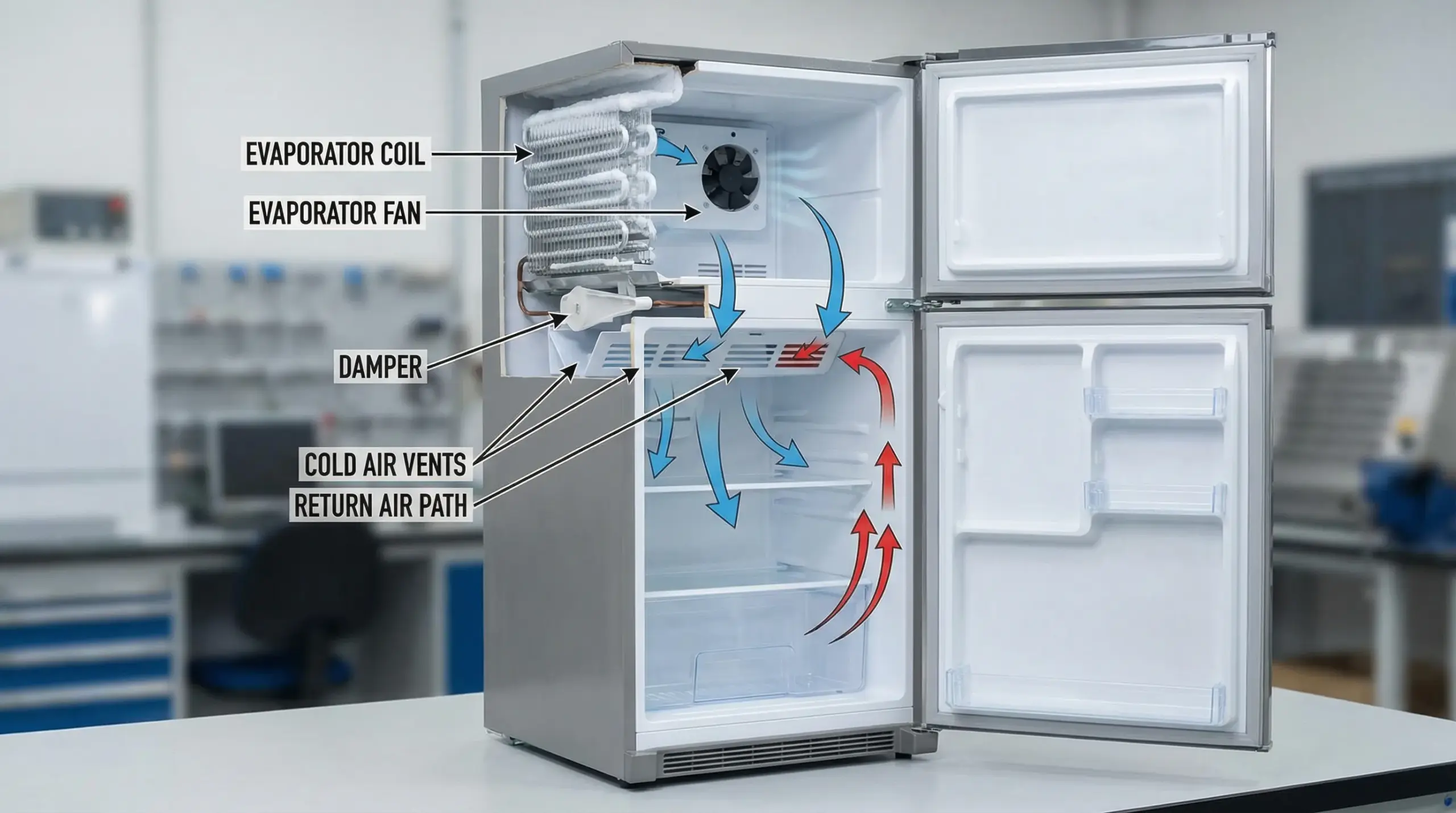
Most refrigerators create cold in the freezer first (at the evaporator coil), then a fan pushes some of that cold air into the fridge through vents and a damper.
So when the freezer stays cold but the fridge warms up, the most common root causes are:
- Air cannot move from freezer to fridge (blocked vent, stuck damper, failed fan)
- Frost/ice is choking airflow (defrost problem)
- The fridge is leaking cold (door gasket, frequent openings, poor placement)
Warm fridge, cold freezer: symptom-to-cause cheat sheet
Use this to pick the most likely checks first.
| What you notice | Most likely cause | Best DIY check |
|---|---|---|
| Fridge is warm, freezer is very cold, little airflow at fridge vent | Evaporator fan not running or airflow blocked | Listen for fan, check vents for blockage |
| Freezer back wall has thick frost/ice | Defrost system problem | Look for frost blanket, do a controlled manual defrost |
| Fridge warms more when it is packed full | Blocked return vent or overpacking | Reorganize, keep vents clear |
| Frost or moisture around fridge doors, frequent cycling | Door gasket leak | Dollar-bill test, inspect gasket |
| Works for a day after unplugging, then warms again | Ice buildup returning | Defrost system or airflow issue |
| Fridge warm even with strong airflow from vent | Damper stuck closed or sensor/control issue | Check damper movement (if accessible), verify settings |
Step-by-step troubleshooting (start with the easiest wins)
1) Check settings, modes, and basics
It sounds obvious, but it is common.
- Make sure the unit is not in “Demo” or “Showroom” mode (some brands run lights but disable cooling).
- Confirm the freezer is set around 0°F and the fridge around 37°F.
- If your model has “Vacation” mode, turn it off.
Also check the simple airflow killers:
- Food packages pressed against the fridge vent
- A pizza box or bag of frozen food blocking the freezer air outlet
- Overstuffing that prevents air circulation
In Phoenix, garage fridges are especially vulnerable. If the refrigerator is in a garage that regularly runs above 95°F, the fridge side can struggle even if the freezer feels “fine,” because the system is fighting heat gain nonstop.
2) Clean condenser coils and improve ventilation
Dirty coils make the whole system less efficient, and Phoenix dust can clog coils fast.
Safe approach:
- Unplug the fridge.
- Locate coils (often behind the toe-kick grille or on the back).
- Use a coil brush and vacuum to remove dust.
- Ensure there is airflow space around the fridge (check your manual for exact clearance).
If cleaning coils improves performance but the fridge side still runs warm, move to airflow and defrost checks.
3) Test for a door gasket leak (fridge side)
If the gasket is not sealing, your fridge compartment will warm up first.
Dollar-bill test: Close a dollar bill (or thin paper) in the door and gently pull.
- Strong resistance: seal is likely okay in that spot.
- Easy slide out: that section may be leaking.
Also inspect for:
- Torn gasket
- Hardened, flattened sections
- Sticky residue that prevents sealing (clean with mild soap and water, dry fully)
If you find a clear gasket failure, replacement is often straightforward, but model-specific. If you prefer a pro to handle it, consider scheduling refrigerator service during cooler morning hours to reduce food exposure.
4) Check for airflow from the fridge vent
With the unit running and doors closed for a few minutes, open the fridge door and feel at the vent (usually top rear).
- No airflow or very weak airflow: suspect evaporator fan, blocked ducts, or a stuck damper.
- Good airflow but still warm: suspect damper not directing enough cold, temperature sensor issue, or heavy heat gain (door leak, placement).
5) Listen for the evaporator fan (the freezer fan)
On most designs, the evaporator fan is in the freezer compartment, often behind the rear panel.
Signs the fan may not be working:
- Freezer is cold but “still” (no air movement)
- Fridge warms quickly
- You do not hear a soft fan sound when the compressor is running
Important: Many fridges stop the fan when you open the freezer door. Press the door switch (if accessible) and listen carefully. If you suspect a failed fan motor, that is typically a repair job, since it may require panel removal and electrical testing.
6) Look for a defrost problem (ice blanket on the freezer back wall)
A classic warm-fridge/cold-freezer scenario is a frozen evaporator coil. The freezer can stay cold, but airflow to the fridge gets choked by ice.
What to look for:
- Thick frost on the freezer’s back inside wall
- Freezer vents blocked with snow-like ice
- Problem temporarily improves after you unplug the fridge
What you can do safely:
- Do a controlled manual defrost: unplug the unit, open freezer and fridge doors, place towels to catch water.
- Let it defrost long enough to melt hidden ice (often 12 to 24 hours).
Avoid using sharp tools to chip ice. You can puncture a coil and turn a fixable problem into a replacement.
If the fridge works normally for a short time after manual defrost, the underlying issue is usually in the defrost system (heater, defrost thermostat, sensor, or control board). Diagnosing those parts often requires a multimeter and model-specific access.
7) Check the damper (if your model has an accessible one)
The damper is the “door” that regulates how much freezer air enters the fridge.
Common damper failures:
- Stuck closed (fridge warms, freezer stays strong)
- Broken foam door or motor
- Ice blocking the damper channel
Some dampers are visible inside the fridge near the vent cover. If you see heavy frost around it, the fix may be defrosting and addressing root causes like a door leak or defrost issue.
8) Consider control or sensor problems
If airflow seems normal and there is no heavy frost, the issue can be a thermistor (temperature sensor) or control board logic problem.
Clues:
- Temperature swings that do not match the setting
- Fridge runs too warm while freezer holds steady
- Odd cycling behavior (short runs, long pauses) without obvious frost
At this point, a professional diagnosis is usually faster than guessing and swapping parts.
When to stop DIY and call a Phoenix refrigerator technician
Some symptoms suggest an urgent or technical repair, especially in Phoenix heat where food spoils quickly.
Call for service if:
- You smell burning, see melting wiring, or hear repeated clicking (unplug the fridge)
- The evaporator fan is not running and you cannot confirm a simple obstruction
- You have recurring heavy frost after a full manual defrost
- The fridge is in a hot garage and cannot maintain safe temps even after cleaning coils and confirming seals
- You see water leaking from unusual areas after icing events (can indicate clogged drains plus ice buildup)
If you need emergency appliance repair in Phoenix or same day refrigerator repair in Phoenix, it helps to provide these details when you schedule:
- Brand and model number (usually inside the fridge compartment)
- Current fridge and freezer thermometer readings
- Whether the freezer back wall has frost
- Whether you hear the evaporator fan
- Whether a 12 to 24 hour defrost temporarily restores cooling
What this repair might cost in Phoenix
Warm-fridge/cold-freezer issues range from simple maintenance (coil cleaning, airflow reorganization) to part replacements (fan motor, defrost components, damper, controls).
For a realistic breakdown of what homeowners pay locally, see our guide on refrigerator repair cost in Phoenix. If you are deciding between fixing and replacing, especially during peak summer demand, this related article also helps: Is it worth repairing a refrigerator in Phoenix’s heat?.
Prevent it from happening again (especially in Phoenix)
Once you restore normal temps, a few habits can reduce repeat failures.
- Clean condenser coils at least twice a year (more often if you have pets or live in a dusty area).
- Keep vents clear inside both compartments, leave visible space around vent covers.
- Do not overload the freezer so tightly that air cannot circulate.
- Keep the fridge out of direct sunlight and away from heat sources. For garage units, consider relocating during extreme heat if temps cannot stay safe.
- Wipe door gaskets regularly and check for gaps after moving the fridge or storing heavy items in the door.
Bottom line
A warm fridge with a cold freezer is usually an airflow or defrost-related failure, not an immediate sign that the whole refrigerator is “dead.” Start by confirming temperatures, clearing vents, cleaning coils, and checking gaskets. If you see heavy frost on the freezer back panel or the fan is not running, you are likely in repair territory and getting help quickly matters in Phoenix.
If you want to compare expected repair scenarios before booking service, our Phoenix refrigerator repair cost guide is the fastest next step.