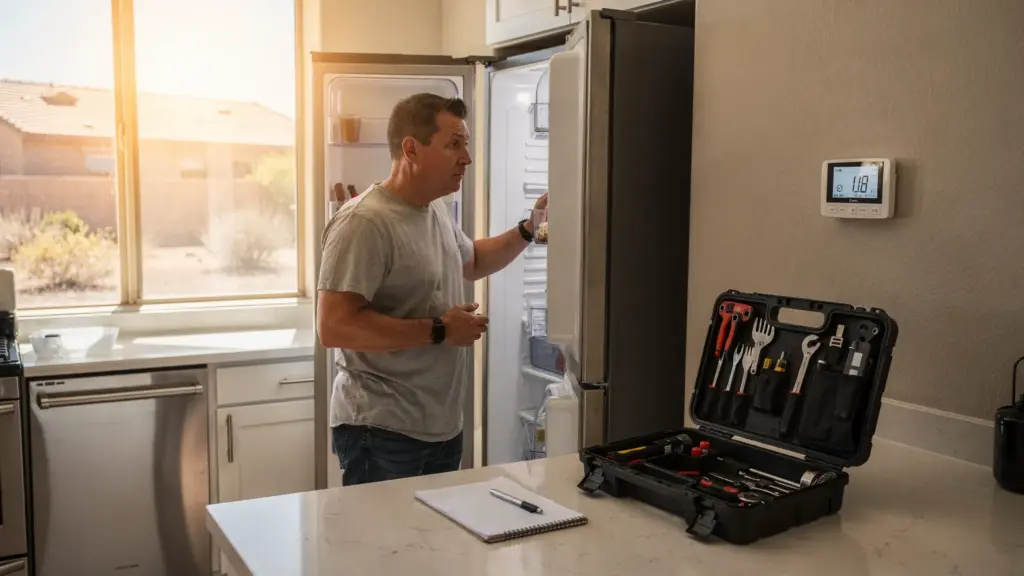
When an appliance fails, the decision is rarely just “fix it or trash it.” In Phoenix, extreme heat, high summer electric bills, and the risk of food spoilage can turn a normal breakdown into a same-day problem. The good news is that most repair vs replace decisions become much clearer when you look at a few practical factors: age, total repair cost, efficiency, safety, and how quickly you can get dependable service.
Below is a homeowner-friendly framework you can use for refrigerators, ovens, washers, dryers, dishwashers, and more, plus Phoenix-specific considerations that can tip the scales.
Start with urgency and safety (before you compare costs)
Some failures are annoying but safe (a noisy dryer roller). Others can be hazardous or time-sensitive.
Treat these as “stop and assess now” situations:
- Refrigerator not cooling in summer, especially if temperatures in the kitchen or garage are high. Food safety can become a concern quickly.
- Gas odor, sparking, or tripped breakers related to an oven/range or dryer. Shut off gas/electric if safe and contact a qualified technician.
- Water leaking that could damage flooring, cabinets, or cause mold, common with washers, dishwashers, and some refrigerator water lines.
If you are in a true time crunch (for example, a warm fridge during a heat wave), prioritize emergency appliance repair Phoenix availability and transparent pricing over squeezing out a small savings. Waiting a few days can cost more in spoiled groceries than the repair itself.
Step 1: Check the appliance’s “expected life” first
Age is one of the fastest ways to narrow your decision. If an appliance is near the end of its typical lifespan, it can still be repaired, but you should expect more failures soon.
A commonly referenced source is the NAHB’s Study of Life Expectancy of Home Components (useful as a planning baseline, not a guarantee). See the NAHB life expectancy resource.
| Appliance | Typical lifespan (planning baseline) | Repair vs replace rule of thumb |
|---|---|---|
| Refrigerator | ~13 years | Repair more often makes sense under midlife, replace more often makes sense when older plus major sealed-system issues |
| Range/oven | ~13 to 15 years | Repair is often worthwhile unless there are repeated control failures or major safety concerns |
| Dishwasher | ~9 years | Replace more often if leaks, rust, or repeated pump/control problems near end of life |
| Clothes washer | ~10 years | Repair midlife for pumps, belts, valves, replace more often for transmission or major tub issues on older units |
| Clothes dryer | ~13 years | Repair is often cost-effective unless the drum or motor is failing on an older unit |
Phoenix note: appliances located in hot garages, dusty utility rooms, or tight unventilated closets may age faster due to heat stress and airflow restrictions.
Step 2: Compare repair cost to replacement cost, using a simple threshold
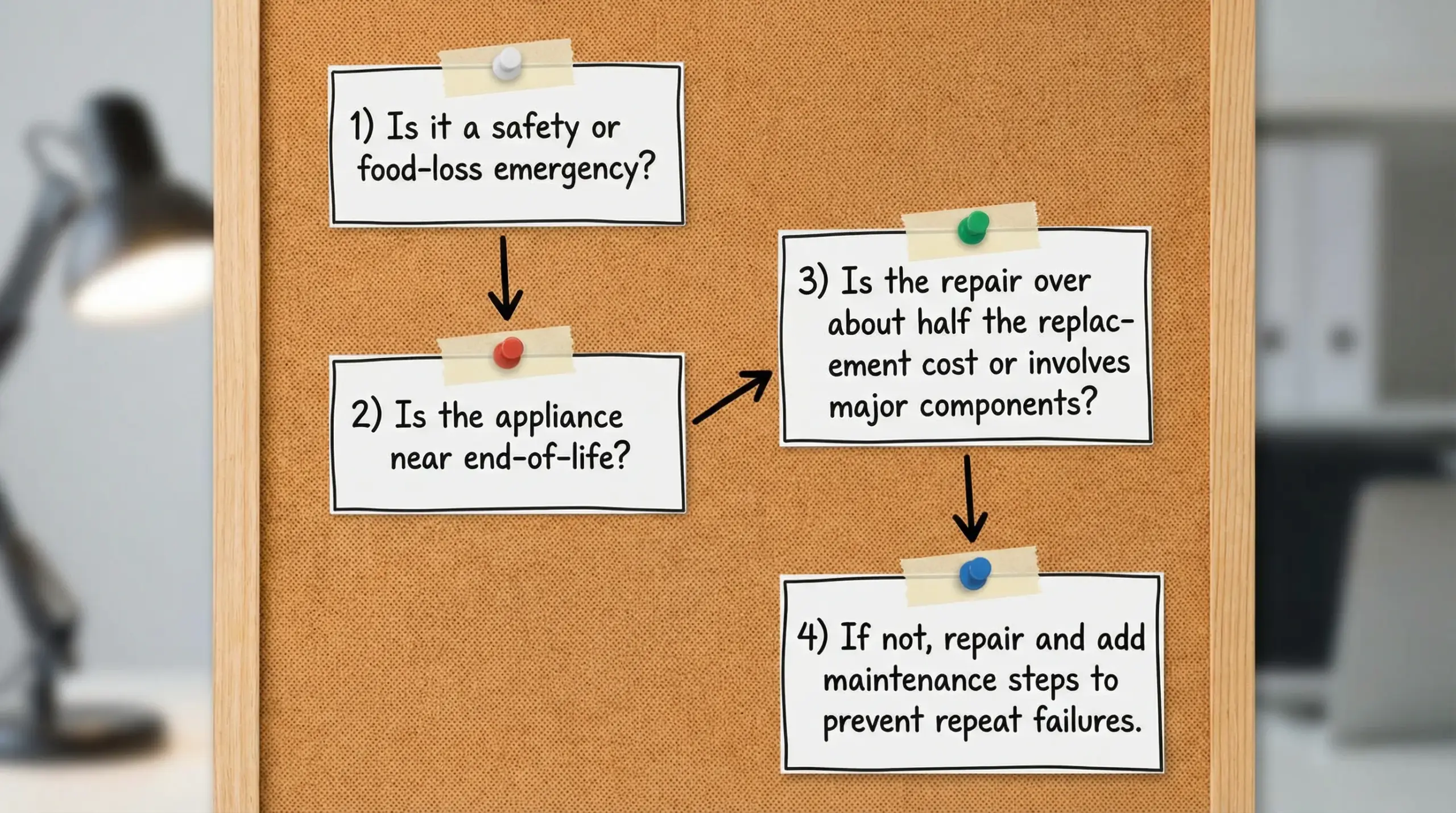
A popular guideline is the “50% rule”: if the repair is 50% or more of the cost of a comparable replacement, replacement starts to look smarter. That rule is not perfect, but it is a useful starting point.
A more realistic way to use it is to look at total cost and expected remaining life.
| If this is true… | Repair is usually the better bet | Replacement is usually the better bet |
|---|---|---|
| Appliance is under about half its expected lifespan | Yes, especially for mechanical parts (fans, pumps, igniters) | Only if repair is unusually expensive or parts are unavailable |
| Appliance is near end-of-life and needs a major component | Sometimes, if you need a short bridge (for example, 6 months) | Yes, especially if the repair is a compressor, control board, transmission, or multiple parts |
| You have had 2+ significant repairs in the last 12 to 18 months | Often no, reliability is declining | Often yes, replacement can lower downtime and surprise costs |
| Energy use is clearly high (old fridge, older electric dryer) | Depends, repair may not fix inefficiency | Often yes, newer models can cut ongoing operating costs |
If you want local context on what repairs typically run in the Valley, use your estimate to sanity-check against Phoenix-specific guidance, for example this resource on refrigerator repair cost Phoenix.
Step 3: Factor in energy efficiency, especially for refrigerators
For some appliances, efficiency gains are modest. For others, they can be meaningful.
- Refrigerators run 24/7, so older, inefficient units can quietly drive up your bill. If your fridge is old and struggling in Phoenix heat, replacement may lower monthly costs and reduce the risk of another summer failure.
- Electric dryers can also be costly if airflow is restricted (crushed vent, clogged duct), but many “inefficiency” complaints are really ventilation problems you can fix.
For general guidance on comparing efficient models, the ENERGY STAR product finder is a reliable starting point.
Phoenix note: A refrigerator that works “fine” in spring can fail in July if coils are dirty, ventilation is poor, or the unit is in a garage that regularly exceeds recommended ambient temperatures.
Step 4: Consider repairability, parts availability, and turnaround time
Two appliances with the same symptom can have very different outcomes depending on parts and service logistics.
Repair tends to be faster and simpler when:
- The problem is a common wear component (door gasket/seal, igniter, thermal fuse, drain pump).
- Parts are widely available and the model is not discontinued.
- The unit is easy to access (not tightly built-in with limited clearance).
Replacement tends to win when:
- The model has known parts shortages, or the control board is on long backorder.
- Multiple components are failing, or there is evidence of extensive corrosion, wire damage, or sealed-system issues.
If your fridge is warming and you need a quick fix, prioritize providers that clearly advertise same day refrigerator repair Phoenix availability, and confirm whether they stock common parts for your brand.
Step 5: Watch for “replace” red flags by appliance type
These are not absolute rules, but they are common scenarios where replacement becomes the more rational choice.
Refrigerator: sealed-system and compressor economics
Refrigerators are often worth repairing for fans, thermostats, defrost components, and some electrical issues. The decision gets harder when the problem involves the sealed system.
Replacement becomes more likely when:
- The unit is older and needs a compressor or major sealed-system work.
- Cooling is weak in high heat even after basic maintenance (coil cleaning, airflow checks), and the diagnosis points to sealed-system performance.
Phoenix-specific tip: if the refrigerator is in a garage, confirm the unit is designed for that environment. Many standard refrigerators are not meant for extreme ambient temperatures, which can make “repairs” feel temporary.
Oven/range: safety, control boards, and heat leakage
Many oven problems are straightforward: igniters, elements, sensors, and switches are common repairs.
Replacement becomes more likely when:
- There are recurring electronic control failures on an older unit.
- The oven has safety concerns (repeated breaker trips, scorching smells that persist, damaged wiring).
- The cabinet is heavily damaged or rusted.
If the issue is heat leaking and long preheat times, a repair can be simple. For example, a failing door gasket is often fixable, and you can reference this Phoenix-focused guide on oven door seal repair for what the process generally involves.
If you are troubleshooting broader oven issues and want to understand what’s typically repairable, see this overview on oven repair Phoenix.
Washer: leaks, bearings, and “stacked” failures
Washers are often repairable for pumps, valves, lid locks, and hose-related leaks.
Replacement becomes more likely when:
- The tub bearings are failing (loud roaring on spin), especially on older units.
- The drum/spider arm is damaged (common on some front-load designs).
- The unit has repeated control and mechanical problems close together.
Even when the fix is simple, uncontrolled leaks can damage floors quickly, so don’t delay diagnosis.
Phoenix-specific decision factors that homeowners overlook
1) Heat amplifies small problems
In extreme heat, marginal components fail faster. A condenser fan that is “kind of noisy” in April can become a no-cool emergency in July.
2) Dust and airflow matter more than you think
Dusty coils, blocked toe-kicks, and tight built-in clearances reduce cooling efficiency and strain motors. That impacts repair vs replace because poor airflow can make a repaired unit fail again.
3) Service demand spikes in summer
During peak heat, schedules fill up. If you need Phoenix appliance repair services, ask about:
- Earliest appointment window
- Whether diagnostic fees apply and whether they roll into the repair
- Part availability for your appliance brand
4) Water quality can increase wear
Hard water can contribute to valve issues, mineral buildup, and reduced performance in appliances that use water (washers, dishwashers, ice makers). A repair may solve today’s symptom, but prevention (filters, periodic cleaning) protects the investment.
Repair vs replace: a quick decision tree you can keep
If you replace: what “home appliance sales and service” should include
If you are buying a new appliance, service considerations should be part of the purchase, not an afterthought. A good sales-and-service experience typically includes:
- Clear warranty terms (manufacturer warranty and any retailer plan), in writing
- Installation quality, including correct venting for dryers and proper water line connections for refrigerators
- Haul-away and responsible disposal
- Access to parts and service in your area
On disposal, keep in mind that many refrigerators and freezers contain refrigerants and foam blowing agents that should be handled properly. The EPA provides guidance through its Responsible Appliance Disposal (RAD) program.
If you repair: how to get a quote you can trust
Whether you are dealing with a routine fix or emergency appliance repair Phoenix, these steps help you avoid surprises:
- Ask for an itemized estimate (labor, parts, service call, and any trip fees).
- Confirm whether the technician offers a warranty on labor and parts (and how long).
- Ask whether the part is OEM, aftermarket, or rebuilt, and what that means for reliability.
- For time-sensitive problems (refrigerators), ask what “same day” really means, same-day diagnosis only or same-day repair when parts are needed.
If you are comparing providers, prioritize consistency and transparency over the lowest initial quote. The cheapest diagnostic fee can become expensive if it leads to repeat visits or misdiagnosis.
The bottom line for Phoenix homeowners
- Repair tends to win when the appliance is midlife, the issue is a common component, and the cost is well below replacement.
- Replace tends to win when the appliance is near end-of-life, the repair involves a major core component, parts are delayed, or you are experiencing repeated breakdowns.
- In Phoenix, speed and reliability matter more during summer, especially for refrigeration.
If you want local, appliance-specific guidance before you decide, browse the Phoenix-focused cost and troubleshooting resources on appliancerepairpros.net, including refrigerator cost benchmarks and practical oven repair tips.