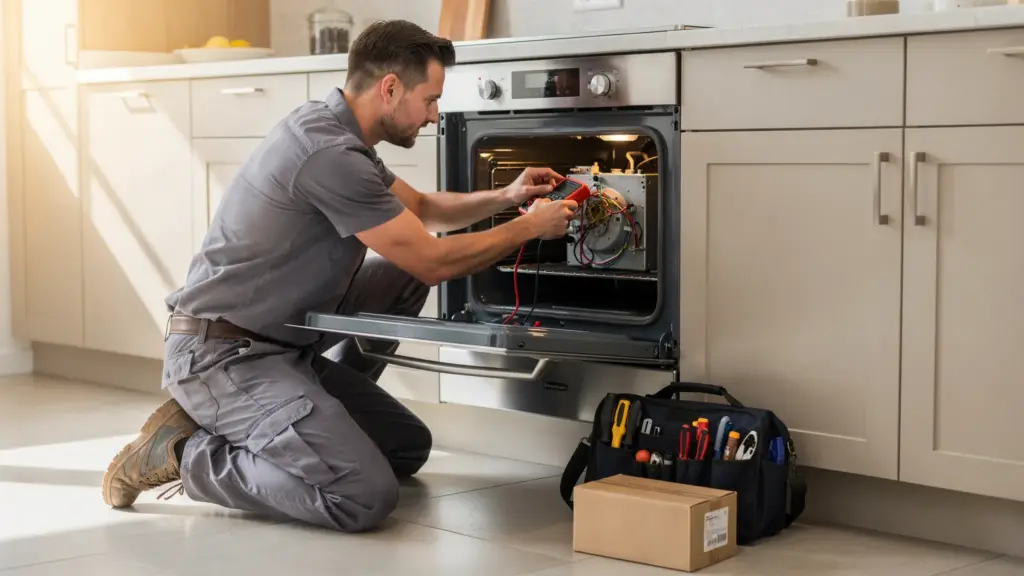
Oven problems always seem to show up at the worst time, right before guests arrive, when you are meal-prepping for the week, or during a Phoenix heat wave when cooking indoors is already a challenge. The good news is that many oven issues are repairable, and the bill is often far less than replacing a full range or wall oven.
This guide breaks down oven repair cost the way homeowners actually experience it: by the problem you are seeing, the parts most commonly involved, and the pricing factors that move your estimate up or down.
The 3-part formula behind most oven repair bills
Most oven repair pricing, in Phoenix and elsewhere, comes down to three line items:
- Service call or diagnostic fee: A trip fee that covers the technician coming out, testing components, and identifying the failure. Many companies apply this fee toward the repair if you approve the work.
- Labor: Time to disassemble, access the failed component, replace it, reassemble, and test.
- Parts: The component itself (and sometimes small extras like terminals, high-temp connectors, or mounting hardware).
If you are comparing quotes, make sure you are comparing the same structure. A “cheap” quote can be missing the diagnostic fee, warranty, or the cost of a required part.
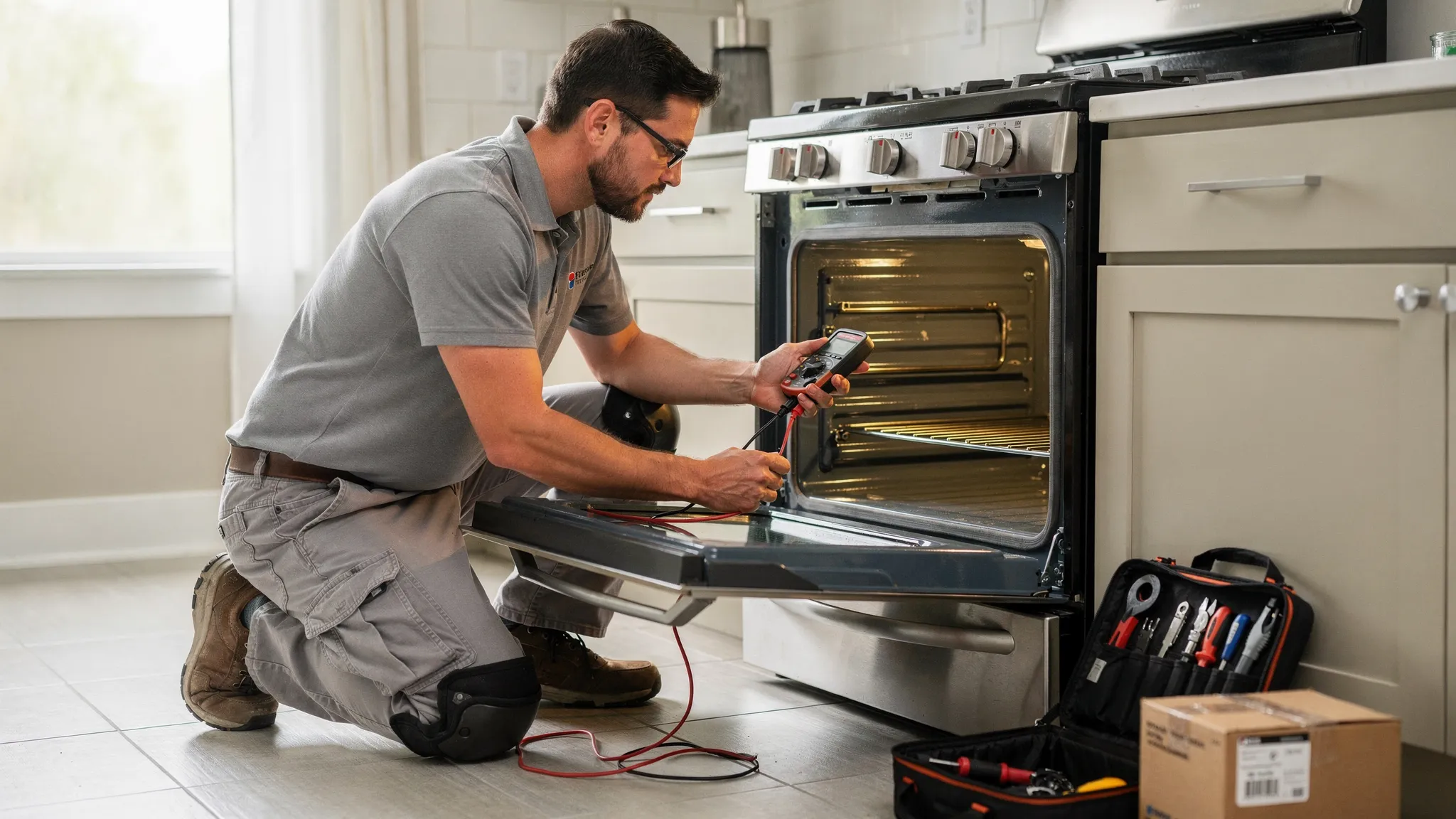
Oven repair cost by problem (real-world price ranges)
The table below covers common oven symptoms, the most likely fixes, and typical total price ranges you may see on an invoice. Prices vary by brand, access (slide-in vs built-in wall oven), and whether the repair requires multiple parts.
Important: These are typical “all-in” estimates (diagnosis, labor, parts) for standard daytime service. After-hours or emergency calls can cost more.
| What you notice | Common cause | What the repair usually involves | Typical total cost range (USD) |
|---|---|---|---|
| Oven not heating at all (electric) | Burned-out bake element, blown thermal fuse, failed relay on control | Testing continuity, replacing element or fuse, verifying control output | $150 to $400 |
| Oven heats, but takes forever or won’t reach temp | Weak bake element, temperature sensor drift, calibration issue | Element replacement or sensor replacement, calibration check | $180 to $450 |
| Gas oven won’t heat (no flame) | Weak/hot-surface igniter, gas safety valve issue, clogged burner | Testing igniter draw, replacing igniter, verifying burner ignition | $200 to $500 |
| Gas oven clicks but doesn’t light consistently | Ignition system, dirty burner ports, airflow issues | Cleaning and adjustment, sometimes igniter replacement | $150 to $400 |
| Broiler not working (electric or gas) | Broil element/igniter failure, control issue | Component testing and replacement | $150 to $450 |
| Temperature swings, uneven baking, hot spots | Sensor, convection fan problem, door seal leak, control calibration | Sensor or fan replacement, seal inspection, calibration | $180 to $600 |
| Convection fan not spinning (but oven heats) | Fan motor seized, fan blade obstruction, wiring issue | Accessing rear panel, replacing motor or clearing obstruction | $250 to $650 |
| Display is dead, buttons unresponsive, random beeping | Control board, touch panel, ribbon cable issue, power supply problems | Diagnosis, board or keypad replacement, wiring inspection | $250 to $800 |
| Oven door won’t close, heat escapes around door | Worn door gasket (seal), loose hinges, warped door | Replacing gasket and/or hinges, door alignment | $150 to $450 |
| Oven trips breaker or blows fuse | Shorted element, pinched wiring, moisture damage, control failure | Isolation testing, replacing shorted part, repairing wiring | $200 to $700 |
| Burning smell (beyond normal “self-clean” odor) | Food residue, melted plastic, overheated wiring, failing insulation | Cleaning guidance, inspection, replacing overheated components | $120 to $500 |
If the symptom is heat leaking around the door, a damaged gasket is one of the most cost-effective fixes. If you want a step-by-step overview of that specific job (and what to look for first), see: How to Repair an Oven Door Seal in Phoenix – Stop Heat Leaks Fast.
Why the same “problem” can price out differently
Two homeowners can both be told, “You need an igniter,” and still see very different totals. Here are the most common reasons.
1) Built-in wall ovens often cost more to service
Wall ovens can require extra time to pull the unit safely, protect cabinetry, and access components. That extra labor is a real cost driver compared with a freestanding range.
2) Brand and parts availability matter
Some manufacturers price parts higher, and some models have longer lead times. If your technician has to return for a second trip once a part arrives, you might see:
- A second labor charge (sometimes reduced)
- An additional trip fee (sometimes waived)
Always ask how follow-up visits are handled before approving parts.
3) Control and display issues can mean multiple components
A dead display is not always “just the board.” It could be the user interface, a harness, a thermal event, or a power supply issue. Diagnosis time goes up, and costs can rise if multiple components are required.
4) Safety-related repairs often involve more testing
Gas ignition issues, breaker-tripping faults, and overheating wiring problems require careful verification. A reputable technician will test thoroughly rather than “parts swapping,” which can add labor but reduces the risk of repeat failures.
Quick checks that can save you a service call (and when not to DIY)
A few simple observations can help you avoid paying for a visit that ends in “no problem found.”
Safe, homeowner-friendly checks
- Confirm the clock/display has power: If the display is off, check the breaker. Many ovens are on a dedicated circuit.
- For gas ovens, confirm the cooktop burners light: If the cooktop also fails to light, you may have a gas supply issue.
- Look for obvious door alignment issues: If the door is visibly sagging, hinges may be the real problem, not temperature calibration.
- Cancel self-clean and let the oven cool: Some ovens lock out heating after a thermal event until they cool completely.
Avoid these DIY moves unless you are qualified
- Disassembling panels to test live voltage
- Attempting gas valve adjustments
- Bypassing thermal fuses or safety devices
If you are dealing with gas smell, sparking, breaker trips, or smoke, stop using the oven and call a professional.
Common oven repairs explained (what you are really paying for)
Understanding what’s involved helps you judge whether a quote is reasonable.
Heating element replacement (electric bake or broil)
This is one of the most straightforward repairs when access is good. Cost typically includes testing the element, installing the new part, and verifying current draw and heating performance.
What can push the price up:
- A seized mounting screw or damaged terminal
- Heat-damaged wiring that must be repaired safely
Igniter replacement (gas oven)
A weak igniter is a classic cause of “it clicks but won’t light,” or “it lights sometimes.” The technician should verify the failure with proper testing (not guesswork), then replace the igniter and confirm flame characteristics.
What can push the price up:
- Hard-to-access igniter locations
- Additional burner cleaning required due to soot or debris
Sensor, thermostat, and calibration issues
If your oven is consistently off by a noticeable margin, it may be a sensor drift or control calibration issue. Calibration adjustments can be relatively minor. Sensor replacement is usually moderate.
What can push the price up:
- Intermittent faults that require longer diagnostic time
- Control board issues that mimic sensor problems
Control board or touch panel replacement
Control repairs can be expensive because parts cost more and diagnosis must be precise. A good technician will:
- Confirm proper incoming power
- Check harnesses and connectors
- Look for heat damage
- Verify whether the failure is the display, the control board, or both
This is also where warranty matters most, because electronic parts can fail again if the underlying cause (overheating, moisture, loose connections) is not corrected.
Pricing factors that affect your estimate (especially in Phoenix)
Phoenix homeowners often ask why appliance pricing seems to swing so much between companies. Use this table as a checklist when comparing quotes.
| Cost factor | Why it changes the price | What to ask the repair company |
|---|---|---|
| Diagnostic fee | Covers travel and problem identification | “Is the diagnostic fee applied to the repair if I proceed?” |
| Same-day or after-hours | Dispatch priority and extended hours | “Is there an emergency or after-hours surcharge?” |
| Appliance type | Wall ovens and slide-ins can take longer | “Is this price different for a wall oven vs freestanding range?” |
| Part availability | Rush ordering or second trips can add cost | “If the part is ordered, do I pay another trip fee?” |
| Complexity of access | Tight cabinetry and stacked units increase labor | “Do you need to pull the oven out of the cabinet?” |
| Multiple failures | Heat damage can take out more than one part | “If the first part doesn’t solve it, how is additional diagnosis handled?” |
| Warranty | Longer warranties can cost more upfront | “What warranty do you provide on parts and labor?” |
Repair vs replace: a practical decision framework
There is no universal rule, but these guidelines work well for most households.
Repair is usually the better move when
- The oven is under about 8 to 10 years old and otherwise reliable.
- The repair is a single, common component (element, igniter, sensor, gasket).
- The total repair cost is well below half the cost of replacement.
Replacement may make more sense when
- The unit has had repeated electronic failures.
- The estimate involves a costly control board and you are also seeing other wear (door hinge sag, noisy fan, multiple burner issues).
- Your model is known for expensive or hard-to-source parts.
If you are already in decision mode, this companion article can help you think through repair economics in a Phoenix context: Can Ovens Be Repaired? Phoenix Technicians Explain Common Fixes.
How to get a tighter oven repair quote (before anyone arrives)
You can often reduce back-and-forth, and sometimes even shorten diagnostic time, by giving the right details on the first call.
Have this ready:
- Brand and model number (a photo of the rating plate helps)
- Fuel type (gas or electric)
- Appliance type (wall oven, slide-in range, freestanding)
- Exact symptom (for example, “bake doesn’t heat but broil works,” not just “it’s broken”)
- Any error codes on the display
- Whether the issue started after self-clean, a power outage, or a breaker trip
Ask these pricing questions:
- “What is your diagnostic fee, and is it credited toward the repair?”
- “Do you give a price range by likely problem?”
- “What warranty do you provide on parts and labor?”
- “If a part must be ordered, what does the follow-up visit cost?”
Choosing an oven repair company: what “good” looks like
A fair price is important, but so is competence. For ovens, especially gas models and electrical breaker-tripping issues, workmanship and correct diagnosis matter.
Look for:
- Clear, written estimates that separate diagnostic, labor, and parts
- Technicians who test and explain, not just guess
- Practical safety guidance (for gas odor, overheating, breaker trips)
- Reasonable warranty terms on labor and parts
If you are comparing broader appliance work across the house, you may also find it useful to benchmark other big-ticket repairs. For example, here is how local pricing often breaks down for cooling failures: Refrigerator Repair Cost in Phoenix – Real Prices from Local Experts.
Bottom line: what most homeowners should budget
If you want a simple budgeting takeaway, most oven repairs land in the low to mid hundreds when the fix is a common component like an element, igniter, sensor, or gasket. Costs climb when the job involves:
- A control board or touch interface
- Convection fan motors with difficult access
- Electrical shorts that require deeper troubleshooting
- Built-in wall ovens that must be pulled from cabinetry
If you share your oven’s model number and the exact symptom, a reputable local shop can usually narrow your likely cost range quickly and tell you whether same-day service is realistic for that specific part and brand.