If your oven temperature is 50 degrees off, dinner can go from underbaked to scorched even when you set the dial correctly. The good news is that you can test the problem at home with an inexpensive oven thermometer, a little patience and the right method. The key is not to trust one quick reading right after preheat, because ovens cycle above and below the set temperature by design.
A 50 degree difference is large enough to affect baking, roasting, casseroles and frozen foods. It can also point to a simple calibration issue, a worn door gasket, a weak igniter, a failing temperature sensor or a control board problem. This guide walks you through a reliable test before you decide whether to adjust the oven, replace a part or call a technician.
Before You Test, Know What Normal Oven Cycling Looks Like
Most ovens do not sit exactly at 350°F every second. They heat above the target temperature, shut the heating source off, cool below the target and heat again. That cycle is normal.
What matters is the average temperature over time. For example, an oven set to 350°F might swing between 325°F and 375°F and still perform reasonably well. If it averages closer to 300°F or 400°F after a proper test, that is when you can say the oven is truly off by about 50 degrees.
This distinction matters because the preheat beep is often not the full story. Some ovens beep when the air near the sensor reaches temperature, but the walls, racks and cookware still need more time to stabilize. For baking, that extra stabilization can make a real difference.
Tools You Need to Test When Your Oven Temperature Is 50 Degrees Off
You do not need specialized repair equipment for the first test. Start with basic tools that measure oven performance without opening panels or touching electrical parts.
Use these items:
- A freestanding oven thermometer rated for high heat
- A timer or phone alarm
- Paper and pen for recording readings
- An empty oven rack placed in the center position
- The owner's manual if you plan to check calibration settings
Choose an analog or digital thermometer designed for oven use, not an instant read meat thermometer. A meat thermometer is useful for food safety, but it is not the right tool for tracking air temperature inside the oven over 30 to 60 minutes. The USDA's food thermometer guidance is still worth following when cooking meat, poultry or casseroles, since the internal food temperature is what confirms doneness.
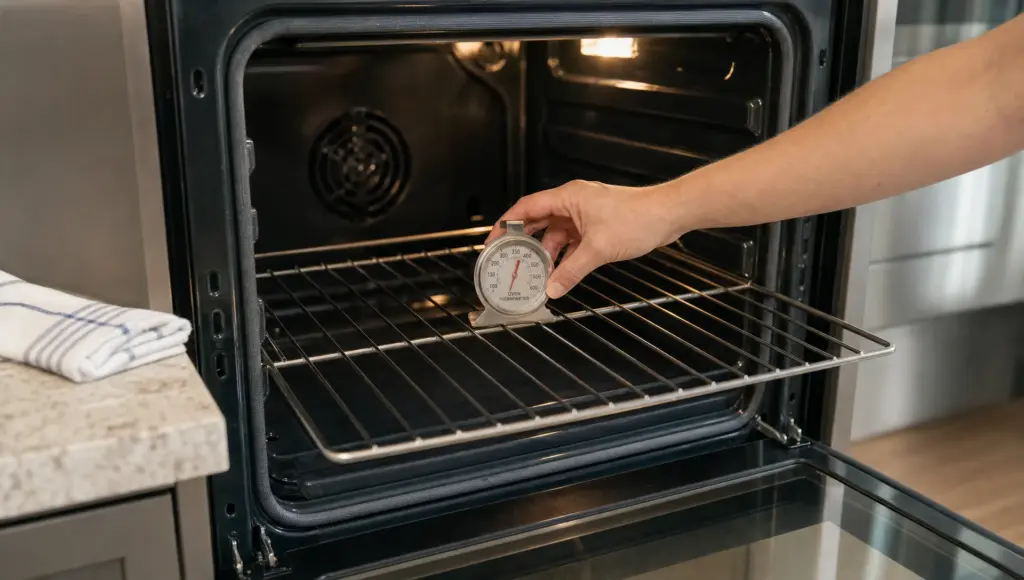
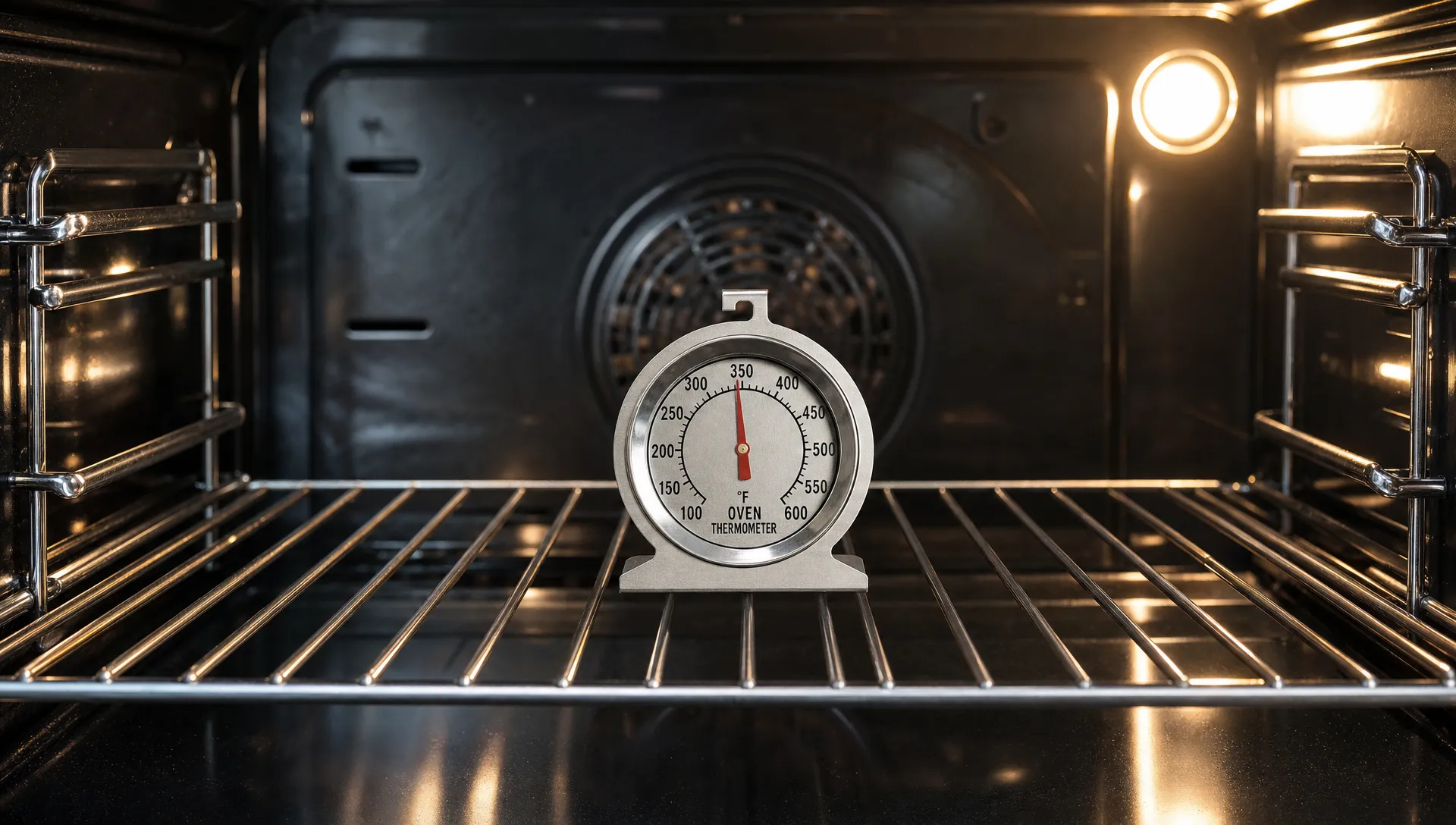
If possible, use a thermometer that can stand or hang from the rack. Place it where food usually cooks, not against a wall, on the floor of the oven or near the door glass.
Step by Step: How to Test Oven Temperature Accurately
The goal is to measure the average oven temperature, not the highest or lowest moment in the cycle. Follow the same process twice if the result seems surprising.
- Place the thermometer in the center of the oven: Put it on the middle rack, centered left to right and front to back. Keep the oven empty.
- Set the oven to 350°F: This is a practical test temperature because many recipes use it and most ovens cycle predictably there.
- Wait for the preheat signal, then wait 10 more minutes: This gives the oven cavity time to stabilize.
- Record the first reading without lingering: Open the door only long enough to read the thermometer, then close it.
- Record readings every 10 minutes for 40 minutes: Take at least four readings after the oven has stabilized.
- Average the readings: Add the readings and divide by the number of readings.
If your readings are 325°F, 340°F, 350°F and 335°F, the average is 337.5°F. That oven is not 50 degrees off, even if one moment looked low. If the readings are 285°F, 300°F, 305°F and 295°F, the average is 296.25°F, which means a 350°F setting is running about 54 degrees cool.
For more confidence, repeat the test at 400°F. Some ovens are fairly accurate at one temperature but drift badly at higher heat.
| Test result at 350°F setting | What it usually means | Next step |
|---|---|---|
| Average is 340°F to 360°F | Normal or close to normal | No repair needed, adjust recipes only if needed |
| Average is 325°F to 339°F or 361°F to 375°F | Mild calibration issue | Use the oven's temperature offset feature if available |
| Average is around 300°F or 400°F | Oven is about 50 degrees off | Test again, then inspect likely causes |
| Readings swing wildly by more than 75°F | Heating or sensing problem | Check door seal, sensor, igniter or control system |
| Temperature never reaches set point | Heat source problem | Consider professional diagnosis |
Mistakes That Make the Test Look Worse Than It Is
Small testing errors can create a false 50 degree difference. Before assuming a part has failed, make sure the test was fair.
Opening the door too often is the most common problem. Each long door opening dumps heat into the kitchen and can delay recovery, especially in a smaller oven. Read quickly and close the door right away.
Thermometer placement also changes the result. Temperatures near the side walls, door glass and top heating element can be very different from the center rack. Since recipes are built around food sitting on a rack, the center rack is the best place to measure.
Convection settings can confuse the reading as well. Many convection ovens automatically adjust the displayed temperature downward or move heat faster than a standard bake mode. For your first test, use regular bake unless you are specifically troubleshooting convection performance.
What a 50 Degree Difference Usually Points To
Once you confirm the oven is truly off by about 50 degrees, the pattern of the readings can help narrow the cause. You do not need to disassemble the appliance to gather useful clues.
The oven is consistently 50 degrees too cool
A consistently cool oven may need calibration, especially if it is only off at common baking temperatures and still heats smoothly. Many modern electronic ovens allow a temperature offset through the control panel, often within a limited range. Check the owner's manual for the exact button sequence.
If the oven is more than the allowed calibration range, the problem may be the temperature sensor, control board, weak bake element or, on a gas oven, an igniter that is slow to open the gas valve. A gas oven can appear to work while still heating weakly because the igniter glows but does not pull enough current for proper burner performance.
The oven is consistently 50 degrees too hot
An oven that runs hot may also be corrected with calibration, but do not ignore it. Overheating can burn food, damage cookware and create excess heat around cabinets.
A failing sensor or control relay can cause overheating. If the broil element stays on during bake more than expected or the oven keeps climbing well past the set point, stop the test and schedule service. That is no longer a simple recipe adjustment problem.
The oven heats correctly, then drifts low
If the oven starts near the right temperature but falls low after 20 to 30 minutes, suspect heat loss or recovery issues. A damaged door gasket, bent hinges or a door that does not close flush can leak enough heat to affect baking.
Phoenix kitchens see plenty of heat, dust and heavy use, and rubber seals can dry out over time. If you see gaps, brittleness or flattened gasket sections, this guide to repairing an oven door seal in Phoenix explains what to inspect before replacing the seal.
Can You Calibrate an Oven That Is 50 Degrees Off?
Sometimes, yes. Calibration is worth trying when the oven is consistently off by the same amount and there are no signs of a mechanical or electrical failure.
Electronic controls often have a temperature adjustment menu. Analog ovens may have an adjustment screw behind the temperature knob, depending on the model. Do not force a knob or control panel setting if you cannot confirm the correct procedure in the manual.
A practical rule is simple: if the oven is off by 15 to 30 degrees, calibration may solve it. If the oven temperature is 50 degrees off, calibration might help, but you should verify there is not a bad sensor, seal issue or heating component problem first.
After any calibration adjustment, repeat the thermometer test. Do not rely on a single batch of cookies or one casserole as proof. Food moisture, pan color, rack position and recipe timing can all change results.
When the Temperature Sensor May Be the Problem
In many electric and gas ovens, the temperature sensor is a thin metal probe mounted inside the oven cavity, usually on the back wall. It tells the control board how hot the oven is. If it reads incorrectly, the control board may shut heat off too soon or keep heat on too long.
Some common sensor clues include an oven that is consistently too hot or too cool, error codes on the display or temperature swings that do not match normal cycling. A sensor can also be knocked out of position, especially after cleaning or moving racks.
Do not test sensor resistance unless you are comfortable turning off power at the breaker, accessing the sensor safely and using a multimeter. Many oven sensors read around 1,080 ohms at room temperature, but exact specs vary by model. The service sheet for your appliance is the authority.
If you are not comfortable with electrical testing, stop at the thermometer test. That result is still valuable because it gives a technician a clear symptom instead of a vague complaint.
When to Call for Oven Repair
Call for service if the oven is confirmed 50 degrees off after two careful tests and calibration does not correct it. You should also get help if the oven will not reach temperature, overshoots dangerously, trips a breaker, smells like gas or shows error codes.
For homeowners comparing local options, a problem based price guide can help you understand what may be involved before booking service. PHX Appliance Fix's breakdown of oven repair prices Phoenix techs charge in 2026 covers common repairs like igniters, bake elements, sensors and control boards.
If the test points to a broader performance issue rather than a simple calibration change, this overview of Phoenix oven repair services for homeowners can help you understand which oven problems are usually repairable.
Quick Reference: What to Do Based on Your Test
Use the average temperature, not the most dramatic single reading, to decide what comes next.
| Confirmed average | Best action |
|---|---|
| Within 10°F of setting | Keep using the oven normally |
| 10°F to 25°F off | Monitor performance and adjust recipes if needed |
| 25°F to 35°F off | Check the manual for calibration instructions |
| Around 50°F off | Repeat the test, inspect the door seal and consider service |
| More than 75°F off | Stop relying on the oven until it is diagnosed |
If you are in the middle of cooking and discover a major temperature problem, use a food thermometer to check doneness rather than adding random time. This is especially important for poultry, ground meat, leftovers and casseroles.
Frequently Asked Questions
Is it normal for an oven to be 50 degrees off? No. Normal cycling can create temporary highs and lows, but the average temperature should not be consistently 50 degrees above or below the setting.
How long should I test my oven temperature? Plan on at least 40 minutes after the oven stabilizes. Take readings every 10 minutes and average them for a more accurate result.
Can I fix an oven temperature problem by changing recipe times? You can compensate for a mild difference, but a confirmed 50 degree error should be tested and corrected. Otherwise, results will stay inconsistent.
Should I use convection mode for the test? Use regular bake first. Test convection separately only if regular bake checks out and your problem happens mainly when convection is turned on.
Does a bad oven door seal affect temperature? Yes. A damaged seal can let heat escape, slow recovery and make the oven run cooler than the display suggests.
Bottom Line
When an oven temperature is 50 degrees off, do not guess based on one meal or one quick thermometer glance. Test from the center rack, wait beyond the preheat beep, record several readings and calculate the average.
If the result is consistent, check calibration and inspect the door seal. If the problem remains, the most likely causes are a sensor, igniter, heating element or control issue. A careful home test gives you better information, saves time and helps any appliance repair Phoenix technician diagnose the issue faster.