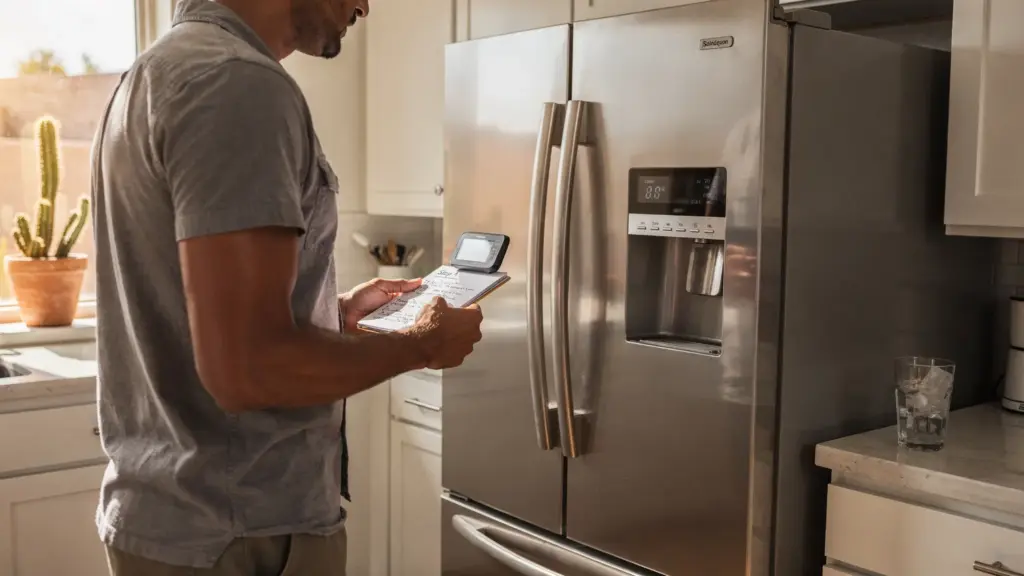
A refrigerator that’s running but not cooling is one of those problems that feels like it can’t wait, especially in Phoenix when indoor temps climb and groceries spoil fast. The good news is you can rule out several common (and fixable) causes in 15 to 30 minutes, and you can also gather the right clues so a technician can diagnose it faster if you do need service.
Below is a practical “before you call” checklist for a refrigerator not cooling, organized by urgency and likelihood.
Step 1: Protect food first (don’t troubleshoot with the doors open)
Before you start taking panels off or moving the fridge, treat this like a food safety situation.
- Keep doors closed as much as possible.
- Put an appliance thermometer in a glass of water in the fridge section, and if you can, another thermometer between frozen items in the freezer.
- If the fridge is above 40°F for more than 2 hours, perishable foods may no longer be safe (and that time can shrink in very hot conditions). The USDA’s guidance on safe cold temperatures is 40°F or below for refrigerators and 0°F for freezers. See USDA Cold Food Storage for official thresholds.
| Compartment | Safe target | If it’s warmer than target | What to do now |
|---|---|---|---|
| Refrigerator | 34 to 40°F | Above 40°F | Minimize door openings, move perishables to a cooler with ice, keep logging temp |
| Freezer | 0°F | Above 10 to 15°F and rising | Consolidate frozen items, add ice packs, avoid opening, plan for cooler transfer |
If you want a step-by-step discard timeline, use this Phoenix-focused guide: What Happens When Your Fridge Stops Cooling? Food Safety Timeline.
Step 2: Do the “5-minute checks” (highest payoff, lowest risk)
These are the checks most likely to solve simple “not cooling” situations without tools.
Confirm the fridge actually has stable power
A fridge can appear “on” (lights work) but still not run correctly.
- Make sure the cord is fully seated in the outlet.
- Check the breaker. A partially tripped breaker can cause odd behavior.
- If you use a power strip or extension cord, remove it and plug directly into the wall.
If the fridge is completely dead or repeatedly trips the breaker, stop and consider professional help.
Make sure it’s not in demo mode (yes, this happens)
Many modern refrigerators have a showroom or “demo” mode where lights and controls work but cooling is disabled.
Clues:
- The display looks normal, but the compressor and fans don’t seem to run.
- It started right after a power outage, cleaning, or a settings change.
Look up your model’s demo mode procedure (often a specific button combo). If you can’t find it quickly, take a photo of the control panel and model tag (see “What to tell a tech” below).
Check temperature settings and airflow basics
- Set fridge to around 37°F and freezer to 0°F.
- Don’t pack items tightly against the back wall or vents.
- Make sure nothing is preventing the doors from closing fully.
In Phoenix homes, overcrowding after a big grocery run plus frequent door openings can make a marginal fridge look “broken” when it’s really an airflow problem.
Step 3: Identify which “not cooling” pattern you have
This pattern matters because it points you to different components.
| What you observe | Most common direction | What to check next |
|---|---|---|
| Freezer is cold, fridge is warm | Airflow from freezer to fridge is blocked or not moving | Vents, evaporator fan, damper, frost buildup |
| Both fridge and freezer are warm | Heat can’t be rejected, compressor not running right, or sealed-system issue | Condenser coils, condenser fan, compressor start behavior |
| Heavy frost on back wall inside freezer | Defrost system problem causing airflow blockage | Defrost pattern, door sealing, fan airflow |
| Fridge cools “a little” but can’t keep up | Dirty coils, poor ventilation, hot room/garage, weak airflow | Coils, clearances, condenser fan, placement |
If your exact situation is “warm fridge, cold freezer,” this dedicated guide goes deeper without repeating everything here: Fridge Freezer Repair: Fix Warm Fridge, Cold Freezer.
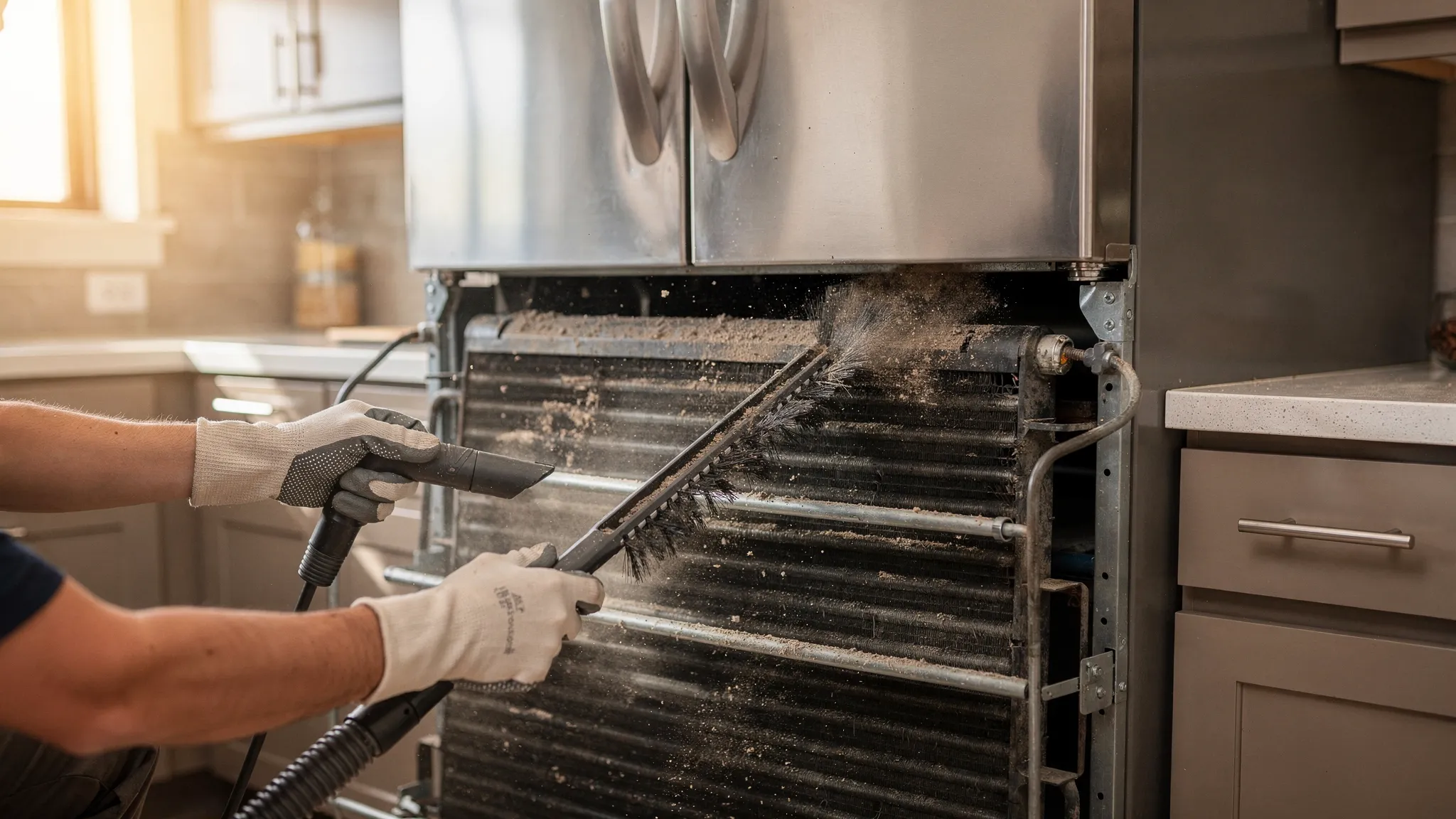
Step 4: Clean the condenser coils (the #1 Phoenix-friendly fix)
In Phoenix, dust is a refrigerator’s enemy. Dirty condenser coils can cause high temperatures, long run times, and eventual shutdowns.
Unplug the refrigerator first.
What to do:
- Locate coils (often underneath behind a toe-kick grille, or on the back).
- Use a coil brush and vacuum to remove dust and pet hair.
- Restore power and give it time. Temperature recovery can take several hours.
Also check ventilation:
- Make sure the fridge has the clearance recommended in your manual.
- Don’t block the base grille (many fridges pull air in from the bottom front).
Step 5: Listen and look for fan clues (without disassembling everything)
Most refrigerators rely on two fans (varies by design):
- Evaporator fan (usually in or behind the freezer section) moves cold air.
- Condenser fan (near the compressor on many models) moves heat away.
Quick fan checks you can do safely
- Open the freezer door. On many models, the evaporator fan pauses when the door opens. Press and hold the door switch and listen for a fan.
- At the back/bottom, listen for a steady fan sound near the compressor area.
What the symptoms often mean:
- No fan sound and rising temps can point to a failed fan motor, an ice blockage, a door switch issue, or a control problem.
- A grinding or squealing fan noise can mean the fan blade is hitting ice or the motor bearings are failing.
If your refrigerator is noisy (or suspiciously quiet), this sound-based guide helps pinpoint the source: Why Your Refrigerator Is Noisy: Meanings by Sound Type.
Step 6: Check the door seal (gasket) and closing alignment
A bad seal lets warm air pour in, which is especially punishing during Phoenix summers.
Simple tests:
- Dollar-bill test: Close the door on a bill. If it slides out easily, the seal may not be sealing.
- Look for gaps, tears, or hardened areas.
- Check that the fridge is reasonably level so doors self-close.
If you suspect gasket problems, use this focused guide: Refrigerator Door Seal: Signs It’s Failing and Why.
Step 7: Look for frost buildup that blocks airflow
If the freezer panel has heavy frost, the fridge often stops cooling properly because air can’t move.
What you can do before calling:
- Confirm vents are not blocked by food packages.
- If the back wall of the freezer is heavily frosted, avoid chipping ice with sharp tools.
A full manual defrost (unplug, doors open, towels down) can be a temporary way to restore airflow, but it’s usually a sign something else failed (defrost heater, defrost thermostat, control, or a door sealing issue). If it cools again after a manual defrost and then fails again within days or a couple weeks, that pattern is valuable information for a tech.
Step 8: Understand what you should not DIY
Some refrigerator fixes are unsafe or require certification.
Avoid:
- Adding refrigerant or “recharging” the system without proper diagnosis.
- Piercing lines or using any “stop leak” product.
- Sealed-system work (compressor, evaporator, condenser, refrigerant leak repair).
If you’re hiring someone for refrigerant-related work, they should have EPA Section 608 certification. The EPA overview is here: EPA Section 608 Technician Certification.
Step 9: Decide if it’s time to call a technician (and what to tell them)
Call sooner (same day if possible) if:
- Both compartments are warming quickly.
- The compressor is clicking on and off repeatedly.
- You smell burning plastic, see smoke, or hear loud electrical buzzing.
- The fridge is in a hot garage and can’t maintain safe temps.
The fastest way to get a useful quote or diagnosis
Have this information ready:
- Brand and model number (photo of the model tag inside the fresh-food section is best)
- Temperatures in fridge and freezer (and how fast they’re rising)
- Whether the compressor is running (low hum/vibration) and whether you hear a click every few minutes
- Whether fans are running (evaporator and condenser)
- Frost pattern (none, light, heavy sheet of frost on freezer back wall)
- Recent events (power outage, cleaning, moving the unit, doors left ajar)
That detail helps a technician arrive with the right parts or narrow the likely failure category quickly.
If you want pricing context before you schedule service, start here: Refrigerator Repair Cost in Phoenix – Real Prices from Local Experts.
Phoenix-specific note: heat, dust, and garage installs change the odds
A refrigerator that limps along fine in a 75°F kitchen can struggle in a 95 to 110°F garage. Dust also accumulates faster in coils and fan areas here than many homeowners expect.
If your refrigerator is in the garage:
- Keep coils clean more often.
- Make sure airflow at the bottom and back is unobstructed.
- If it’s an older unit, expect longer run times during peak summer.
For a broader view of what extreme heat does to appliances, see: Appliance Repair in Phoenix: What Breaks Most in Heat.
Frequently Asked Questions
Refrigerator not cooling, what to do first? Keep doors closed, verify power and settings, put a thermometer inside, then clean condenser coils and check for blocked vents.
How long should I wait after cleaning coils to see improvement? Many refrigerators need several hours to pull temperatures back down, especially if they were warm. If temps keep rising after coils are cleaned and airflow is clear, move to fan and frost checks, then consider service.
My freezer is cold but the refrigerator is warm. What does that mean? It usually points to an airflow issue between compartments, like a blocked vent, a stuck damper, a failing evaporator fan, or frost buildup from a defrost problem.
Is it safe to unplug my refrigerator to reset it? In many cases, yes. Unplugging for 5 minutes can reset controls. If you suspect electrical burning smells, sparking, or repeated breaker trips, stop and call a professional.
Can I add refrigerant myself if the fridge isn’t cooling? No. Refrigerant work requires proper tools, leak testing, and certification. Adding refrigerant without fixing a leak is temporary at best and can damage the system.
Next steps
If you’ve worked through the checks above and temperatures still won’t stabilize, you’ll usually get to an answer faster by narrowing the “bucket” (airflow/frost, dirty condenser and ventilation, fan failure, controls, or sealed-system).
For deeper DIY steps that stay on the safe side, use: Refrigerator Repair How To: Safe DIY Steps to Try First.
And if you’re comparing providers, this guide helps you avoid bad quotes and verify credentials: Home Appliance Repair Near Me: How to Vet a Tech.