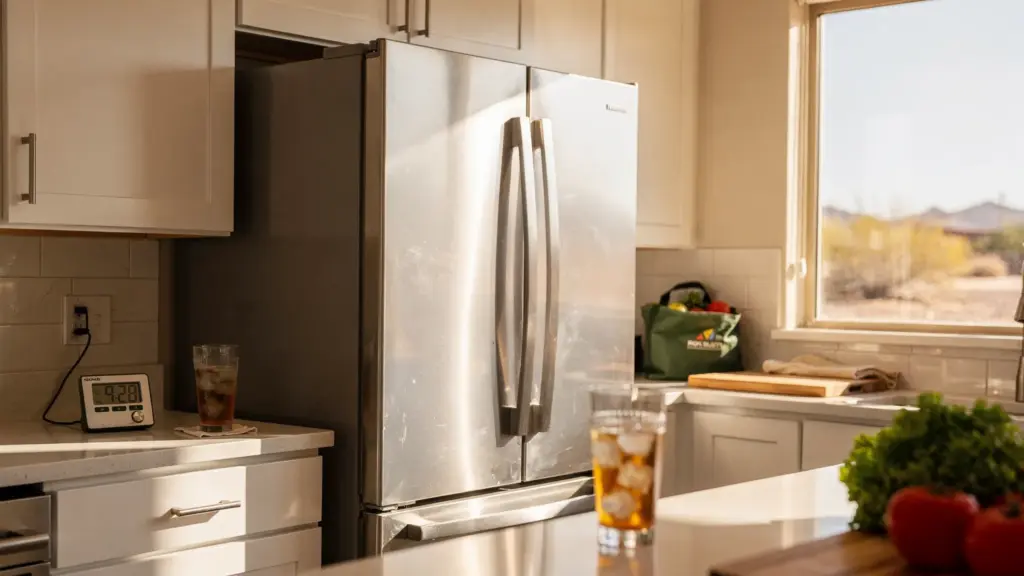
In Phoenix, it can feel like your refrigerator never gets a break once summer hits. The good news is that longer run times are often normal when your kitchen, garage, or pantry is hot and the fridge is working against higher heat load. The not so good news is that “running constantly” can also be the first sign of an airflow, seal, or cooling-system problem.
This guide helps you tell the difference, using simple temperature checks and Phoenix-friendly troubleshooting.
First: what “normal” actually looks like in summer
A refrigerator does not run at a fixed schedule. It cycles on and off to hold temperature, and the percentage of time it runs is often called a “duty cycle.” In summer, the duty cycle naturally increases because:
- Your home’s ambient temperature is higher.
- Every door opening dumps cold air and pulls in warm air.
- The condenser has a harder time shedding heat (especially with dust buildup).
Normal in a Phoenix summer can mean the compressor runs most of the day, especially if:
- The fridge is in a garage or laundry room.
- The unit is older.
- You have a full household with frequent door openings.
- You are making a lot of ice.
What matters is not the sound of “it’s always on,” but whether the fridge is holding safe temperatures.
The quickest way to know: check temperatures (not just run time)
If your refrigerator is running a lot but temperatures stay stable, it may be doing exactly what it should.
Target temperatures most food safety guidance aligns with:
- Fridge: 37°F to 40°F (aim for about 37°F if you can)
- Freezer: 0°F
The USDA recommends keeping your refrigerator at 40°F or below for food safety (USDA FSIS cold storage chart).
Practical test: Put an appliance thermometer in the fridge (center shelf) and one in the freezer. Check morning and evening for a day. If your fridge is staying at or below 40°F and the freezer is near 0°F, the “constant running” may be normal summer strain.
If you need a deeper, safety-first plan for unstable temps, see: What Happens When Your Fridge Stops Cooling? Food Safety Timeline.
Normal summer scenarios vs “not normal” (fast reference)
| Situation | Often normal? | What you should observe | What would be concerning |
|---|---|---|---|
| Hot kitchen (AC set higher during day) | Yes | Longer run time midday, temps stay stable | Temps creep above 40°F |
| Fridge in a garage (very hot afternoons) | Sometimes | Very long run time, may struggle at peak heat | Freezer softening, fridge 41°F+ |
| After grocery loading (warm items added) | Yes | Runs longer for several hours, then settles | Still can’t recover overnight |
| Ice maker running often | Yes | More frequent cycling, slightly longer run times | Ice production drops and temps rise |
| Dusty coils / blocked airflow | No | Often runs long and cools poorly | Hot fridge exterior, warm temps, noisy fan |
| Door not sealing well | No | Runs more, humidity/condensation | Frost, moisture, door feels “light” |
Why your fridge runs longer in Phoenix summers (and it can be normal)
Here are the most common non-failure reasons a refrigerator runs almost nonstop during hot months.
1) Higher ambient temperature (especially garages)
Refrigerators are designed to reject heat into the room. When the room is already hot, the condenser struggles to dump heat efficiently, so the compressor runs longer.
Phoenix-specific note: a garage can exceed the comfort range many standard fridges were designed around, especially during late afternoon. In extreme heat, a garage fridge may run nearly continuously and still have trouble maintaining setpoint.
2) Door openings and “summer traffic”
Frequent openings (kids home, guests, drinks, popsicles) are a huge load. Every opening pulls in warm air and moisture, and the unit has to remove that heat.
3) Warm food going in (grocery day effect)
If you load a large grocery haul, especially room-temperature drinks or leftovers that have not cooled, expect extended run time for several hours.
4) Defrost cycles and humidity
Even in the desert, moisture enters the fridge every time the door opens. Your unit periodically runs defrost functions to keep the evaporator from icing up. You may notice longer run blocks during these cycles.
When “running constantly” is a sign of a problem
If your refrigerator runs all the time and still cannot hold temperature, it is time to treat it as a troubleshooting issue.
Red flags that justify same-day help
These are situations where it is smart to escalate quickly, especially in Phoenix heat:
- Fridge temperature is above 40°F for more than a short period.
- Freezer items are soft, melting, or you see thaw-refreeze patterns.
- The compressor is hot to the touch and it never seems to cycle off.
- You see heavy frost on the back wall of the freezer (not just a light dusting).
- You hear a fan trying to spin but rubbing, squealing, or failing.
If you suspect active cooling loss, use the safety playbook here: What Causes a Refrigerator to Stop Cooling? Top Culprits.
The most common fixable causes (without guessing parts)
This article is not a parts-swapping guide. But these are the highest-probability culprits technicians see when summer run time becomes excessive.
Dirty condenser coils (very common in Phoenix)
Dust and pet hair insulate the condenser, making it harder to dump heat. The compressor compensates by running longer.
If you want a safe walkthrough, this is covered in more detail here: Refrigerator Repair How To: Safe DIY Steps to Try First.
Poor airflow around the fridge
If the fridge is pushed tight to the wall or boxed into a cabinet with limited ventilation, heat stays trapped around the condenser.
Door gasket leaks (seal problems)
A weak door seal is one of the most common reasons for longer run times in summer. Warm air leaks in, moisture increases, and the system runs longer to compensate.
- Signs and tests: Refrigerator Door Seal: Signs It’s Failing and Why
- DIY repair options: Refrigerator Door Seal Repair: Stop Leaks and Frost
Fan problems (condenser fan or evaporator fan)
Fans move heat where it needs to go. If a fan is weak, obstructed by debris, or failing, the compressor may run longer and temps may drift.
Defrost problems (ice restricting airflow)
If the evaporator coils ice up, airflow to the fridge compartment drops and the unit runs constantly trying to recover.
Sealed-system issues (refrigerant/compressor related)
If you have cleaned coils, verified the seals, and temperatures still won’t hold, the issue may be deeper (and not DIY). In that case, a professional diagnosis is the safest next step.
A safe, homeowner-friendly checklist (15 to 45 minutes)
Do these in order. Stop if anything seems unsafe.
- Verify settings first: Confirm the fridge is not set unusually warm and that “vacation mode” is off.
- Measure real temperatures: Use a thermometer, not just the dial. Check for 40°F or below in the fridge and about 0°F in the freezer.
- Check door sealing: Try the dollar-bill test at several points around the gasket. If it slips out easily, the seal may be weak.
- Look for airflow blockage inside: Make sure vents are not covered by containers, pizza boxes, or bags.
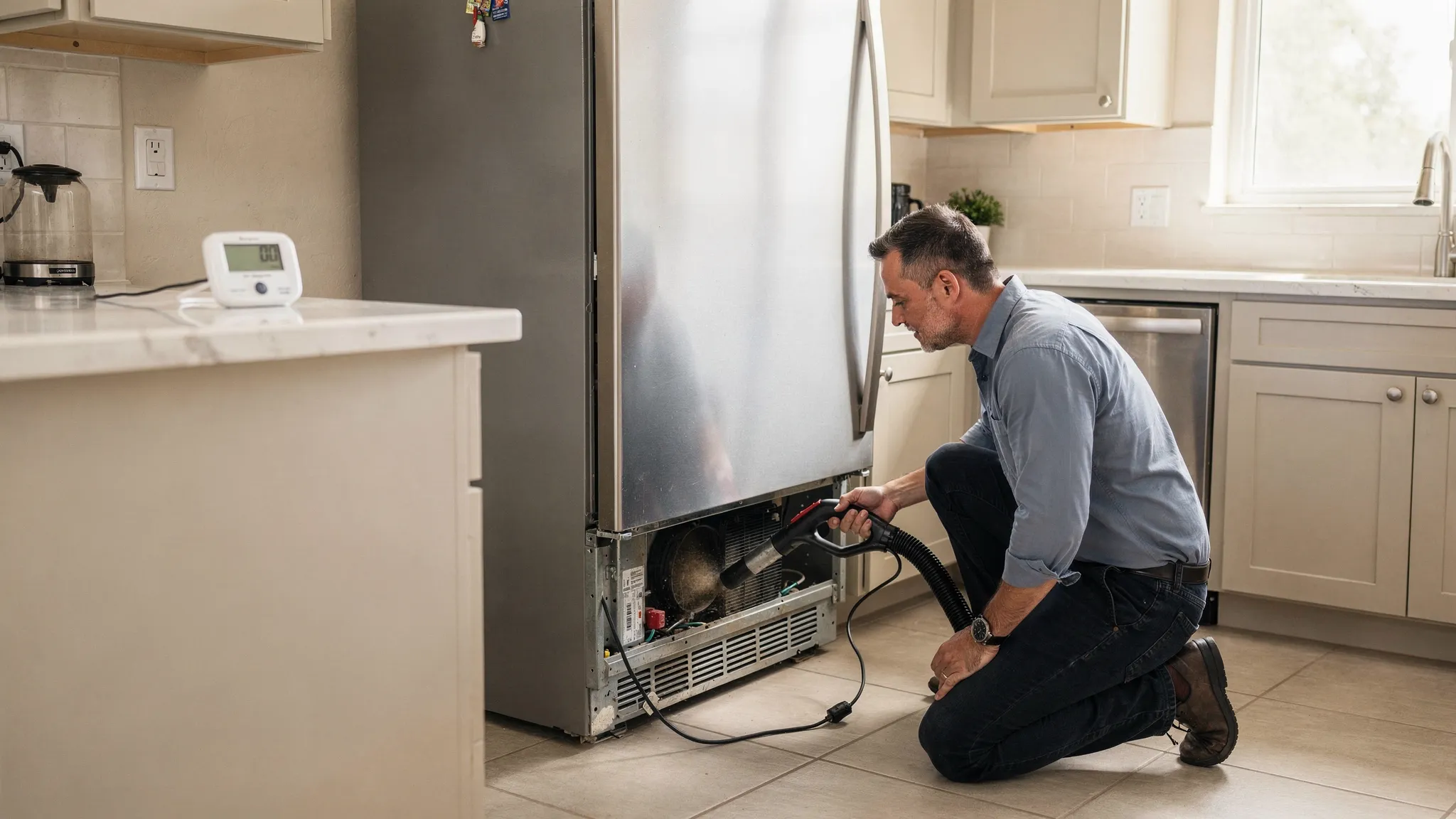
- Clean the condenser area: Unplug power, then vacuum dust from the front grill and coil area (location varies by model). Avoid bending fins.
- Give it space: Pull the fridge slightly away from the wall to improve airflow, while keeping it stable and safe.
- Watch a full day trend: After cleaning and clearing vents, track temps for 24 hours.
If you want a more complete troubleshooting flow that stays DIY-safe, use: Refrigerator Repair How To: Safe DIY Steps to Try First.
Phoenix-specific reality check: garages can push fridges past their comfort zone
Many service calls in summer come down to this: a standard refrigerator in a super-hot garage is being asked to do more than it reasonably can.
If your fridge lives in a garage, a few improvements often help:
- Put it where it gets the most shade and airflow.
- Keep it away from a hot water heater exhaust area or direct sun.
- Reduce door openings during peak afternoon heat.
- Keep coils cleaner than you would indoors (dust load is higher).
If the garage is extremely hot and temps won’t hold, you may need professional guidance on whether repair makes sense or whether placement and appliance choice are the real issue. This decision framework may help: Is It Worth Repairing a Refrigerator in Phoenix’s Heat?
When to call a pro (and what to tell them for faster diagnosis)
Call for service when:
- The fridge cannot stay at 40°F or below after basic airflow and coil checks.
- The freezer is warming, softening ice cream, or melting cubes.
- You see persistent frost buildup that returns quickly after a manual defrost.
- The unit is tripping breakers, you smell burning, or you hear loud mechanical grinding.
To speed up a same-day or emergency appointment, have this ready:
- Make and model (photo of the data tag inside the fridge is fine)
- Your measured fridge and freezer temps
- Where the unit is located (kitchen vs garage)
- What changed recently (power outage, grocery load, moving the unit)
If you are comparing options and timelines for urgent issues, you may find this helpful: Kitchen Appliance Repair Near Me: Same-Day Options.
For Phoenix pricing context if repair is needed: Refrigerator Repair Cost in Phoenix – Real Prices from Local Experts.
Frequently Asked Questions
Is it normal for a refrigerator to run all day in summer? Yes, it can be normal for a fridge to run most of the day during extreme heat, heavy use, or after loading groceries, as long as it holds safe temperatures.
How do I know if my fridge is running too much or actually failing? Use thermometers. If the fridge is consistently above 40°F or the freezer cannot stay near 0°F, constant running is a warning sign.
Does cleaning condenser coils really help in Phoenix? Often, yes. Phoenix dust and pet hair commonly reduce heat transfer at the condenser, which can increase run time and hurt cooling performance.
My refrigerator runs constantly but the freezer is cold. Is that normal? Sometimes, but it can also point to an airflow issue between compartments (fan, damper, defrost). Measure both temps and check vents and frost signs.
Will a bad door seal make the fridge run nonstop? Absolutely. A leaking gasket pulls in warm air and moisture, forcing longer run times. The dollar-bill test is a quick screening tool.
When is this an emergency in Phoenix? If the fridge is over 40°F and food is at risk, or if you see rapid warming during extreme heat, treat it as urgent and consider same-day refrigerator repair.
Need help fast? Get Phoenix-focused guidance before food is at risk
If your refrigerator is running constantly and temperatures are drifting above safe ranges, summer heat can turn a small issue into a food-safety problem quickly. Browse more Phoenix troubleshooting resources on PHX Appliance Fix Blog, or if you are at the point of scheduling service, start with our same-day planning guide: Kitchen Appliance Repair Near Me: Same-Day Options.