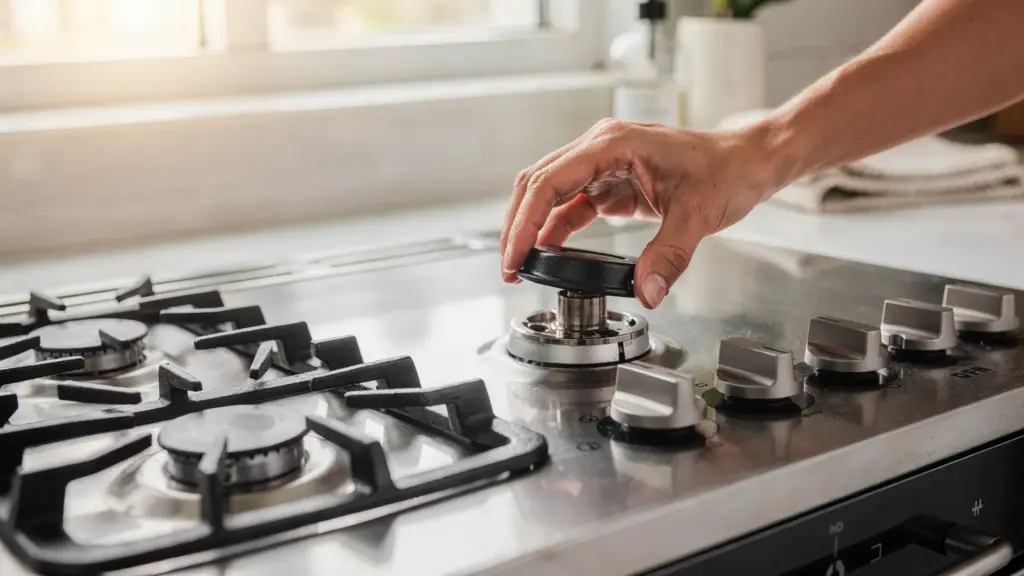
If your stovetop burners won’t ignite, the problem is usually something simple like moisture, misaligned burner caps, or clogged ports. But because you’re dealing with gas (and sometimes electricity), it’s important to troubleshoot in a safe, methodical way, and to know when to stop and call a pro.
This guide focuses on gas cooktops and gas ranges with electric spark ignition, which is the most common setup in Phoenix homes.
1) Identify what “won’t ignite” really means
Different symptoms point to different causes. Before you take anything apart, note what you’re seeing and hearing:
- No clicking sound on any burner when you turn a knob to “Lite.”
- Clicking sound happens, but no flame on one burner or all burners.
- One burner won’t light, others work fine.
- Burner lights with a match, but not by itself (some models allow this, but use caution).
- Igniter keeps clicking even after the flame is on (often a moisture or dirty-switch issue).
That quick observation will save you time.
2) Safety first: what to do before troubleshooting
Gas appliances are safe when working correctly, but unsafe troubleshooting can create a fire risk.
- If you smell gas (a strong sulfur or “rotten egg” smell), turn all burner knobs off, don’t create sparks (no switches, no lighters), open windows, and shut off the gas supply valve if you can. Leave the home if the odor is strong and contact your gas provider or a qualified technician.
- Unplug the range (or switch the breaker off) before cleaning around igniters or removing burner parts. Spark systems are electrical.
- Let everything cool down fully.
If you’re ever unsure, it’s completely reasonable to switch from DIY to professional appliance repair in Phoenix, especially for anything involving gas supply components.
3) Quick 5-minute checks (most common fixes)
These are the highest impact checks, in the right order.
Confirm you have both power and gas
Even gas cooktops often need electricity for the igniters.
- Is the unit plugged in? If it’s a range, check the outlet behind it.
- Did a breaker trip? Reset once.
- Is the gas shutoff valve open? Under/behind the range or in the cabinet for cooktops. The handle is typically parallel to the pipe when open.
If all burners fail and there’s no clicking, power is the likely issue.
Check burner cap alignment
Misaligned caps are a top cause of “clicking but no flame.” On sealed burners, the cap must sit flat.
- Remove the grate.
- Lift the burner cap.
- Reseat it so it sits level and centered.
Check for moisture after cleaning or boil-overs
Phoenix kitchens are often dry, but moisture from wiping, spray cleaners, or a boil-over can still prevent ignition.
- If you recently cleaned, wait 15 to 30 minutes for parts to dry.
- Use a dry towel to blot water around the burner head and igniter.
- You can run a fan in the kitchen to speed drying.
Make sure the burner ports aren’t clogged
Food residue can block the tiny gas ports.
- If you see crusty debris around holes in the burner head, plan to clean them (steps below).
4) Stovetop anatomy: what you’re about to clean and inspect
Understanding the parts makes troubleshooting easier.
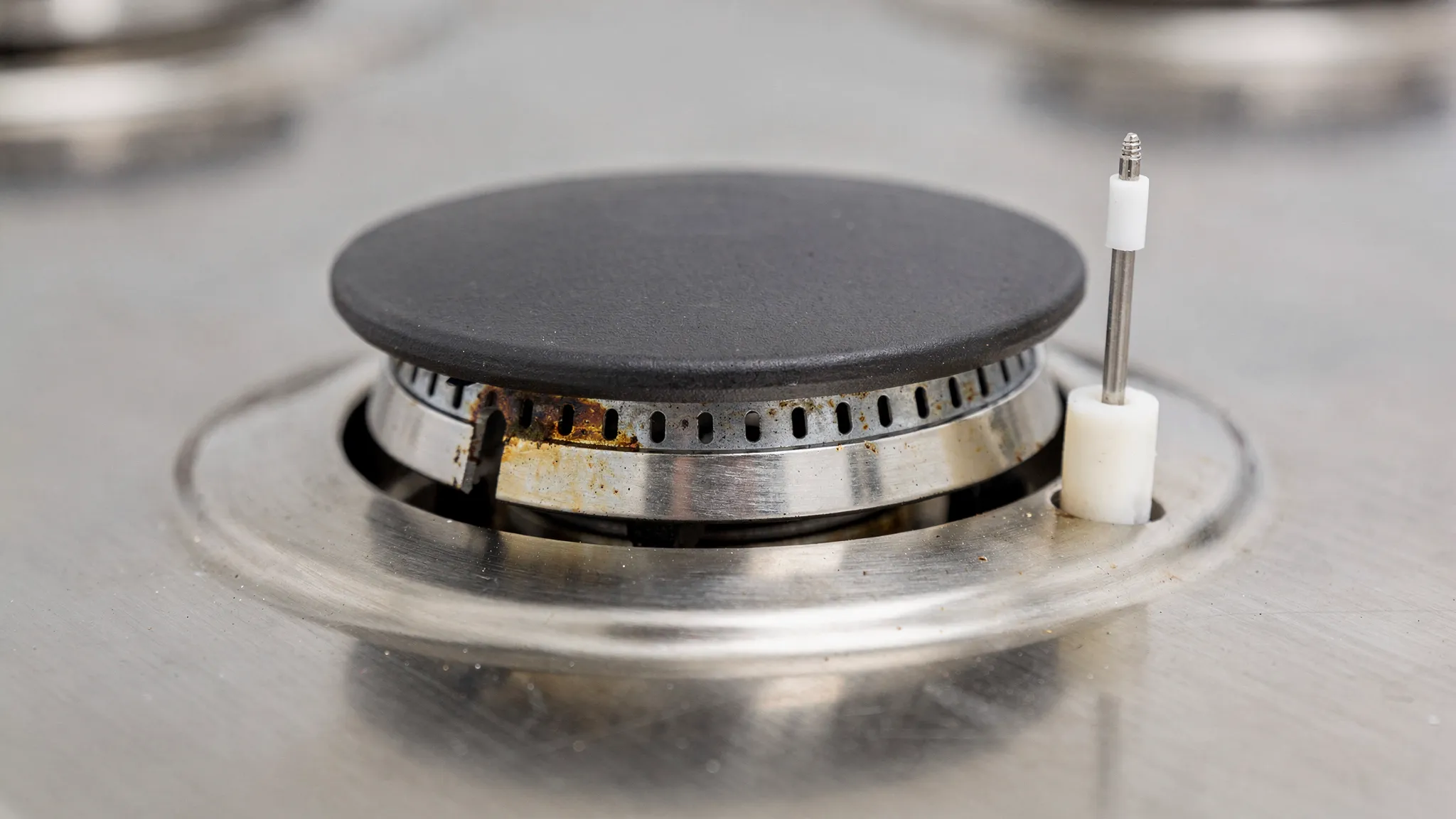
On most sealed gas burners you’ll see:
- Burner cap (removable top)
- Burner head/base (where gas ports are)
- Spark electrode/igniter (often a small white ceramic piece with a metal tip)
- Ignition switch (behind the knob, tells the spark module to click)
- Spark module (creates the clicking spark)
5) Step-by-step DIY: burners click but won’t light
Step A: Clean and dry the burner cap and head
- Turn the knob off. Unplug the unit.
- Remove the grate and burner cap.
- Wash cap and head with warm water and mild dish soap.
- Rinse and dry completely.
Avoid soaking parts that have electrical components attached. Burner caps are fine to wash, but do not submerge any wired components.
Step B: Clear clogged gas ports safely
If ports are clogged, gas flow is uneven and the flame may not “catch” near the igniter.
- Use a wooden toothpick or a soft nylon brush to loosen debris.
- Avoid metal that can enlarge ports.
- Wipe loosened residue away.
If you have a can of compressed air, you can use short bursts to blow away dry crumbs (keep it controlled and don’t force debris deeper).
Step C: Clean the spark electrode area
Grease or cleaner residue can “short” the spark to the metal base instead of across the gap.
- Gently wipe the ceramic igniter with a dry cloth.
- If there’s stubborn grease, use a lightly damp cloth with a tiny bit of dish soap, then dry thoroughly.
- Inspect for cracks in the ceramic. A cracked electrode often fails intermittently.
Step D: Reassemble correctly (this matters)
- Place the burner head/base correctly.
- Set the cap on top, centered and level.
- Put the grate back.
Then plug the unit back in and try lighting.
Step E: Watch the spark location
When you turn the knob to “Lite,” you should see a spark jump from the electrode tip to the burner.
- Spark is present, still no flame: likely gas flow issue (clogged ports, valve problem, or gas supply issue).
- No spark on that burner, but others spark: likely electrode/wire/connection issue on that burner.
6) Step-by-step DIY: no clicking sound at all
If none of the burners click, focus on power and ignition control.
Check power again (yes, again)
- Try a different small appliance in the same outlet.
- If it’s a range, confirm the cord is firmly seated.
Try a “reset” (power cycle)
Spark modules can occasionally glitch.
- Turn all knobs off.
- Unplug the unit (or turn breaker off) for 60 seconds.
- Restore power and test.
If it still doesn’t click
At that point the common culprits are:
- Failed spark module
- Failed ignition switch assembly (sometimes one stuck switch prevents proper operation)
- Loose wiring connection
These repairs often require removing control panels and working near wiring. If you’re not comfortable doing that safely, it’s a good time to contact Phoenix appliance repair services.
7) Special case: igniter keeps clicking after the burner lights
If the burner lights but the clicking continues, it’s usually because the igniter system “thinks” the flame is not established.
Common causes you can address:
- Moisture around the burner or knob shaft (especially after cleaning)
- Food spillover or grease film around the igniter
- Dirty or sticking ignition switch behind the knob
Try drying and cleaning first. If the clicking persists for days, a technician may need to replace the switch or address wiring.
8) Troubleshooting table: symptoms and the most likely causes
| What you notice | Most likely cause | What you can do | When to call a pro |
|---|---|---|---|
| No clicking on any burner | No power, failed spark module, failed switch | Check outlet/breaker, power cycle | If power is good and still no clicking |
| Clicking but no flame on one burner | Misaligned cap, clogged ports, wet igniter | Reseat cap, clean and dry burner parts | If gas flow seems weak or problem returns quickly |
| One burner won’t spark, others do | Bad electrode, dirty igniter, loose wire | Clean/dry electrode area, inspect for cracks | If electrode is cracked or wiring is involved |
| All burners click, none light | Gas supply off, regulator issue, severe clogging, spark weak | Confirm gas valve open, clean ports | If gas supply is confirmed and still no ignition |
| Gas smell during attempts | Gas leak or unburned gas buildup | Turn knobs off, ventilate, shut off gas | Immediately, don’t continue testing |
9) When it’s not DIY: situations that justify same-day service
Some stovetop issues are not just inconvenient, they’re urgent.
Seek emergency appliance repair in Phoenix (or stop and schedule service right away) if:
- You smell gas and can’t confidently resolve it at the shutoff valve.
- The burner ignites with a “whoosh” or repeatedly flares unusually high.
- You suspect a damaged gas line, regulator, or internal valve.
- You’ve cleaned and reseated everything and multiple burners still won’t ignite.
If you’re cooking daily, same-day help can also be practical when the range is your only cooking option. (Many companies offer same day refrigerator repair in Phoenix and similar urgent scheduling for cooking appliances, but availability depends on the shop and season.)
10) Common professional repairs for ignition problems (and what affects cost)
For pricing, the biggest variables are typically:
- Whether it’s a cooktop vs a full range
- Brand and parts availability
- Access complexity (built-in units can take longer)
- Whether the issue is electrical (ignition) vs gas delivery
To help you understand what a technician may recommend, here are common fixes and what they usually involve.
| Likely repair | What it addresses | Notes |
|---|---|---|
| Replace spark electrode (one burner) | No spark or weak spark at one burner | Part cost is often modest, labor varies by access |
| Replace ignition switch | No clicking or inconsistent clicking | Switches can stick after spills or wear out |
| Replace spark module | No clicking on all burners or weak spark across burners | Often located under the cooktop top or control area |
| Clean/adjust burner assembly | Poor flame carryover to igniter | Common after boil-overs and heavy cooking |
| Diagnose gas valve/regulator issues | Gas present but not reaching burners correctly | Typically pro-only for safety reasons |
If you like having a baseline for repair economics before scheduling service, these two local-style decision guides can help you frame the repair vs replace question:
- Refrigerator repair cost in Phoenix (real price ranges and factors)
- Is it worth repairing a refrigerator in Phoenix’s heat?
The appliance is different, but the evaluation logic is similar: age, safety, part cost, and how fast you need the appliance back.
11) Prevention tips (especially useful in Phoenix homes)
Ignition problems are often caused by residue and repeat spillovers. A few habits reduce repeat failures:
- Wipe spills quickly, especially sugary sauces that harden and clog ports.
- Avoid flooding the burner area with spray cleaners. Apply cleaner to a cloth instead.
- Dry thoroughly after any cleaning around burners.
- Lift grates carefully to avoid bumping or cracking electrodes.
- If your cooking produces a lot of grease, do a weekly quick clean of burner caps and the surrounding surface.
Frequently Asked Questions
Can I light a gas burner with a match if the igniter doesn’t work? Some gas ranges can be lit manually, but you should only do this if your manufacturer allows it and you can do it safely. If you smell gas or the flame behaves strangely, stop and schedule service.
Why does my burner click but not light, then suddenly lights later? The most common causes are moisture (after cleaning), a slightly misaligned cap, or partially clogged burner ports. Cleaning, drying, and reseating usually fixes intermittent ignition.
Why is only one burner not igniting? Usually it’s local to that burner: a dirty or cracked electrode, clogged ports, or a cap that’s not seated flat. If other burners work, start with cleaning and alignment.
What if all burners stopped igniting at the same time? Check for power first (outlet, breaker) and confirm the gas shutoff valve is open. If power and gas are good, the spark module or ignition switch may have failed.
Is a clicking stove dangerous? Clicking alone is not necessarily dangerous, but repeated clicking can indicate moisture, a failing switch, or poor ignition. If clicking is paired with a gas odor or delayed ignition, stop using the appliance and get it checked.
When should I call a technician instead of DIY? Call a technician if you smell gas, if multiple burners won’t light after cleaning and drying, or if the likely fix involves internal wiring, spark modules, or gas valves.
Need help getting your stovetop working again?
If you’ve tried the safe cleaning and alignment steps and your burners still won’t ignite, it may be time to bring in a local technician for diagnosis. Explore more Phoenix-focused repair guidance on the PHX Appliance Fix Blog at ApplianceRepairPros.net, including our local insights on oven repairs and what drives repair costs in the Valley.