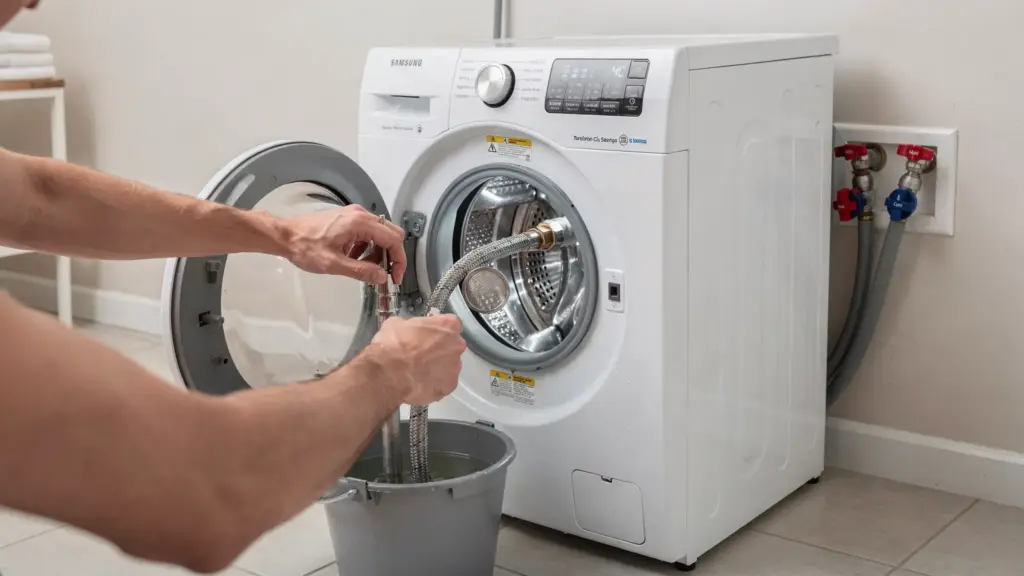
When your Samsung washer flashes 4C, it’s telling you a simple thing: the machine is not getting water the way it expects. That can mean no water at all, not enough water pressure, or water flowing in too slowly to complete the fill step on time.
In Phoenix, this pops up a lot after a plumbing shutoff, during water pressure fluctuations, or when hard-water sediment clogs the tiny inlet screens.
What does 4C mean on a Samsung washer (and what it does not mean)
4C = water supply (inlet) error. The washer tried to fill, but the control did not detect proper water flow.
Depending on model year, you may also see related codes:
| Code on display | What it typically indicates | What to check first |
|---|---|---|
| 4C | Water is not entering correctly (slow fill, no fill, low pressure) | Supply valves, hoses, inlet screens, home water pressure |
| 4E | Older labeling for the same water-inlet issue | Same checks as 4C |
| 4C2 | Water temperature problem, often hot water too hot or wrong hose connection | Hot/cold hoses reversed, hot water temp, correct faucet connections |
If your washer is draining fine but won’t fill, 4C fits. If it’s not draining, that’s typically a different error (often drain-related), and you’ll want a different troubleshooting path.
Before you troubleshoot: 2 quick safety moves
- Press Power to stop the cycle, then unplug the washer if you will touch hoses or screens.
- Turn off both water supply valves (hot and cold) before disconnecting any hose.
If there’s standing water in the drum and you need laundry out urgently, use the washer’s drain/spin option if available. If it won’t cooperate, stop and avoid forcing doors on front-load models.
The most common 4C causes (and the fastest fixes)
The best way to clear 4C is to start with the highest-probability, lowest-effort checks.
1) One (or both) water valves are partially closed
This sounds obvious, but it’s the top real-world cause.
- Confirm both wall valves are fully open (turn counterclockwise until they stop).
- If your home has quarter-turn lever valves, make sure the lever is fully parallel to the pipe.
Tip: Even a “mostly open” valve can cause a slow fill that triggers 4C.
2) A kinked hose, crushed hose, or clogged hose filter
Look behind the washer for:
- A hose pinched against the wall
- A sharp bend at the connection
- A crushed section from pushing the washer back too far
If hoses are old rubber, consider replacing them with braided stainless hoses. (This is more about leak prevention than 4C, but it’s a smart upgrade in general.)
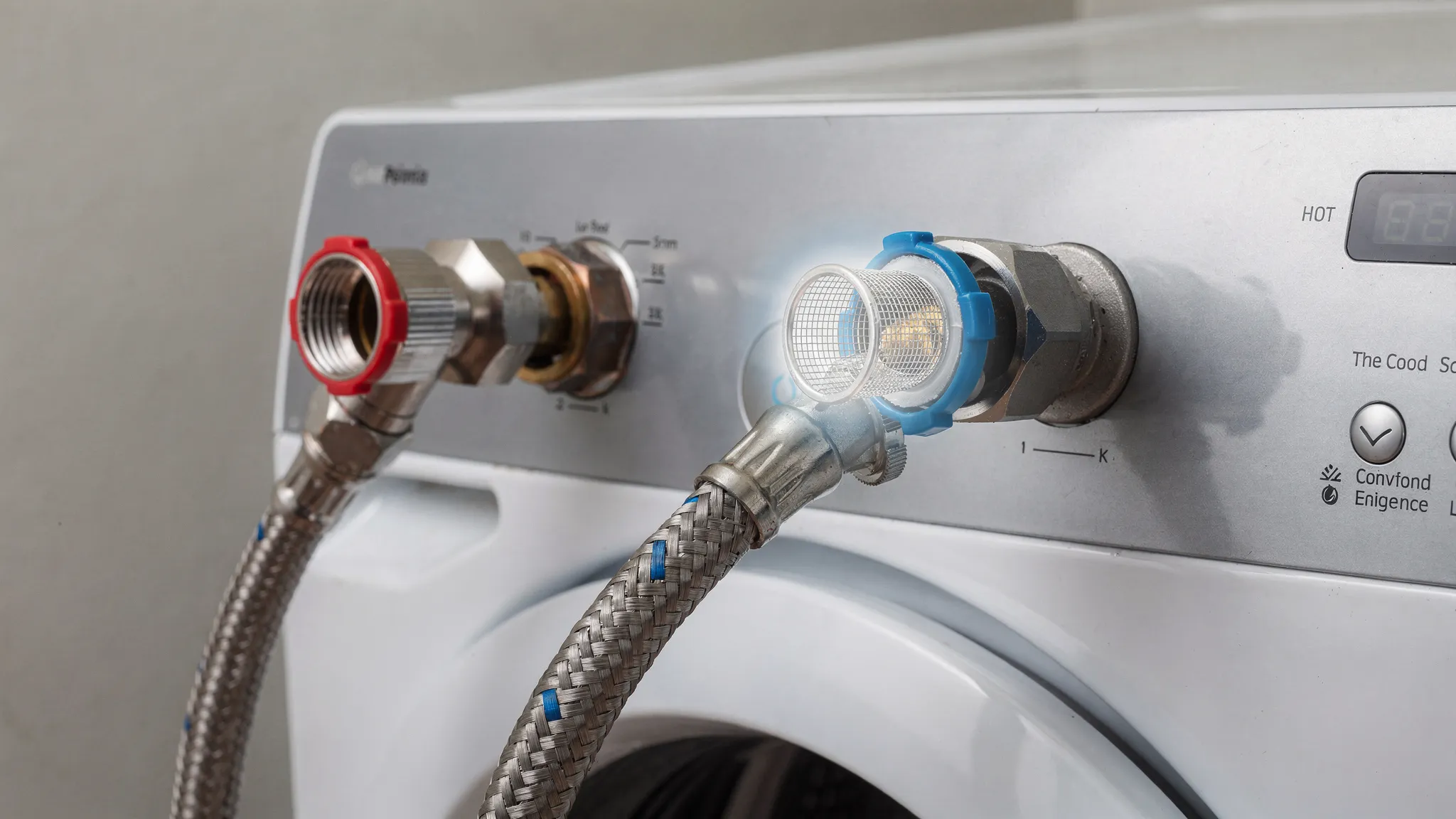
3) The inlet mesh screens are packed with sediment (very common in hard-water areas)
Most Samsung washers have tiny mesh screens right where the hoses connect to the washer’s inlet ports. In Phoenix-area water, those screens can collect mineral grit and debris.
What to do:
- Turn off both water valves.
- Remove the hoses from the back of the washer.
- Carefully pull out and rinse the small mesh screens (needle-nose pliers help, but be gentle).
- Rinse until water runs clear, then reinstall.
If you clean screens and immediately see a lot of sand-like debris, also flush the hoses briefly into a bucket before reconnecting.
For a deeper, model-by-model walkthrough, see: Samsung Washer 4C Error: Water Inlet Troubleshooting.
4) Low home water pressure or a temporary supply issue
Samsung washers generally need consistent water pressure to fill within a set time. If pressure drops, the washer may time out and throw 4C.
Common real-life reasons:
- A recent plumbing repair where a valve was reopened only partway
- Multiple fixtures running at once (showers, irrigation, dishwasher)
- Apartment or HOA water work
A quick test:
- With the washer off, disconnect the hose at the washer end.
- Aim it into a bucket and briefly open the valve.
- You should get a strong, steady stream.
If flow is weak at the wall valve, the washer is not the problem.
5) Hot and cold hoses are reversed (or 4C2 appears)
If you see 4C2, check hose routing:
- Cold hose to cold faucet
- Hot hose to hot faucet
Some cycles expect temperature changes and mixing. If hoses are reversed, temperature readings can look “wrong,” and the washer may abort.
6) Drain hose siphoning (washer fills, then loses water, then errors)
A less obvious 4C trigger is siphoning, where water enters the tub but drains out as fast as it fills because the drain hose is installed incorrectly.
Clues:
- You hear water entering, but the tub level never rises.
- You can hear water running down the standpipe during fill.
What to check:
- The drain hose should not be shoved too far down the standpipe.
- The standpipe should be the correct height for your installation.
- You need an air gap to prevent a vacuum effect.
If you’re also dealing with draining symptoms (slow drain, standing water, or spin issues), this companion guide can help: Washer Repair Checklist: Diagnose Leaks and No Spin.
A quick diagnosis table (symptom to likely cause)
Use this to avoid jumping straight to parts.
| What you notice | Likely cause | Try this first | DIY difficulty |
|---|---|---|---|
| 4C appears immediately, no water sound | Valves closed, no supply, failed inlet valve | Open valves, test flow into bucket | Easy to Moderate |
| Water trickles in slowly, then 4C | Clogged inlet screens, kinked hose, low pressure | Clean screens, straighten/replace hose | Easy |
| Water enters, but tub level never rises | Siphoning through drain | Reposition drain hose, verify standpipe height | Moderate |
| 4C2 or temp-related behavior | Hot/cold hoses reversed or hot water too hot | Correct hose hookups, run cold-only test | Easy |
| 4C keeps returning after all supply checks | Inlet valve, pressure sensor, wiring, control issue | Professional diagnosis recommended | Advanced |
When the problem is inside the washer (and when to stop DIY)
If you’ve confirmed strong water flow at the wall, cleaned screens, corrected hose routing, and ruled out siphoning, 4C can be caused by an internal fault such as:
- Failing water inlet valve assembly (valve does not open fully, or a solenoid is weak)
- Pressure sensor (water level sensor) issues (washer does not “see” water level rise)
- Wiring harness or connector corrosion/loose connection
- Main control board problems (less common, but possible)
At this point, DIY often requires a multimeter, disassembly, and safe electrical testing. If you are not comfortable working around live circuits, it’s a good time to book service.
If you do schedule a technician, tell them:
- The exact code (4C vs 4C2)
- Whether water flow at the wall valve is strong
- Whether screens were cleaned
- Whether the washer fills at all (even briefly)
That reduces diagnosis time and can cut down on repeat visits.
Phoenix-specific tips: why 4C shows up here
Phoenix homes tend to see a few patterns that make inlet errors more likely:
- Hard water and sediment: Inlet screens can clog faster, especially after city line work or a water heater replacement.
- Seasonal pressure fluctuations: Summer usage and irrigation cycles can coincide with laundry time, causing intermittent slow-fill timeouts.
- Laundry in garages: Heat does not directly cause 4C, but it can accelerate wear on hoses and rubber seals, and it can make small leaks or drips worse if a connection is disturbed.
If you repeatedly find gritty debris in inlet screens, consider adding a whole-home sediment filter or talking with a plumber about upstream filtration. (That’s a home plumbing decision, not a washer feature.)
When to call a pro (recommended)
Book service if any of the following are true:
- You have confirmed strong water pressure at the valve, but the washer still throws 4C.
- The washer hums/buzzes during fill but no water enters (common inlet valve symptom).
- You see burning smell, electrical odor, or scorched wiring.
- The washer fills unpredictably, overfills, or you suspect a sensor problem.
If you’re comparing estimates and want to understand how service calls are typically structured, this guide helps you read quotes clearly: Appliance Repair Costs: Service Fees vs Parts Explained.
How to prevent the 4C error from coming back
Most repeat 4C situations come down to water supply consistency and screen maintenance.
- Clean inlet screens periodically if you’re in a hard-water area or you’ve recently had plumbing work.
- Don’t push the washer tightly against the wall where hoses kink.
- Replace aging hoses on a schedule (especially if they’re rubber and not braided).
- After any shutoff, reopen valves fully and run a short rinse cycle to confirm normal fill.
If you want Samsung’s official perspective for your exact model, you can also check Samsung Support and search your model number plus “4C”.
If you’d like the most detailed step-by-step checks (including inlet screen cleaning specifics and less common causes), continue here: Samsung Washer 4C Error: Water Inlet Troubleshooting.