If your fridge stops cooling, two things happen fast: food safety risk increases as temperatures rise above 40°F, and the appliance itself can be damaged further if the underlying problem is ignored. In Phoenix, that urgency is amplified because hot indoor garages, warm kitchens, and frequent door openings can push food into the “danger zone” sooner.
Below is a practical food safety timeline, what to do in the first minutes and hours, and the most common reasons a refrigerator suddenly stops cooling.
First, confirm the “not cooling” problem (without wasting time)
A fridge can feel “not cold” even when it is still limping along. Your goal is to quickly verify temperature and protect food.
- Target temperatures: The U.S. food safety standard is 40°F or below for refrigerators and 0°F for freezers. Source: USDA FSIS.
- Best tool: An appliance thermometer in the fridge and freezer, or a probe thermometer for checking items.
If you do not have a thermometer, treat it as a potential emergency anyway and follow the timeline steps.
The food safety timeline: what to do, minute by minute
Food safety is mostly about time + temperature. Harmful bacteria grow rapidly between 40°F and 140°F, often called the “danger zone.” Source: USDA FSIS danger zone guidance.
0 to 10 minutes: stop the warming
- Keep the doors shut. Every extra look speeds warming.
- Check the basics quickly:
- Is the fridge plugged in (and the outlet working)?
- Did a breaker trip?
- Did the temperature get bumped warmer?
- Are interior lights on when the door opens?
- Listen and look: Do you hear a fan? Is the compressor area (back/bottom) silent, clicking, or buzzing?
If you suspect a power outage, jump to the “power outage rule of thumb” section below.
10 to 30 minutes: triage your most perishable foods
If the fridge is clearly warming (or already above 40°F), prioritize what spoils first.
Highest risk foods include:
- Meat, poultry, seafood
- Milk, soft cheeses, yogurt
- Cooked leftovers
- Cut fruit, cut vegetables
- Cooked rice and pasta
- Deli meats
If you have ice, start building a cooler setup now.
30 to 60 minutes: move food strategically (if needed)
If the fridge temp is climbing, do not wait for it to “maybe recover.”
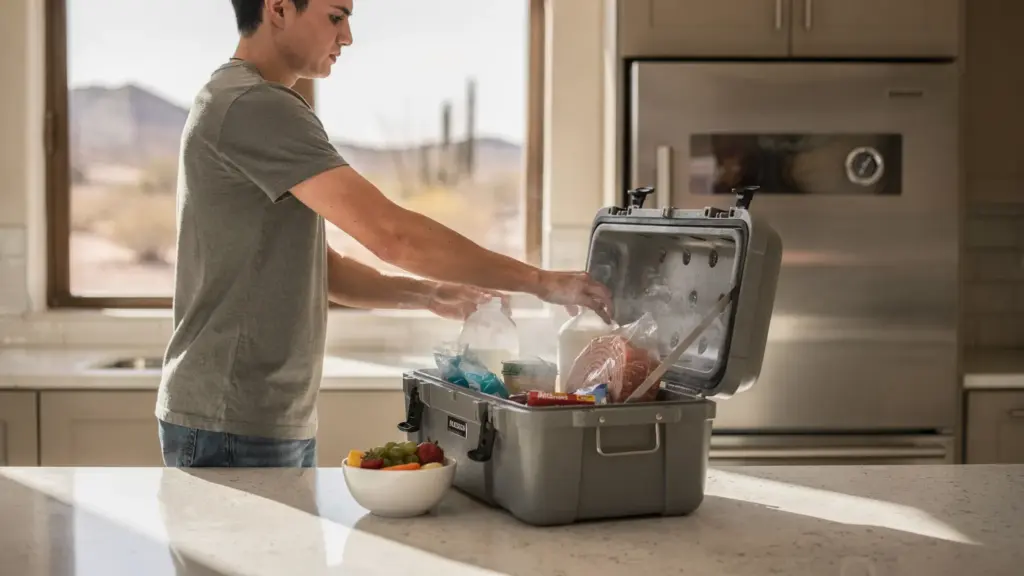
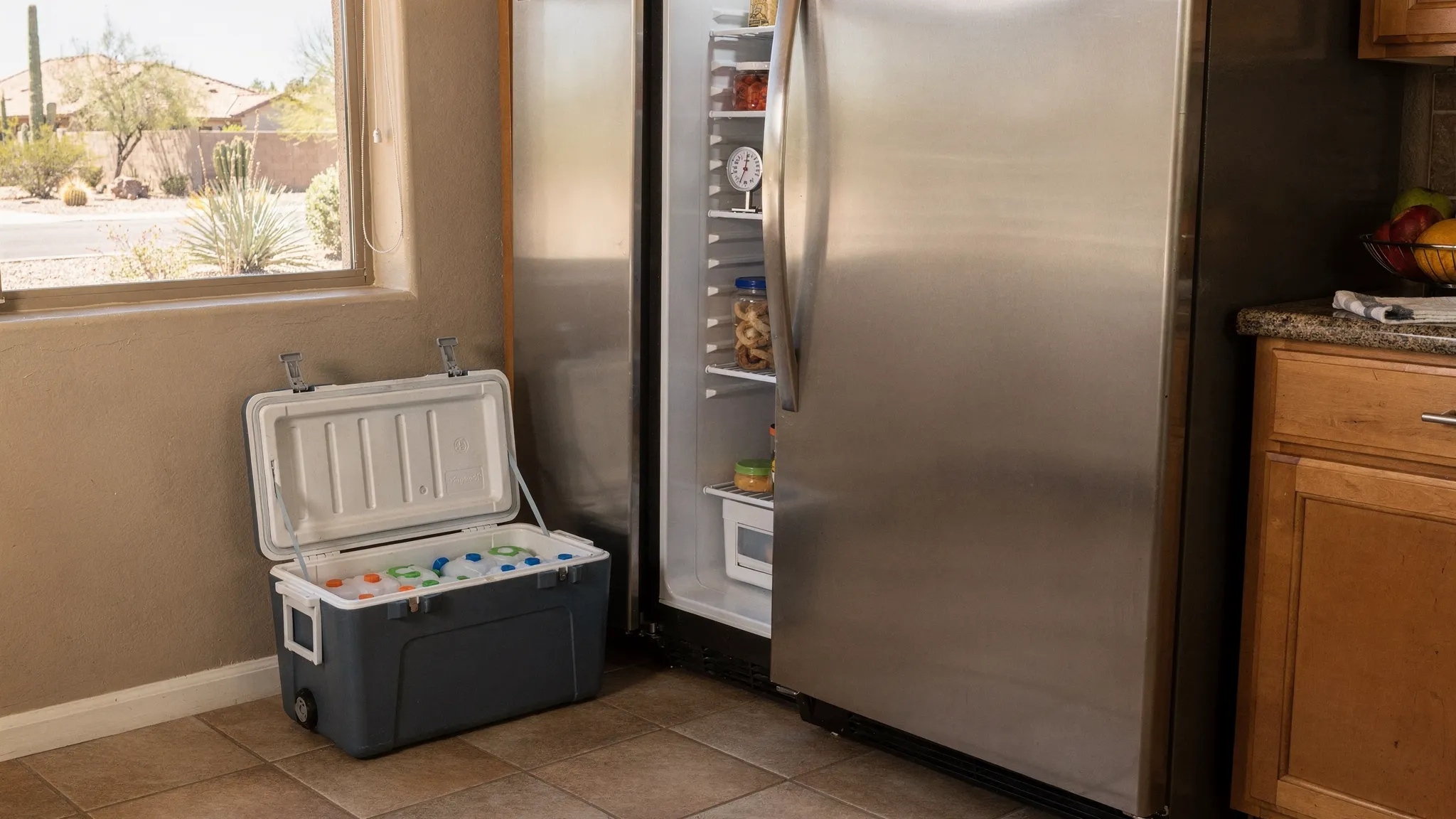
- Set up a cooler with ice or gel packs. Pre-chill it by adding ice first.
- Move the highest-risk foods first.
- Group foods tightly. Cold items stay cold longer when packed together.
- Avoid putting hot food into the cooler. Hot items raise overall temperature.
In Phoenix, if your kitchen is warm (and especially if your fridge is in a garage), moving perishables sooner is the safer play.
1 to 2 hours: start the discard clock if food is above 40°F
A widely used U.S. food safety rule is:
- Discard perishable foods left above 40°F for 2 hours or more.
- If the ambient temperature is above 90°F, the limit drops to 1 hour.
This “2-hour rule” is commonly referenced by USDA/food safety education (often framed as “left out at room temperature”). In real life, a warming refrigerator can act like “room temperature” surprisingly quickly once it climbs past safe temps and stays there.
In Phoenix, the 90°F rule matters in situations like:
- Food transferred to a counter while you troubleshoot
- A fridge in a hot garage
- A door left ajar during a heat wave
2 to 4 hours: decision time (and likely technician time)
At this point, if your refrigerator is not returning to safe temperatures, assume you have an actual cooling failure.
- If you kept the door closed: many fridges can hold a safe temperature for a while, but it varies.
- If the door was opened repeatedly: expect faster warming and more loss.
If you are unsure how long food has been above 40°F, the safest guidance is the classic: when in doubt, throw it out.
After 4 hours: treat it like an outage scenario
USDA guidance for outages is a useful benchmark: a refrigerator keeps food cold for about 4 hours if unopened. Source: FoodSafety.gov emergency guidance.
If your fridge has been failing for longer than that, you should assume:
- Most perishables in the fridge are no longer safe unless you confirmed temps stayed at 40°F or below.
- Your next priority is preventing repeat loss (fix the fridge, and consider a cooler plan).
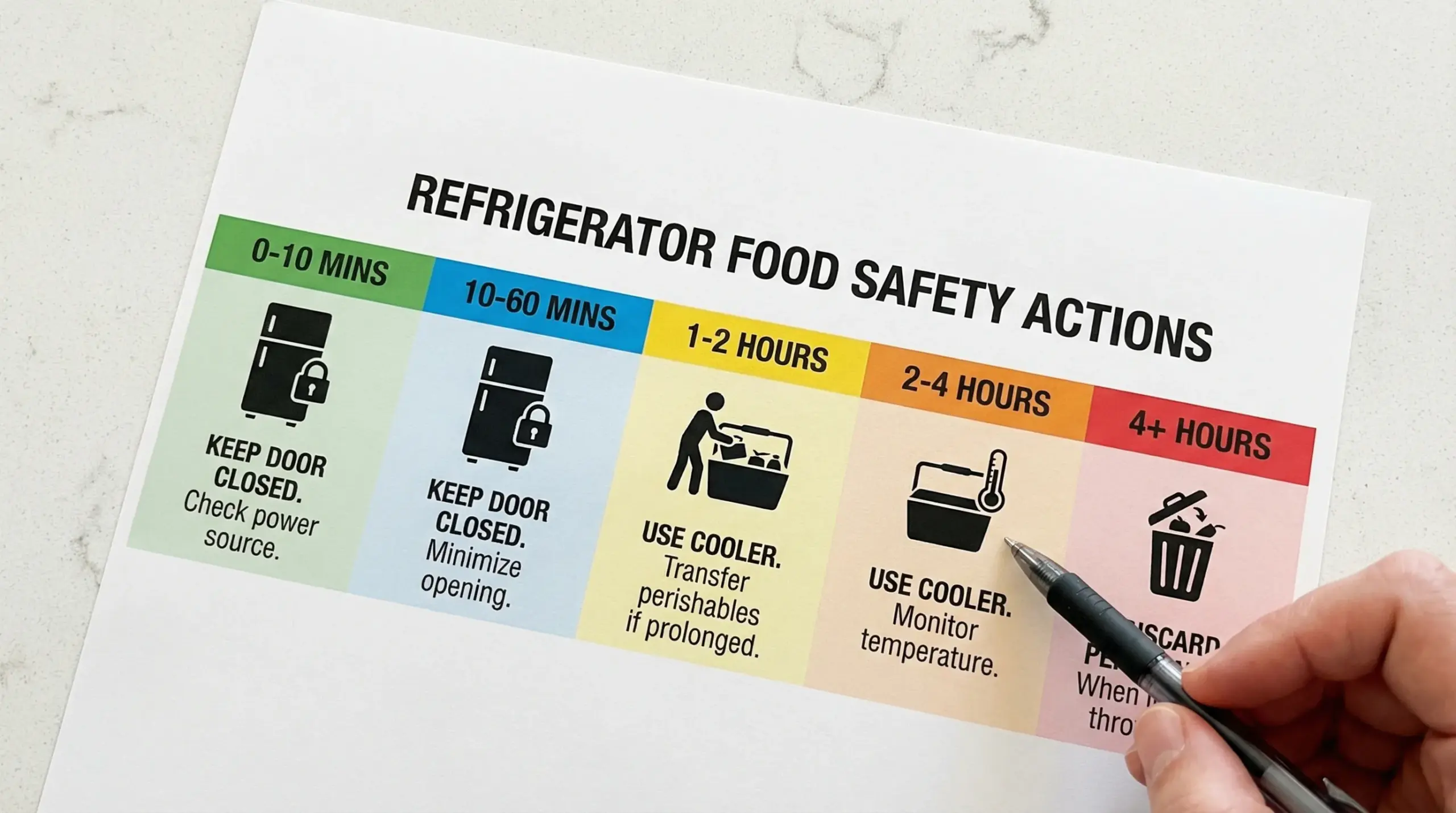
Quick-reference table: food safety timeline for a warming fridge
Use this as a practical guide. The key variable is whether foods stayed at 40°F or below.
| Time since cooling stopped | What’s likely happening | What you should do |
|---|---|---|
| 0 to 10 minutes | Temperature begins rising slowly if door stays closed | Keep doors shut, verify power/settings fast, find a thermometer |
| 10 to 60 minutes | Perishables start approaching risk range if fridge is truly failing | Set up cooler, move highest-risk items, minimize door opening |
| 1 to 2 hours | Some items may enter the danger zone depending on starting temp and door openings | Track time, keep cold chain with ice, avoid “sniff tests” as proof of safety |
| 2 to 4 hours | Higher probability food has been above 40°F too long | Discard perishables that warmed too long, call for service |
| 4+ hours | Comparable to extended outage conditions | Assume most fridge perishables are unsafe unless verified cold; prioritize repair/replacement decision |
What foods to keep vs toss (practical categories)
Smell and appearance are not reliable indicators for pathogens. Some dangerous bacteria do not change odor, taste, or appearance.
Here is a conservative, homeowner-friendly sorting guide based on common U.S. food safety recommendations.
| Category | Examples | If above 40°F for 2+ hours (or 1+ hour above 90°F) |
|---|---|---|
| High-risk perishables | Raw/cooked meat, poultry, seafood; leftovers; deli meats | Toss |
| Dairy (more risky) | Milk, cream, soft cheeses, yogurt | Toss |
| Cooked starches | Cooked rice, pasta, beans, potatoes | Toss |
| Cut produce | Cut melon, cut fruit, salad mixes | Toss |
| Lower-risk items | Whole fruits/vegetables, many condiments, hard cheeses (often), bread | Often okay, but check manufacturer guidance and use judgment |
If you want the most authoritative item-by-item guidance during an emergency, use FoodSafety.gov’s cold food storage chart.
Special case: what if the freezer is still cold?
A fridge can stop cooling while the freezer stays cold (or vice versa), depending on airflow and components.
Good news: frozen food is often salvageable if it stays frozen.
USDA outage guidance is a helpful baseline:
- Full freezer: about 48 hours safe if unopened
- Half-full freezer: about 24 hours safe if unopened
Source: FoodSafety.gov power outage guidance.
If foods still have ice crystals and feel refrigerator-cold, they can often be refrozen safely, though quality may suffer.
Why your fridge stops cooling: the most common causes
Once food safety is handled, the next question is what failed. Some causes are DIY-checkable; others need a pro.
Airflow problems (common and sometimes simple)
Refrigerators are basically heat-moving systems. When airflow is blocked, cooling performance collapses.
Common culprits:
- Overpacked fridge blocking vents (especially the back wall vents)
- Frosted-over evaporator reducing airflow
- Failed evaporator fan (often you stop hearing the normal fan sound)
If you open the freezer and do not hear the evaporator fan (and the door switch is pressed), that is a strong clue.
Dirty condenser coils (very common in dusty, desert climates)
Phoenix homes often deal with dust. Dust on condenser coils makes it harder for the fridge to dump heat, which can look like “it won’t get cold.”
A safe DIY step:
- Unplug the fridge
- Gently vacuum coil areas and vents (use a coil brush if accessible)
If cooling returns after cleaning, you may have prevented a bigger failure.
Condenser fan failure (for many models)
Many refrigerators use a condenser fan near the compressor. If it fails, the compressor can overheat and cooling can drop quickly.
Signs include:
- Warmth around the bottom/back
- No fan movement where your model should have one
- Clicking, overheating, intermittent cooling
Defrost system issues (frost buildup and warm fridge)
If the defrost heater, defrost thermostat, or control board fails, frost can build up on the evaporator coil until airflow is choked off.
This often presents as:
- Freezer kind of cold but fridge warm
- Increasing frost over days
- Reduced airflow from vents
Start relay, capacitor, or compressor problems (often not DIY)
If you hear repeated clicking, or the compressor tries to start and fails, you may be dealing with:
- Start relay/capacitor issues
- Compressor failure
- Sealed system problems (refrigerant leak, restriction)
These are usually technician-level repairs.
What not to do when your fridge stops cooling
Some common reactions can make things worse.
- Do not keep opening the door “to check.” You are dumping cold air every time.
- Do not rely on a sniff test. Food can be unsafe without smelling bad.
- Do not chip ice with sharp tools. You can puncture coils and turn a fixable issue into a total loss.
- Do not run extension cords long-term. They can cause voltage drop and damage compressors.
Phoenix-specific realities: why food can spoil faster here
Even indoors, Phoenix heat can shorten your margin for error.
Situations that commonly accelerate warming:
- Refrigerator in a garage where temps can exceed 90°F for long stretches
- Poor airflow around the fridge (tight alcove, blocked toe kick vent)
- Extra door openings during family meals and gatherings
If your refrigerator is in a garage, check your model’s operating range. Some units are not designed to maintain performance in very hot spaces.
When to call a refrigerator repair technician
Call for service promptly if any of these are true:
- The fridge is above 40°F and not trending down within an hour of basic checks
- You hear clicking or the compressor is extremely hot
- There is no airflow from vents and you suspect a fan issue
- You see heavy frost buildup that keeps returning
- You have already cleaned coils and ensured vents are clear, and it still will not cool
If you are budgeting the next step, see our local guide on refrigerator repair cost in Phoenix. If the unit is older or you suspect a major sealed-system issue, this decision guide can help: Is it worth repairing a refrigerator in Phoenix’s heat?.
A simple “save the food” checklist you can print or screenshot
Use this if you are in a rush.
- Keep doors closed
- Confirm power (outlet, breaker)
- Check temperature (goal: 40°F or below)
- Start a timer if temps are rising
- Move high-risk foods to an iced cooler
- Discard perishables above 40°F for 2+ hours (or 1+ hour above 90°F)
- Schedule repair if cooling does not return quickly
Preventing the next emergency (especially in Phoenix)
Once you are past the immediate crisis, a little prevention goes a long way.
Keep a $10 thermometer in the fridge and freezer
This turns panic into a simple decision. You stop guessing and start measuring.
Clean coils and ensure ventilation
For many homes, coil cleaning a few times per year is a reasonable cadence (more often if you have pets or heavy dust).
Set up your fridge for airflow
Avoid packing the back wall solid. Let vents breathe so cold air can circulate.
Keep a basic cooler plan
If you live far from a store or host frequent gatherings, keeping a small cooler and a few reusable ice packs can protect hundreds of dollars in groceries.
The bottom line
What happens when your refrigerator stops cooling is predictable: temperatures climb, food safety risk rises quickly above 40°F, and Phoenix heat can shorten your safe window. If you act early, keep the door closed, and move perishables to ice, you can often prevent the worst losses.
If your fridge does not return to safe temperatures fast, treat it like a true cooling failure and get it checked. The cost of delay is usually paid in spoiled food first, and sometimes in a bigger repair bill later.