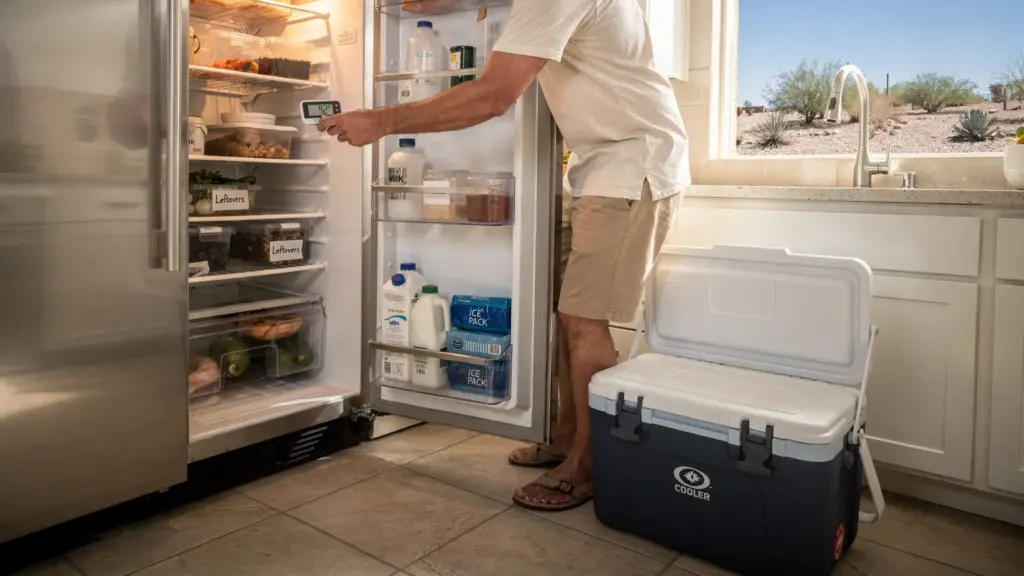
A refrigerator that’s not getting cold is one of the few home problems that turns urgent fast. In Phoenix, high ambient heat (especially in garages) and dust can push a struggling fridge over the edge, so the best approach is to protect food first, then work through a short, high-impact checklist that avoids unsafe DIY.
Step 1: Protect food and reduce temperature loss (first 5 to 10 minutes)
Start with actions that buy time and prevent foodborne illness.
- Keep the doors closed as much as possible. Every minute the door is open dumps cold air and forces the system to catch up.
- Set a timer for 10 minutes and only open the door once you’re ready to check settings and place a thermometer.
- Move high-risk perishables to a cooler with ice if the fridge is already above 40°F (4°C), or if you are unsure and the unit has been warming for hours.
Food safety basics: the USDA guidance is to keep your refrigerator at 40°F or below and your freezer at 0°F. Perishable foods should not sit above 40°F for more than 2 hours (or 1 hour if the air temperature is above 90°F). See the USDA food safety basics for the full temperature and time rules.
If you want a more detailed, step-by-step timeline for what to toss and what to save, use this local guide: What Happens When Your Fridge Stops Cooling? Food Safety Timeline.
Step 2: Confirm it’s truly “not cooling” (not just “feels warm”)
A lot of refrigerator calls come down to expectations or bad readings. Confirm before you troubleshoot.
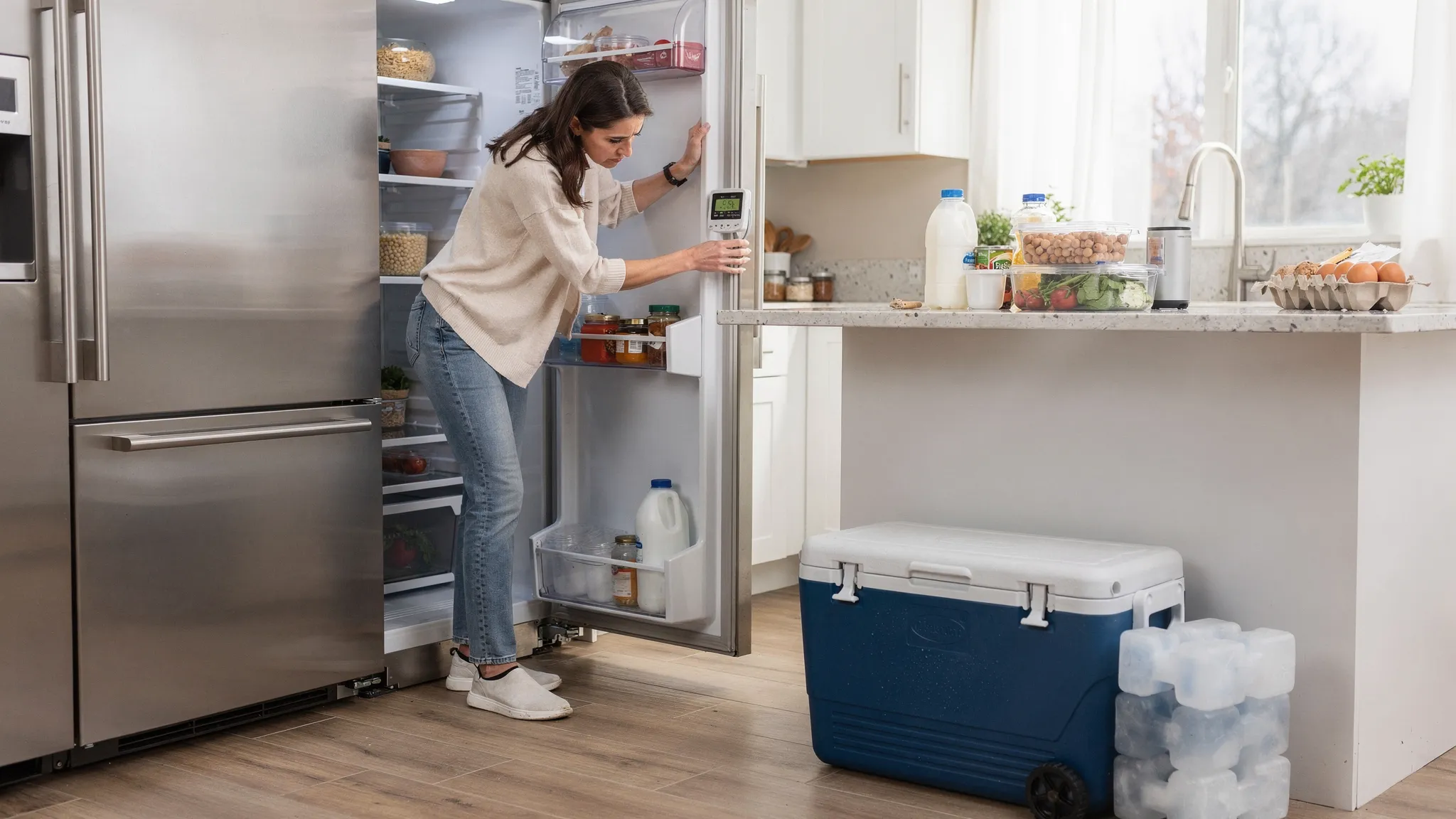
Use a thermometer (not the built-in display alone). Put a refrigerator thermometer in a glass of water on the middle shelf, close the door, and check it in about 20 to 30 minutes for a quick read. (A full stabilization can take longer, but you need a fast baseline.)
Check both compartments. You’re looking for patterns:
- Fridge warm, freezer OK: often airflow, defrost, or damper related.
- Both warm: more likely power, condenser airflow, compressor/start components, or sealed system.
If your exact situation is “warm fridge, cold freezer,” this guide goes deeper without repeating steps here: Fix Warm Fridge, Cold Freezer.
Step 3: Do the two quickest checks that solve a surprising number of cases
Check A: Temperature settings and modes
Before you pull the fridge out or remove panels:
- Make sure the unit isn’t in Demo/Showroom mode (common after moves or power events, and it can look like the fridge is “running” while not cooling properly).
- Verify the temperature didn’t get bumped warmer or set to “Vacation” depending on model.
If you recently had a power outage or breaker trip, do a simple reset:
- Unplug for 2 minutes (or switch off at the breaker), then restore power.
- Wait 10 minutes and listen for fans and compressor activity.
Check B: Doors are actually sealing and closing
A door left slightly ajar can mimic a major failure.
- Look for a box, gallon jug, or drawer preventing the door from closing.
- Check if the fridge is tilted forward. Many units seal better with a slight backward lean. If the door swings open on its own, leveling may be off.
- Look for heavy condensation, frost near the door edges, or a visibly twisted gasket.
If you suspect a gasket issue, use the quick tests and repair options here: Refrigerator Door Seal Repair and Door Seal Signs It’s Failing.
Step 4: Fix airflow problems first (safe, homeowner-friendly)
Cooling failures are often airflow failures. Refrigerators need:
- Air to move through the condenser area (usually back/bottom)
- Air to move inside the cabinet (vents and fans)
4.1 Clear interior vents and avoid “walling off” shelves
In the fridge section, find the air outlets (often top rear) and return vents (often lower rear). Then:
- Remove items blocking vents (pizza boxes and tall containers are common culprits).
- Avoid packing food tight against the back wall.
This can matter more in Phoenix because the refrigerator may already be running close to its limit in summer, so reduced circulation shows up quickly.
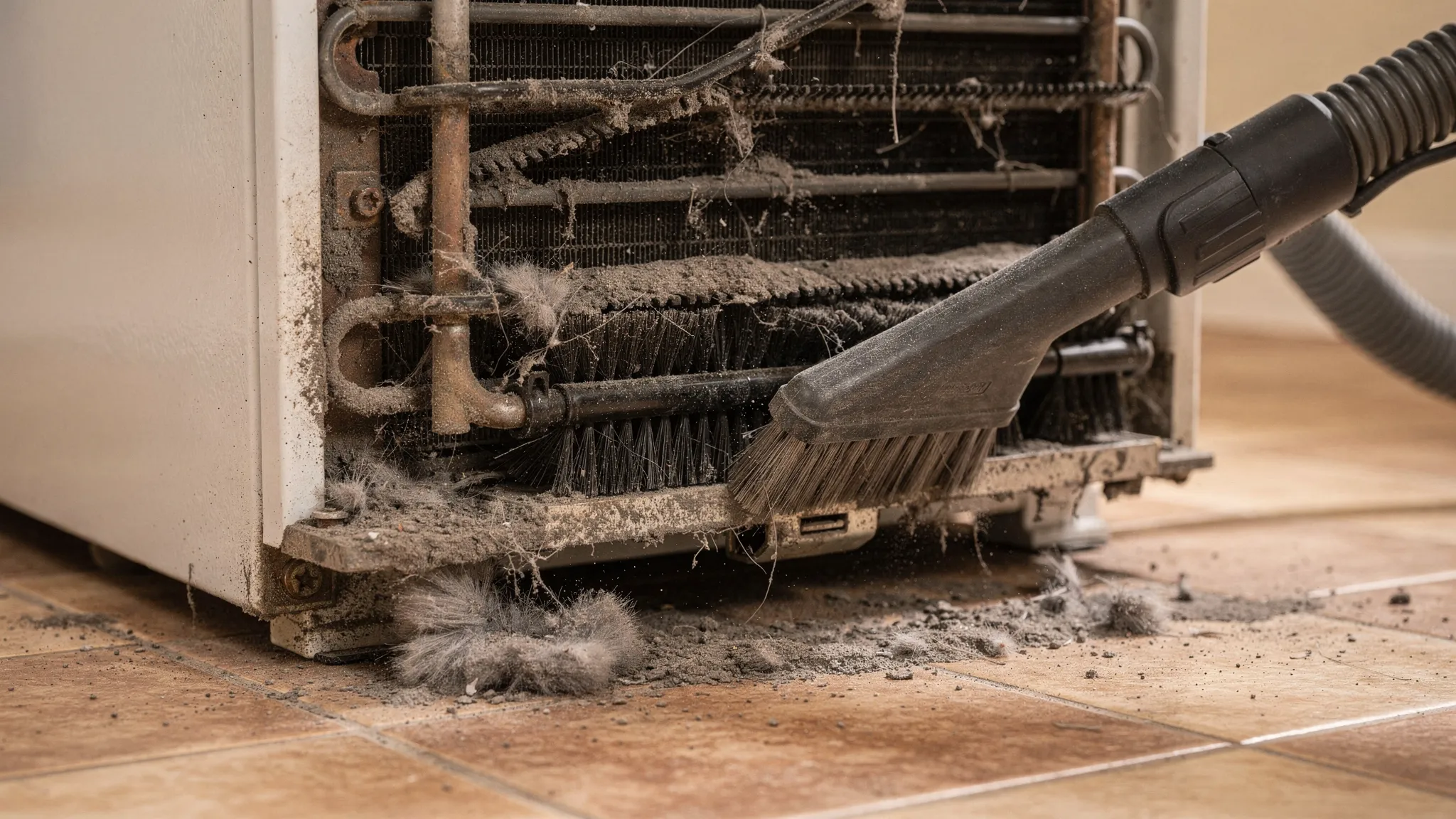
4.2 Clean the condenser coils (one of the highest-value fixes)
Dirty coils make the fridge dump heat poorly, so it runs longer and cools less.
How to do it safely:
- Unplug the refrigerator.
- Locate coils (rear panel or underneath behind a toe-kick grille).
- Use a coil brush and vacuum to remove lint and dust. Avoid bending fins.
- Restore power.
In Phoenix homes with pets, construction dust, or monsoon season dust, coils may need cleaning more often than the typical “once a year” advice.
Step 5: Listen for fan and compressor clues (no tools required)
You can learn a lot without opening anything.
What you want to hear
- A steady hum that comes and goes (compressor cycling)
- A fan sound (evaporator fan inside, condenser fan near compressor depending on model)
Signs something is off
- Silence when it should be running (possible power/control issue)
- Clicking every few minutes without sustained running (possible start relay/overload behavior)
- A fan that stops when the door switch is held can be normal on many models, so test with the door switch pressed.
For a deeper “by sound type” diagnosis, use: Why Your Refrigerator Is Noisy.
Step 6: Check for frost patterns that point to defrost or airflow trouble
A refrigerator can “stop cooling” because the evaporator coil is blocked by ice, choking airflow.
Practical homeowner clues:
- Heavy frost on the freezer back wall or a freezer that seems cold but airflow is weak into the fridge suggests a defrost or air circulation problem.
- Water under crisper drawers can happen when defrost meltwater can’t drain correctly.
A safe next step is often a controlled manual defrost:
- Move food to a cooler.
- Unplug the unit.
- Leave doors open for several hours (use towels for water).
- Restore power and monitor temps.
If cooling returns temporarily and then fails again in a day or two, that strongly suggests a defrost-related issue that may require diagnosis (heater, thermostat, sensor, control). The warm-fridge/cold-freezer article linked earlier covers this pattern in more detail.
Step 7: Phoenix-specific reality checks (garage fridges, heat, and ventilation)
If your refrigerator lives in a garage, a laundry room closet, or a tight alcove, Phoenix conditions can make “not getting cold” more likely.
Garage placement and ambient temperature
Many refrigerators are not designed to maintain safe temperatures in extremely hot spaces. When the surrounding air is very hot:
- The condenser can’t shed heat efficiently.
- Run time increases dramatically.
- Some models behave unpredictably if the space swings hot (day) and cooler (night).
If possible during extreme heat:
- Improve ventilation around the back and bottom.
- Keep the area clear of boxes and clutter that trap heat.
- Avoid running a garage fridge on an extension cord.
Dust load
Phoenix dust can coat coils quickly. If you clean coils and the fridge immediately improves, put coil cleaning on a schedule. For a broader prevention plan built for local seasons, see: Home Appliance Servicing: A Seasonal Maintenance Plan.
What to do, in order: a simple action table
Use this as a fast “what now” guide while you troubleshoot.
| What you observe | What to do immediately | Why it matters |
|---|---|---|
| Fridge and freezer both warm | Keep doors closed, move perishables to cooler, verify outlet power, check breaker | Prevents spoilage and confirms it’s not a simple power issue |
| Freezer cold but fridge warm | Clear fridge vents, check damper area for blockage, listen for evaporator fan, look for freezer frost buildup | This pattern often points to airflow/defrost/damper problems |
| Thick frost on freezer back wall | Do a controlled manual defrost and monitor temps after restart | Ice can block airflow and mimic a cooling failure |
| Unit runs constantly, still warm | Clean condenser coils, confirm clearance and ventilation, check for door seal leaks | Poor heat rejection is common in dusty/hot homes |
| Repeated clicking, won’t stay running | Stop DIY and book service, protect food | Start components, compressor, or control problems need proper testing |
| Burning smell, buzzing with no cooling, or breaker trips | Unplug and call a professional | Electrical hazards should not be troubleshot live |
What not to do (common mistakes that waste time or create risk)
Avoid these moves when your refrigerator is not getting cold:
- Don’t puncture panels or scrape ice with sharp tools. It’s easy to damage coils or lines.
- Don’t keep “resetting” repeatedly hoping it fixes itself. If it’s failing to start, repeated attempts can stress components.
- Don’t open sealed-system lines or handle refrigerant. This requires proper equipment and certification.
If you want a safe, expanded DIY checklist that stays on the homeowner side of the line, use: Refrigerator Repair How To: Safe DIY Steps to Try First.
When to stop troubleshooting and call a technician
Call for service sooner (not later) if any of these are true:
- The refrigerator is above 40°F and you can’t restore cooling quickly.
- Cleaning coils and verifying seals did not change anything.
- The unit clicks, trips the breaker, smells hot, or shows signs of electrical trouble.
- You suspect a compressor/start issue, control board problem, or sealed-system leak.
In Phoenix summers, waiting can turn a repairable situation into a food-loss situation, plus higher wear from long run times.
If you’re comparing repair costs or deciding repair vs replace, these local guides help you set expectations:
How to prepare for a faster, more accurate service visit
If you do need a pro, a few notes can speed diagnosis and reduce back-and-forth:
- Your thermometer readings (fridge and freezer)
- How long the issue has been happening and whether it started after an outage or move
- Any unusual sounds (clicking, buzzing, grinding) and when they occur
- Whether the unit is in a garage and typical ambient conditions
- Model and serial number (usually inside the fridge compartment)
That information helps a technician quickly distinguish airflow/defrost problems from start/compressor or sealed-system failures.
A quick prevention routine for Phoenix homeowners
You can’t prevent every failure, but you can prevent the most common “it’s not getting cold” triggers.
- Clean condenser coils periodically (more often if you have pets or visible dust).
- Keep 2 to 3 inches of clearance for ventilation (follow your manual if it specifies more).
- Avoid overpacking and blocking interior vents.
- Keep a fridge thermometer inside year-round.
- Check door seals and clean the gasket groove so it closes smoothly.
If your refrigerator is not getting cold right now, prioritize food safety first, then work the checklist from power and settings to airflow and coil cleaning. If those basics don’t restore cooling, it’s time to stop guessing and get a proper diagnosis, especially during Phoenix heat waves.