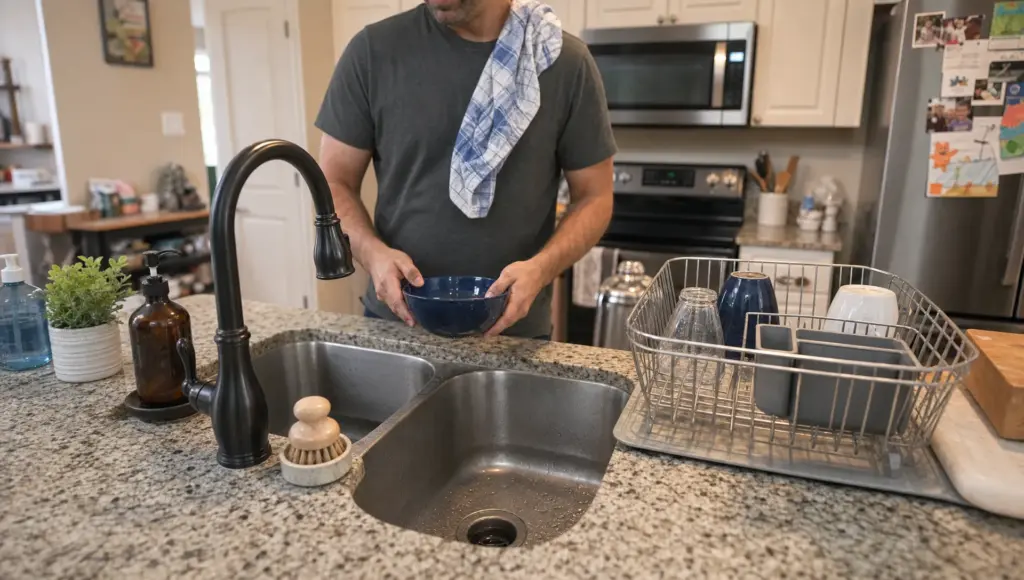
When people say “garbage disposal blades not spinning,” they usually mean the disposal turns on but nothing moves inside the grind chamber. Sometimes it hums, sometimes it is silent and sometimes it starts for a second before shutting off. The good news: many causes are simple to check. The important part is doing it safely because a disposal has a strong motor, electrical wiring and hidden moving parts under the sink.
First, know what is actually supposed to spin
Most residential garbage disposals do not have sharp spinning blades like a blender. Inside the chamber, there is a rotating plate with small metal lugs or impellers that push food waste against a stationary grind ring. That plate is connected to the motor through the flywheel assembly.
So if the “blades” are not spinning, the real issue is usually one of these:
- The flywheel is jammed by a hard object or fibrous food.
- The motor overheated and tripped the reset button.
- Power is not reaching the unit.
- The motor or internal bearings have failed.
- The disposal is spinning, but the drain is clogged so it looks like nothing is working.
This distinction matters because a jammed flywheel can often be freed from outside the unit, while a failed motor usually needs professional diagnosis or replacement.
Safety before you inspect the disposal
Before checking anything inside or underneath the disposal, turn the wall switch off. If the unit plugs into an outlet under the sink, unplug it. If it is hardwired, switch off the breaker that controls the disposal. Do not rely only on the wall switch if you are going to put a tool near the grind chamber.
Never put your hand inside the disposal opening. Even when the power is off, sharp edges, stuck glass, bone fragments or small metal pieces can cut you. Use tongs, needle-nose pliers or a flashlight to inspect and remove visible debris.
Also check for water around the cabinet floor before touching anything electrical. If the area under the sink is wet, stop and dry the area only after power is disconnected. For a broader routine that helps prevent electrical surprises around the house, PHX Appliance Fix has a useful guide to monthly safety checks for electrical appliances.
Garbage Disposal Blades Not Spinning: Safe Checks Before You Call
Start with the symptom. A disposal that hums has a different problem than one that does absolutely nothing. Use the sound and behavior to narrow the likely cause before grabbing tools.
| What you notice | Likely cause | First safe check |
|---|---|---|
| No sound at all | No power, tripped GFCI, bad switch or tripped breaker | Check outlet, reset button and breaker |
| Humming but no grinding | Jammed flywheel or stuck object | Turn power off and use the hex wrench socket |
| Spins briefly then stops | Overload or overheating | Let it cool, press reset and test briefly |
| Grinding noise but poor drainage | Drain clog or blocked discharge | Check sink trap and dishwasher connection |
| Loud metal rattling | Utensil, screw, bottle cap or debris inside | Power off, remove visible object with tongs |
If your unit hums but refuses to grind, that is a very specific jam pattern. You may also want to compare your symptoms with our separate guide on a garbage disposal that hums but will not grind.
Check the power source first
A silent disposal may not be broken at all. Look under the sink to see whether the cord is fully plugged into the outlet. In many kitchens, the disposal outlet is connected to a wall switch, so the top and bottom receptacles may behave differently.
Next, check the GFCI outlet. Some kitchens have a reset button on a nearby countertop outlet, not under the sink. If that GFCI trips, the disposal may lose power even though the breaker panel looks normal.
Then check the breaker. A disposal can trip a breaker if the motor is overloaded, the unit is old or there is a short. If the breaker trips again immediately after you reset it, stop testing. Repeated breaker trips are an electrical warning sign, not a disposal cleaning problem.
Press the reset button correctly
Most disposals have a small red or black reset button on the bottom of the unit. This button pops out when the motor overheats or overloads. Turn the wall switch off before pressing it.
If the disposal recently jammed, let the motor cool for several minutes first. Then press the reset button firmly until it clicks. Restore power and test the unit with cold water running for just one or two seconds.
If it runs normally, the reset solved the immediate problem. If it hums, stalls or trips again, turn it off right away. A reset button is not meant to be used repeatedly to force a stuck disposal to run.
Free a jammed flywheel from underneath
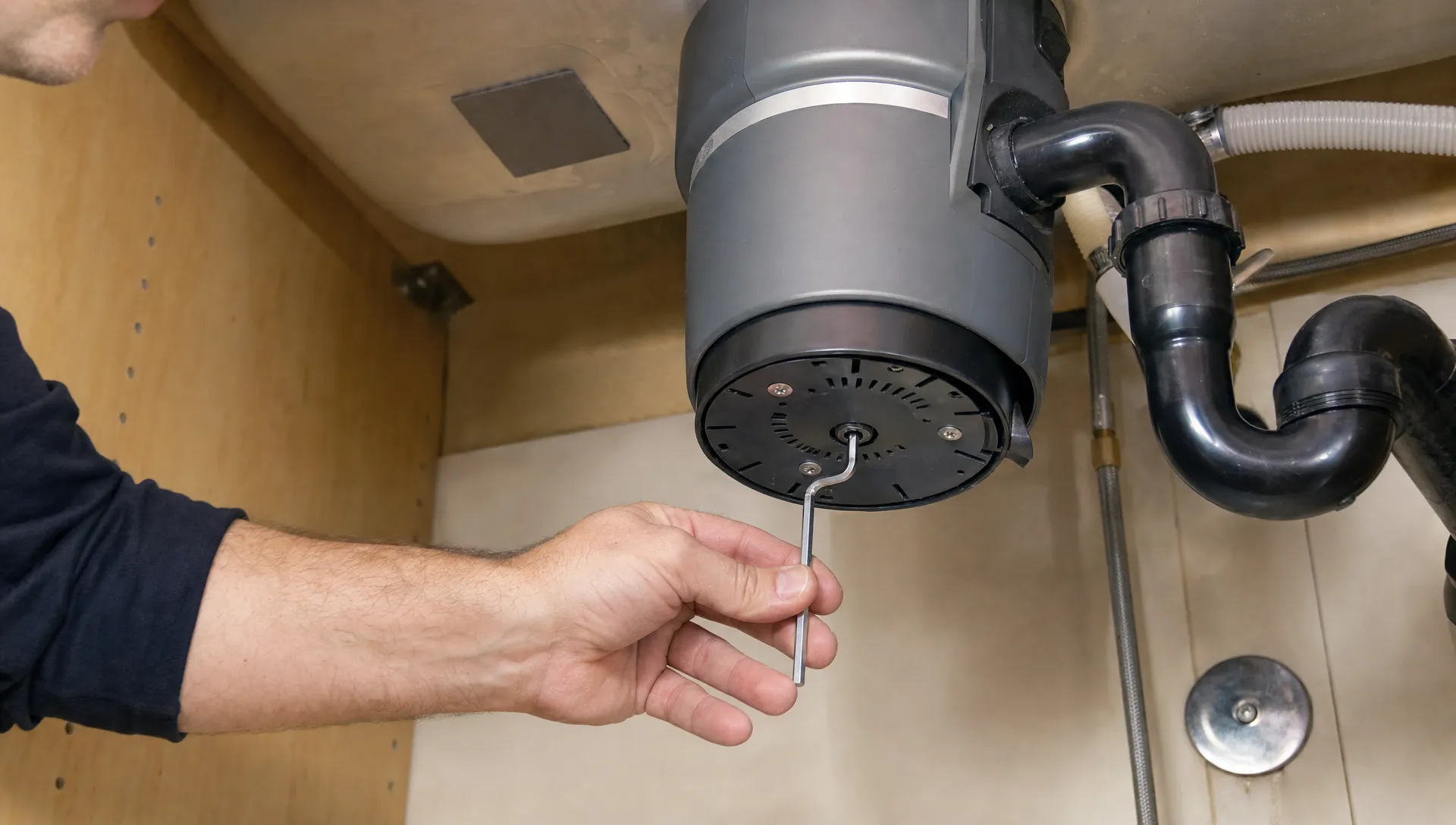
Many disposals include a hex-shaped socket in the center of the bottom plate. This is designed for a disposal wrench or standard Allen wrench, often 1/4 inch on common models. With power disconnected, insert the wrench and rotate it back and forth.
You are not trying to force a full revolution immediately. Work gently in both directions until the flywheel loosens. If it will not budge, there may be a hard object wedged inside or the internal parts may be seized.
Once it moves freely, remove the wrench, restore power and run cold water. Switch the disposal on for a short test. If it spins and drains normally, let it run long enough to clear the chamber.
Remove visible debris from the chamber
If the flywheel loosens but you hear rattling, turn the power off again and inspect the chamber from above with a flashlight. Bottle caps, broken glass, small screws, fruit pits and pieces of utensils are common offenders.
Use tongs or pliers to remove anything you can see. Rotate the flywheel again from the bottom after removing debris to confirm it moves smoothly. Avoid using your fingers, even if the object looks easy to grab.
Fibrous food can also wrap around the impellers or bind against the grind ring. Celery strings, corn husks, onion skins and artichoke leaves are frequent troublemakers. If fibrous material is visible, pull it out with pliers, then flush the disposal with cold water after testing.
Check whether the disposal spins but the drain is blocked
Sometimes the disposal motor is working, but water and food waste do not leave the sink. That can make it seem as if the spinning parts are not doing their job. If you hear normal grinding but water rises in the sink, the problem may be in the discharge pipe, P-trap or dishwasher drain connection.
Do not pour chemical drain cleaner into a disposal. It can splash back, damage rubber parts and create a hazard if a technician later opens the drain. A plunger may help with a simple sink clog, but avoid aggressive plunging if the dishwasher hose connects to the same drain line.
If your dishwasher is also backing up or leaving standing water, the drain system may be shared. This is where our guide to quick fixes for a dishwasher that is not draining can help you separate a disposal problem from a drain problem.
If the disposal still will not spin
If power, reset and jam checks do not restore movement, the issue may be inside the motor assembly. Older disposals can develop seized bearings, worn motor windings or internal corrosion. In that case, the flywheel may refuse to turn even with the wrench, or it may turn manually but fail as soon as power is applied.
A burning smell is another stop sign. Turn the unit off and leave it off. Continuing to test a motor that smells hot can damage wiring or create an electrical hazard.
Also watch for leaks from the bottom of the disposal. A leak near the reset button or lower housing often means the internal seal has failed. Once water reaches the motor area, repair is usually not practical for standard residential disposals.
Repair or replace: how to decide
For many Phoenix homeowners, the decision comes down to age, condition and installation quality. A newer disposal with a simple jam is worth troubleshooting. A very old unit with leaks, repeated resets or a seized motor may be a better candidate for replacement.
| Situation | Repair may make sense | Replacement may make sense |
|---|---|---|
| Jammed by a utensil or food waste | Yes, if no leak or burning smell | Usually no |
| Reset button trips once | Yes, after clearing overload | Maybe, if it keeps happening |
| Flywheel will not move at all | Maybe, if object is visible | Often, if internally seized |
| Water leaks from bottom | Rarely | Usually yes |
| Unit is noisy and very old | Sometimes | Often |
If you do replace the disposal, match the new unit to your household use. A small apartment kitchen and a busy family kitchen do not put the same load on the motor. Proper mounting, drain alignment and electrical connection matter just as much as horsepower.
How to prevent another jam
A disposal lasts longer when it is treated as a food residue grinder, not a trash can. Run cold water before turning it on, feed waste slowly and keep the water running briefly after the grinding sound clears.
Avoid grease, coffee grounds in large amounts, bones, shells, fibrous vegetables and expandable foods like rice or pasta. These can bind the flywheel or clog the drain after leaving the chamber.
For routine cleaning, use cold water and a small amount of dish soap. Ice cubes can help knock loose light buildup, but they will not fix a mechanical jam. Citrus peels can freshen odor in small amounts, but too many peels can create another clog.
Frequently Asked Questions
Why is my garbage disposal humming but the blades are not spinning? A hum usually means the motor is receiving power but the flywheel is jammed. Turn off power, use the hex wrench socket underneath and remove visible debris with tongs.
Can I use a broom handle to unjam a disposal? Only with power fully disconnected, and only gently from the top. The safer first method is usually the hex wrench socket on the bottom of the unit.
Where is the reset button on a garbage disposal? It is typically on the bottom of the disposal housing. It may be red or black and should click when pressed after the motor cools.
Why does my disposal stop again after I reset it? The jam may still be present, the motor may be overheating or there may be an electrical fault. Stop testing if it repeatedly trips or smells hot.
Should I repair a leaking garbage disposal? If the leak comes from the sink flange or drain pipe, repair may be possible. If it leaks from the bottom of the motor housing, replacement is usually the safer choice.
Need help with a stuck disposal in Phoenix?
If the unit still will not spin after safe power, reset and jam checks, it is time to stop forcing it. A technician can determine whether the disposal can be cleared, whether the wiring or switch is involved or whether replacement is the better option.
PHX Appliance Fix Blog is here to help local homeowners troubleshoot safely, compare repair decisions and know when a quick DIY check has reached its limit.